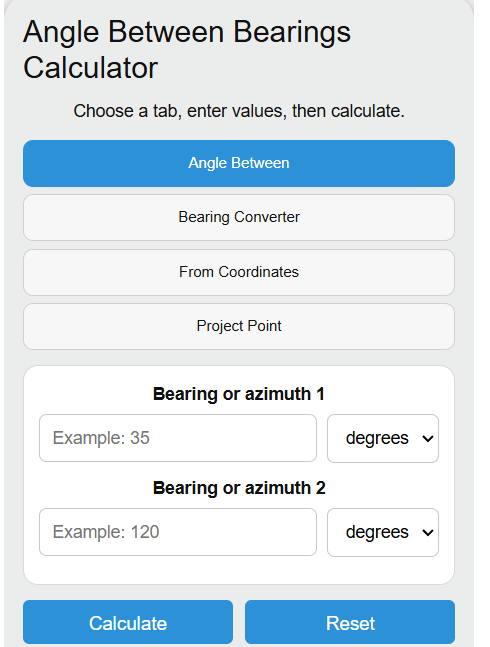
Enter the bearings and the angle between them into the calculator to determine the missing value.

Angle Between Bearings Calculator

Enter any 2 values to calculate the missing variable


Related Calculators

Angle Between Bearings Formula

The following formula is used to calculate the angle between two bearings.

θ = |(B2 - B1 + 360) % 360|

Variables:

  • θ is the angle between the bearings (degrees)
  • B1 is the first bearing in degrees (0 to 360)
  • B2 is the second bearing in degrees (0 to 360)

To find the angle between two bearings, subtract B1 from B2, add 360 to guarantee a positive result, then take the modulus 360 to keep the output within the 0 to 360 degree range. Because bearings wrap around at 360 degrees, the raw difference can be negative or exceed 180 degrees, both of which would produce an ambiguous or counter-intuitive result. The modulo operation resolves the wrap-around, and the absolute value ensures the returned angle is always non-negative. If the result exceeds 180 degrees, subtract it from 360 to return the smaller of the two possible inter-bearing angles.

What is a Bearing?

A bearing is a clockwise angular measurement from a reference direction, almost always north, to a target direction. Bearings are expressed in degrees from 0 to 360, where 0 (or 360) points true north, 90 points due east, 180 points due south, and 270 points due west. This convention is universal across marine navigation, aviation, land surveying, and GIS software, though the specific reference used (true north, magnetic north, or grid north) varies by application.

Bearings always use three digits when written in formal navigation contexts, so north is written as 000, east as 090, south as 180, and west as 270. This zero-padding convention prevents misreading a bearing of 45 degrees as northeast instead of a precise 045. In land surveying, an older quadrant notation persists alongside three-digit notation: N45°E means a direction 45 degrees clockwise from north toward east, which is identical to a bearing of 045 in modern notation.

Types of Bearings

True bearing is measured clockwise from geographic (true) north, the direction toward the North Pole. True north is fixed and does not change over time. All latitude and longitude systems reference true north, making true bearings the standard for geodetic calculations, aeronautical charts, and official survey records.

Magnetic bearing is measured from magnetic north, the direction a compass needle points. Magnetic north is not fixed; it drifts as Earth’s core magnetic field shifts. As of 2025, the magnetic north pole is positioned over the Arctic Ocean north of Siberia and is drifting roughly 50 kilometers per year. The angular difference between true north and magnetic north at any given location is called magnetic declination, also known as magnetic variation. Declination values range from roughly -180 to +180 degrees depending on location, and must be accounted for whenever converting between true and magnetic bearings.

Grid bearing is measured from grid north, the direction of the vertical grid lines on a map projection (usually a UTM or state plane grid). Grid north and true north differ by the convergence angle, which depends on how far east or west a location sits from the central meridian of its map zone. For locations near the central meridian, grid and true north are nearly identical; at the zone edges, the divergence can reach several degrees.

Relative bearing is the angle between a vessel or aircraft’s current heading and a target, measured clockwise from the bow or nose. A relative bearing of 000 means the target is straight ahead; 090 means it is directly to starboard or the right; 180 means it is directly astern. Relative bearings convert to true bearings by adding the vessel’s true heading: True Bearing = Vessel Heading + Relative Bearing (mod 360).

Applications of the Angle Between Bearings

Marine navigation and position fixing. When navigating by compass bearings, mariners take bearings to two or more known landmarks and draw the bearing lines on a chart. The point where those lines intersect is the vessel’s position, called a fix. The angle between the two bearing lines controls how precisely the fix can be determined. A 90-degree angle between the two lines produces the sharpest, most reliable fix because positional errors from each bearing line are perpendicular to each other and do not compound. Research into compass bearing accuracy shows that precision gains little above a 60-degree separation between sights, but accuracy degrades sharply when the angle between bearings falls below 30 degrees. At very small inter-bearing angles, the intersection becomes an elongated diamond rather than a point, introducing large positional uncertainty even with accurate individual bearings.

Land surveying and traverse calculations. In compass surveying, field crews record the fore bearing from each station to the next as they traverse a property or construction site. The angle between successive bearings defines the interior angles of the traverse polygon, which are used to check for systematic error by verifying that the sum of interior angles equals (n – 2) x 180 degrees for an n-sided polygon. Any closure error in that sum indicates accumulated measurement error, instrument misalignment, or local magnetic anomalies that deflected the compass. Computing the angle between each fore bearing and its corresponding back bearing (which should always be exactly 180 degrees different) is the standard field check for individual station accuracy.

Aviation. Pilots use bearing angles when navigating between VOR (VHF Omnidirectional Range) stations, planning instrument approaches, and computing wind correction angles. The angle between the planned track bearing and the bearing to a navigation fix tells the pilot how far off course the aircraft has drifted. In search and rescue operations, aircraft fly expanding square or parallel track search patterns; the turns between legs are computed as specific angular changes to the bearing, typically 90-degree increments for square patterns and 180-degree turns for parallel tracks.

GIS and geospatial analysis. Spatial analysts compute the angle between bearings when measuring turn angles along road networks, calculating the deflection of streams and rivers, and analyzing the orientation of geological features such as fault lines and sedimentary strata. In urban planning, street orientation is often expressed as a bearing from north, and the angular difference between intersecting streets is used to assess site suitability and solar access. Remote sensing workflows use bearing angles to compute the relative positions of satellite ground tracks and the overlap between adjacent image swaths.

Fore Bearing and Back Bearing

The fore bearing is the bearing measured from a starting station to a forward station along a traverse. The back bearing is the bearing measured from the forward station back toward the starting station, and it is always exactly 180 degrees different from the fore bearing. If the fore bearing is less than 180 degrees, add 180 degrees to find the back bearing. If the fore bearing is greater than 180 degrees, subtract 180 degrees. A fore bearing of 045 produces a back bearing of 225; a fore bearing of 260 produces a back bearing of 080.

Verifying the fore and back bearing relationship at each traverse station is the primary field check for systematic compass error. A consistent discrepancy of a fixed amount at all stations typically indicates that the compass has not been properly leveled or that the instrument has a calibration offset. A varying discrepancy suggests local magnetic anomalies caused by buried metallic objects, utility infrastructure, or geological iron ore deposits, all of which can deflect a compass needle by several degrees without any visible indication.

Magnetic Declination and Bearing Accuracy

The angle between a magnetic bearing and a true bearing at any location is the magnetic declination, which must be applied whenever converting compass readings to map coordinates or true bearings. Failing to account for declination introduces a systematic error into every bearing measurement taken at that location. The practical impact is substantial: a 10-degree declination error compounds across distance such that a 1.5-mile trek off a magnetic bearing without declination correction will place a navigator approximately a quarter mile from the intended destination. A 15-degree error on a 1-mile route produces a lateral displacement of roughly 1,380 feet, roughly the length of four city blocks.

Declination varies not only by location but also over time, as the magnetic pole continues its northward drift. Topographic maps and aeronautical charts are printed with declination values that become outdated within years, particularly in high-latitude regions where the rate of change is greatest. The NOAA World Magnetic Model, updated every five years, is the authoritative source for current declination values worldwide and is the model used in aviation navigation databases, smartphone GPS applications, and military compasses.

To convert a magnetic bearing to a true bearing, add easterly declination or subtract westerly declination. The mnemonic “east is least, west is best” is widely used: east declination means magnetic north is east of true north, so the magnetic bearing reads less than true, and you add to correct it; west declination means magnetic north is west of true north, so the magnetic bearing reads more than true, and you subtract.

Bearing vs. Azimuth

Bearing and azimuth are sometimes used interchangeably but have a technical distinction in surveying and geodesy. An azimuth is always measured clockwise from north through a full 360-degree circle, identical to the bearing convention used in navigation. A surveyor’s compass bearing, by contrast, uses quadrant notation and only spans 0 to 90 degrees within each of the four quadrants (NE, SE, SW, NW). Converting a compass bearing to an azimuth requires knowing which quadrant applies: N30°E becomes 030 azimuth, S30°E becomes 150, S30°W becomes 210, and N30°W becomes 330. In modern GIS software and digital navigation systems, the azimuth convention dominates and quadrant bearings are largely obsolete outside of legal property descriptions and historical survey records.