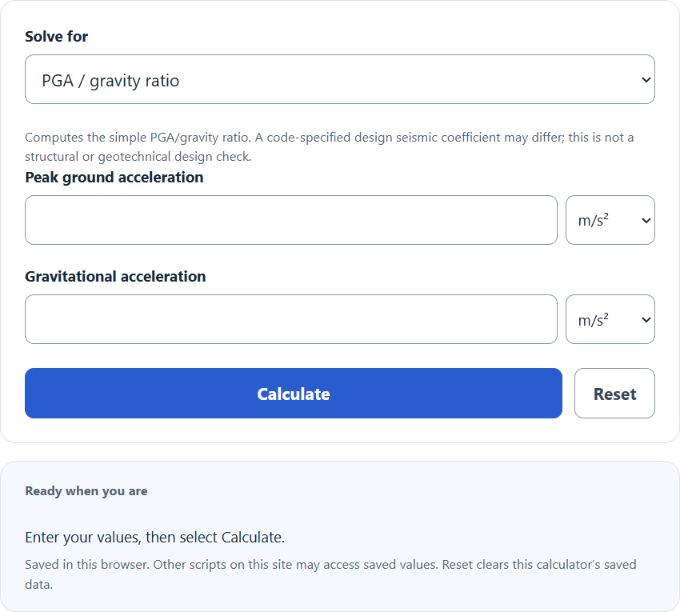
Calculate horizontal seismic coefficient, peak ground acceleration, or gravitational acceleration from any 2 values with unit conversion.
Related Calculators
- Load Per Square Foot Calculator
- SPT To Bearing Capacity Calculator
- Weight Per Foot Calculator
- Gust Factor Calculator
- All Construction Calculators
Horizontal Seismic Coefficient Formula
This calculator uses the simplified ratio HSC = PGA / gravitational acceleration. The ratio is dimensionless. A design horizontal seismic coefficient may instead incorporate code, site, structure, or displacement factors and need not equal PGA/g. This calculator does not select a design coefficient.
Rearranged forms used by the calculator are:
- HSC = horizontal seismic coefficient, dimensionless
- PGA = peak ground acceleration
- g = gravitational acceleration
If you enter peak ground acceleration and gravitational acceleration, the calculator divides PGA by g to find the horizontal seismic coefficient.
If you enter the horizontal seismic coefficient and gravitational acceleration, it multiplies them to find peak ground acceleration.
If you enter the horizontal seismic coefficient and peak ground acceleration, it divides PGA by HSC to find gravitational acceleration.
The calculator converts acceleration units to meters per second squared before applying the formula, then converts the missing value back to the unit you selected.
Acceleration Unit Conversions
Use these values to check unit conversions when comparing results in m/s², ft/s², or g.
| Unit | Equivalent in m/s² | Common use |
|---|---|---|
| 1 m/s² | 1 m/s² | SI acceleration input |
| 1 ft/s² | 0.3048 m/s² | US customary acceleration input |
| 1 g | 9.80665 m/s² | Acceleration as a fraction or multiple of gravity |
Illustrative PGA / Gravity Ratios
These are numerical examples using standard gravity, not hazard categories or recommended design coefficients. Select project-specific design coefficients using the governing code and engineering analysis.
| HSC value | Equivalent PGA | Ratio interpretation |
|---|---|---|
| 0.05 | 0.05 g | PGA equals 5% of standard gravity |
| 0.10 | 0.10 g | PGA equals 10% of standard gravity |
| 0.20 | 0.20 g | PGA equals 20% of standard gravity |
| 0.30+ | 0.30 g or higher | PGA equals 30% or more of standard gravity |
Example Problems
Example 1: Find the horizontal seismic coefficient
Suppose the peak ground acceleration is 2.5 m/s² and gravitational acceleration is 9.80665 m/s².
The horizontal seismic coefficient is 0.2549.
Example 2: Find peak ground acceleration
Suppose the horizontal seismic coefficient is 0.20 and gravitational acceleration is 9.80665 m/s².
The peak ground acceleration is 1.9613 m/s², which is equal to 0.20 g.
FAQ
Is the horizontal seismic coefficient the same as PGA in g?
For this simple ratio, yes, when gravitational acceleration is standard gravity. A PGA of 0.25 g gives a ratio of 0.25. A code-specified design seismic coefficient can differ from that ratio.
Why is the horizontal seismic coefficient dimensionless?
It is dimensionless because it is calculated by dividing one acceleration by another acceleration. The units cancel out, leaving a ratio rather than a value in m/s² or ft/s².
What value should I use for gravitational acceleration?
For most calculations, use standard gravity: 9.80665 m/s², 32.174 ft/s², or 1 g. If your problem or design standard gives a different value, use the value specified there.