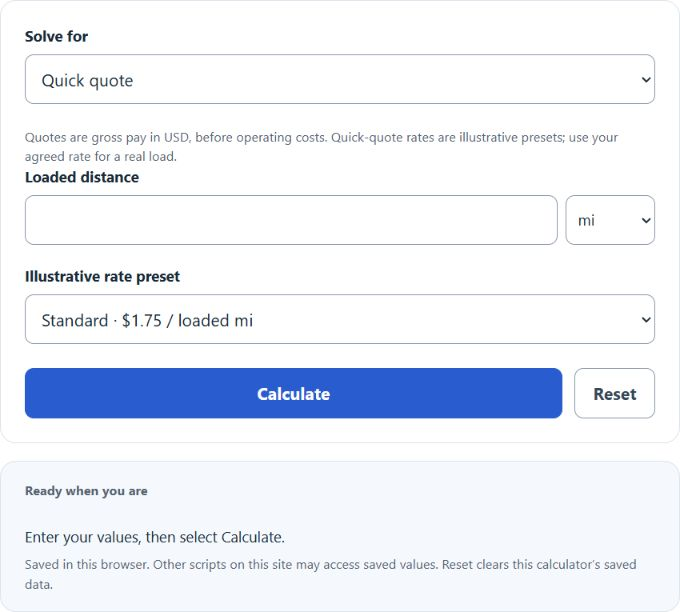
Estimate hot shot load pay by miles with quick quotes, custom per-mile rates, deadhead miles, and target income pricing for every load.
Related Calculators
- Chargeable Weight Calculator
- Shop Rate Calculator
- Total Price Calculator
- Optimal Price Calculator (Best Sell Price)
- All Business Calculators
Hot Shot Rate Formula
The following equation is used to calculate the Hot Shot Rate.
- Where HSR is the hot shot rate ($/shipment)
- BR is your agreed base rate ($/loaded mile)
- D is the distance (miles)
- E is the net total of extras and discounts ($), including fuel, tolls and any urgency charge
Multiply loaded miles by the agreed base rate and add the net extras. Include an urgency charge in extras. Custom quote also reports gross pay per total mile, including empty travel; target-pay mode divides desired gross pay by loaded miles.
What is a Hot Shot Rate?
A hot shot rate is the total price charged for an expedited, direct-delivery shipment using a Class 3, 4, or 5 truck pulling a flatbed or specialty trailer. Unlike standard LTL or truckload freight, hot shot loads move on exclusive vehicles with no stops or co-loading — the entire truck is dedicated to a single shipment from pickup to delivery.
The name originated in the oil fields of West Texas, where truckers would race critical parts to rigs to prevent costly downtime. Today, the same model serves oil and gas, agriculture, manufacturing, and construction industries, where equipment failures cannot wait for standard freight cycles.
Hot Shot Vehicle Classes
| Class | GVWR | Typical Vehicle | Max Payload |
|---|---|---|---|
| Class 3 | 10,001 – 14,000 lbs | Ford F-350, Ram 3500 | ~7,000 lbs |
| Class 4 | 14,001 – 16,000 lbs | Ford F-450, Ram 4500 | ~10,000 lbs |
| Class 5 | 16,001 – 19,500 lbs | Ford F-550, Ram 5500 | ~14,000 lbs |
Hot Shot Rate Benchmarks
Rates vary by route, equipment, timing and agreement. The ranges below and the quick-quote presets are illustrative pricing examples, not verified current market benchmarks. Use an actual negotiated quote for a shipment.
| Load Type | Urgency | Rate Range ($/mile) | Notes |
|---|---|---|---|
| Standard cargo | Routine | $1.00 – $1.50 | Partial loads, flexible schedule |
| Equipment / machinery | Standard | $1.50 – $2.50 | Full load, dedicated truck |
| Oil field parts / critical components | Time-critical | $2.50 – $4.00 | Immediate pickup, direct delivery |
| HAZMAT or oversized | Any | $3.00 – $6.00+ | Special permits, handling required |
Hot Shot Cost Components
Evaluate a quote against complete actual costs, including empty travel, driver time and overhead. The table below uses illustrative assumptions, not verified typical costs; its total is a separate assumed range rather than a sum of the listed items.
| Cost Category | Illustrative Range | Basis |
|---|---|---|
| Fuel | $0.18 – $0.44/mile | $3.50/gal at 8-20 MPG (loaded) |
| Insurance (liability + cargo) | $0.05 – $0.20/mile | $500 – $2,000/month at 10,000 mi/mo |
| Truck and trailer payment | $0.05 – $0.25/mile | $500 – $2,500/month at 10,000 mi/mo |
| Maintenance and tires | $0.05 – $0.15/mile | Averages higher under heavy load |
| Deadhead miles (empty return) | 10 – 30% of total miles | Must be baked into loaded rate |
| Total operating cost | $0.60 – $1.05/mile | Before profit margin |
A 25 – 50% markup on assumed costs of $0.60 – $1.05 per mile gives $0.75 – $1.58 on the same mileage basis. Markup is not profit margin. A loaded-mile quote must also account for empty travel and all omitted costs; these assumed ranges cannot establish a universally profitable minimum rate.
How to Calculate Hot Shot Rate
Example: A carrier quotes 250 loaded miles at $2.00 per loaded mile, with a $50 fuel surcharge and a $45 agreed urgency charge. Enter $95 in extras in Custom quote.
HSR = (BR x D) + E
HSR = (2.00 x 250) + 95
HSR = 500 + 95 = $595
The quote is $2.38 per loaded mile. With an 80-mile empty return, total travel is 330 miles and gross pay is about $1.80 per total mile. Compare $595 with complete actual trip costs before judging profitability.
FAQ
What is the difference between hot shot and standard LTL freight?
Hot shot commonly serves urgent or smaller loads and may offer dedicated direct delivery. LTL combines shipments through a freight network. Actual co-loading, pickup timing, cost and handling depend on the agreement; neither service eliminates delay or damage risk.
Do hot shot drivers need a CDL?
Federal Class A rules cover combinations of at least 26,001 lb with a towed unit over 10,000 lb, using the greater applicable rating or actual weight. Class B covers qualifying heavy single vehicles. Certain placarded hazardous materials and select agents also trigger CDL rules. Truck class alone does not determine licensing. Check FMCSA classifications, endorsement rules and applicable state requirements for the actual vehicle and cargo.
How do deadhead miles affect the rate?
Deadhead includes empty travel to pickup and after delivery. A trip with 250 loaded miles and 80 empty miles covers 330 total miles. At a constant cost per total mile, recovering that cost through loaded miles requires a 330/250 = 1.32 multiplier. If empty miles are 30% of all miles, the multiplier is 1/0.70, about 1.429; 30% of loaded miles instead gives 1.30. These are cost-allocation ratios, not market-price recommendations.
What industries rely most on hot shot trucking?
Oil and gas operations depend on hot shot for wellhead parts, valve replacements, and drill pipe that can cost $50,000+ per day in rig downtime if delayed. Agriculture uses hot shot during harvest and planting when equipment failures are time-sensitive. Manufacturing and construction rely on it for machinery parts, steel components, and specialized tooling that cannot wait for standard freight cycles.
When should I opt for hot shot services?
Hot shot is cost-effective when the value of speed outweighs the rate premium. If downtime costs $5,000/hour and a hot shot rate is $800 to deliver a part in 4 hours versus a 24-hour standard freight run, the premium is justified. The break-even analysis should compare total downtime cost against the freight cost difference.