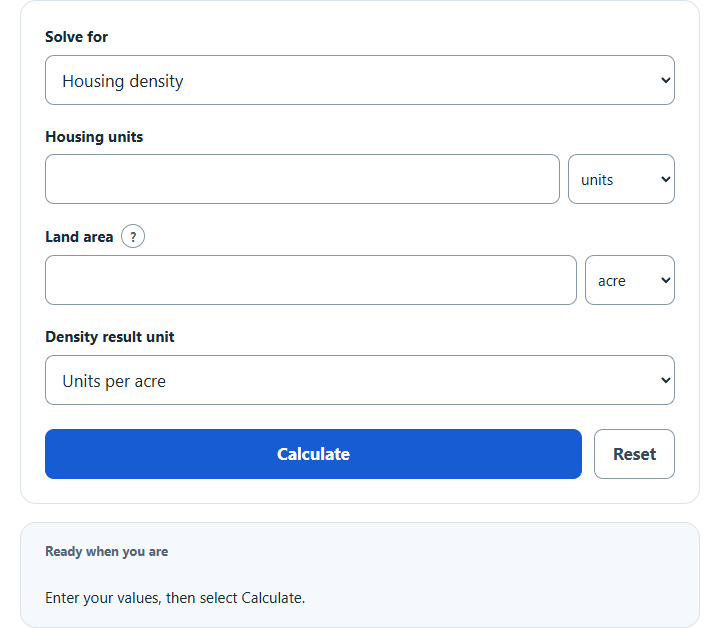
Calculate residential housing density in units per acre, hectare or square mile from housing units and land area, or solve for land area or unit count.
- All Construction Calculators
- All Density Calculators
- Residential Density Calculator
- Population Density Calculator
Calculator Functions
| Function | What it does | What it requires |
|---|---|---|
| Housing density | Finds housing units per unit of land area | Requires the number of housing units and the land area |
| Land area | Finds the land area a number of units needs at a set density | Requires the number of housing units and the housing density |
| Housing units | Finds how many units fit on an area at a set density | Requires the land area and the housing density |
| Zoning buildout estimate | Estimates the whole units a lot can hold under a permitted density | Requires the lot area, the permitted housing density and a rounding choice |
| Population and households | Estimates the people living in a number of housing units | Requires the number of housing units and the average people per occupied household |
Land area can be in acres, square miles, square kilometers, hectares or square meters, and density in units per any of those. Zoning buildout estimate has an optional unbuildable deduction and density bonus, both zero when left blank. Population and households has an optional vacancy rate, land area, target population and target people per acre.
Housing Density Formulas
| HD | Housing density (units per acre, square mile, square kilometer, hectare or square meter) |
| H | Number of housing units, occupied and vacant [1] |
| A | Land area |
The U.S. Census Bureau computes housing unit density the same way: the number of housing units in an area divided by its land area, stated per square mile or per square kilometer [1].
Housing density
The main formula applies directly. A site with 800 housing units on 20 acres has 800 ÷ 20 = 40 units per acre, which is 25,600 units per square mile.
Land area
At 40 units per acre, 800 units need 800 ÷ 40 = 20 acres. The density must be greater than zero.
Housing units
A 20 acre site at 40 units per acre holds 20 × 40 = 800 units.
Zoning buildout estimate
(1 + bonus)
A is the lot area, d the unbuildable deduction and HD the permitted density, with the deduction and bonus written as decimals. A 2.5 acre lot with a 20% deduction has 2 buildable acres. At 12 units per acre that is 24 base units, and a 25% density bonus brings the total to 30. The answer is rounded down, to the nearest whole unit or up, as chosen. A 1.3 acre lot at 12 units per acre works out to 15.6 and rounds down to 15.
Population and households
v is the vacancy rate as a decimal and PPH the average number of people per occupied household. Household size is counted from the people living in occupied housing units [1], so vacant units are taken out first. With 800 units, 5% vacancy and 2.5 people per household, 760 units are occupied and the population is 1,900. Adding a 20 acre land area gives 95 people per acre. A target population is turned into units as target ÷ (PPH × (1 − v)), so 2,375 people need 1,000 units.
Limits of This Estimate
- Gross density uses the whole site and net density uses only residential land. Use the same land area basis as any figure being compared.
- Zoning buildout estimate is arithmetic. It does not establish a zoning entitlement or a permit approval, and local rules may set a different area basis or rounding method.
- Household size and vacancy rate are entered, and no typical value is assumed. Fractional units and people are planning estimates.
Sources
- U.S. Census Bureau, 2020 Census Demographic and Housing Characteristics File (DHC) Technical Documentation, Appendixes A and B: the housing unit density calculation, what counts as a housing unit and how household size is counted