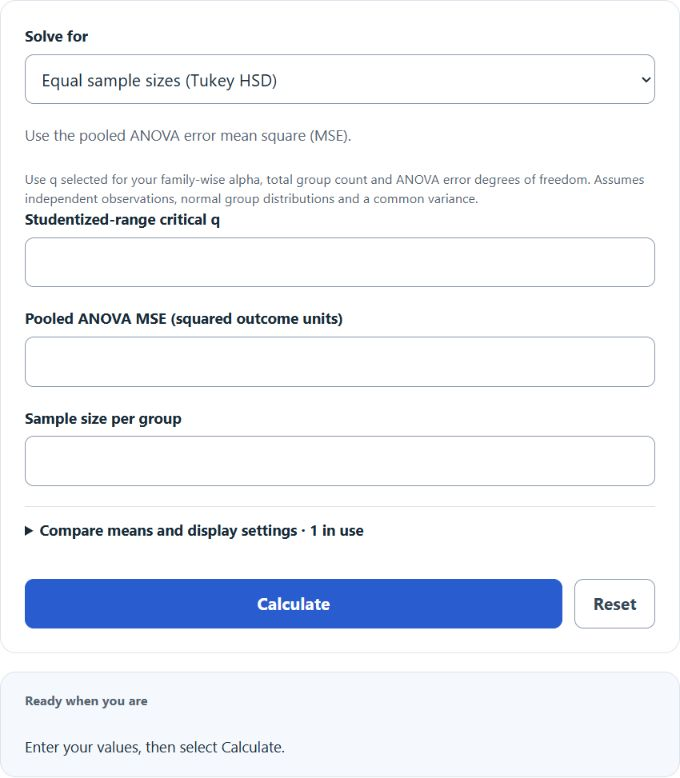
Calculate Tukey HSD and Tukey–Kramer thresholds and compare group means using your supplied Studentized-range critical q, pooled ANOVA MSE and integer sample sizes.
Related Calculators
- Scheffe Test Calculator
- Eta Squared Calculator
- Welch’s T Test Calculator
- MSR (Mean Square of Regression) Calculator
- All Statistics Calculators
HSD (Honestly Significant Difference) Formula
The following formulas are used in Tukey’s multiple-comparisons procedure to calculate the critical difference between group means:
Variables:
- HSD is the Honestly Significant Difference (the critical difference threshold in Tukey’s HSD procedure for equal group sizes)
- q is the critical value from the Studentized range distribution (depends on α, the number of groups a, and the within/error degrees of freedom)
- MSW is the Mean Square Within (also called MSE, the pooled within-group variance estimate from ANOVA)
- n is the sample size per group (for the equal-n case)
- a is the number of groups being compared (used to select q)
Once you obtain q for your family-wise α, total group count and ANOVA error degrees of freedom, compute the critical difference. Compare unrounded values: |meani − meanj| must exceed the critical difference; equality is not significant. This method assumes independent observations, normal group distributions and a common variance, including with unequal sample sizes. The calculator does not compute q, ANOVA or adjusted p-values.
What is an HSD (Honestly Significant Difference)?
The Honestly Significant Difference (HSD) is the name commonly given to the critical difference threshold used in Tukey’s HSD post-hoc multiple-comparisons method. It is often used after an ANOVA (Analysis of Variance) indicates that at least one group mean differs, and you want to identify which pairs of group means differ while controlling the family-wise Type I error rate across many pairwise comparisons. Under Tukey’s method, a pairwise comparison is typically called significant when the absolute difference between two group means is greater than the HSD (or the Tukey–Kramer critical difference in the unequal-n case).
How to Calculate HSD (Honestly Significant Difference)?
The following steps outline how to calculate the Honestly Significant Difference (HSD).
- Run (or review) the ANOVA and record MSW (MSE) and the within/error degrees of freedom.
- Choose a family-wise significance level (α), such as 0.05.
- Determine the number of groups being compared (a) and the sample size per group (n) (or the group sample sizes ni for unequal sample sizes).
- Look up the Studentized range critical value q for your α, number of groups a, and within/error degrees of freedom.
- Compute the critical difference: for equal n, HSD = q × √(MSW / n); for unequal n, use the Tukey–Kramer form CDij = q × √(MSW/2 × (1/ni + 1/nj)).
- For each pair of groups, compute |meani − meanj| and conclude the pair differs significantly if |meani − meanj| > (HSD or CDij). You can verify your result with the calculator above.
Example Problem:
Use the following variables as an example problem to test your knowledge.
Mean difference (between two group means) = 5
Pooled within-group standard deviation = 2 (so MSW = MSE = 22 = 4)
Sample size per group (n) = 20
For illustration, take q = 4.00; this is not a verified lookup for a particular α, group count or error degrees of freedom. HSD = 4 × √(4 / 20) ≈ 1.7889. Since the mean difference 5 exceeds this threshold, the illustrative pair is significant under the supplied q.