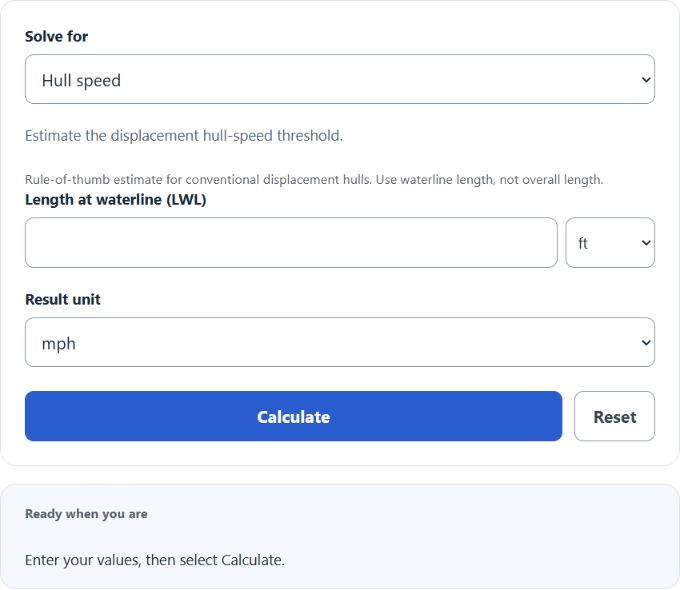
Calculate hull speed from length at waterline or find LWL from hull speed, with results in knots or mph and lengths in ft, m, or in.
- All Physics Calculators
- Airboat Prop Speed Calculator
- Boat Draft Calculator
- Boat Gross Tonnage Calculator
Hull Speed Formula
Hull speed is a rule-of-thumb threshold where wave-making resistance typically rises for a conventional displacement hull; it is not a strict top speed. It is based on the boat’s length at waterline (LWL), which is the portion of the hull actually sitting in the water at rest. For traditional monohulls, the estimate is commonly calculated in knots with the formula below.
If your waterline length is entered in meters, the same relationship can be written as:
To convert the result from knots to miles per hour:
Combining those steps gives a direct mph version when LWL is in feet:
Variable Definitions
- HS = hull speed estimate
- kn = knots
- mph = miles per hour
- LWL = length at waterline
- ft = feet
- m = meters
Solving for Required Waterline Length
If you know the target speed and want to estimate the waterline length needed to support it as a displacement hull, rearrange the formula:
If speed is known in miles per hour instead of knots:
How to Use the Hull Speed Calculator
- Enter the boat’s length at waterline, not the overall deck length.
- Select the correct unit for the input value.
- Read the estimated hull speed in knots or mph.
- If you are planning a trip, remember that cruising speed is often somewhat lower than the hull speed estimate.
Important: LWL is different from LOA (length overall). A boat with long overhangs may have an overall length much larger than its true waterline length, and using LOA will overstate the result.
Example
For a boat with a waterline length of 28 ft:
This means a conventional displacement boat with a 28 ft waterline will typically become much less efficient as it approaches about 7.09 knots or 8.16 mph.
Quick Reference Table
| LWL (ft) | Hull Speed (knots) | Hull Speed (mph) |
|---|---|---|
| 10 | 4.24 | 4.88 |
| 20 | 5.99 | 6.90 |
| 30 | 7.34 | 8.45 |
| 40 | 8.47 | 9.75 |
| 60 | 10.38 | 11.94 |
What Hull Speed Actually Means
Hull speed is not a strict speed cap. It is a rule-of-thumb threshold where wave-making resistance rises quickly for displacement boats. As the vessel moves faster, it creates larger bow and stern waves. Near hull speed, the boat is effectively trying to climb its own bow wave, so each additional increase in speed usually requires a disproportionate increase in power.
- Below hull speed: generally efficient operation and easier cruising.
- Near hull speed: resistance climbs sharply and fuel efficiency often drops.
- Above hull speed: possible for some designs, but usually requires a very slender hull, semi-displacement behavior, or planing lift.
When the Estimate Is Most Useful
This calculator is most useful for:
- displacement sailboats
- trawlers and cruising displacement powerboats
- trip planning and realistic passage estimates
- comparing how waterline length changes expected speed
It is less useful as a top-speed predictor for planing hulls, hydrofoils, racing powerboats, or designs that operate far outside classic displacement behavior.
Factors That Can Change Real-World Speed
- Hull shape: fine-entry and slender hulls may perform differently from fuller hulls.
- Displacement and loading: extra fuel, gear, water, or passengers can change trim and resistance.
- Sea state: waves and chop can reduce sustainable speed even when power is available.
- Wind and current: speed through the water and speed over ground are not the same.
- Hull condition: marine growth and rough surfaces increase drag.
- Propulsion efficiency: propeller selection, engine output, and drivetrain losses matter.
Common Input Mistakes
- Using overall boat length instead of waterline length.
- Reading the result in mph when your navigation data is in knots.
- Assuming the number is the boat’s absolute maximum speed in every condition.
- Ignoring current, which can make GPS speed higher or lower than the theoretical hull speed.
Related Boating Terms
- Displacement hull: a hull that moves through the water primarily by buoyancy rather than planing lift.
- Planing hull: a hull that can rise and ride partly on top of the water at higher speed.
- Waterline length: the length of the hull measured where it meets the water surface.
- Knots: nautical miles per hour, the standard speed unit used in marine navigation.