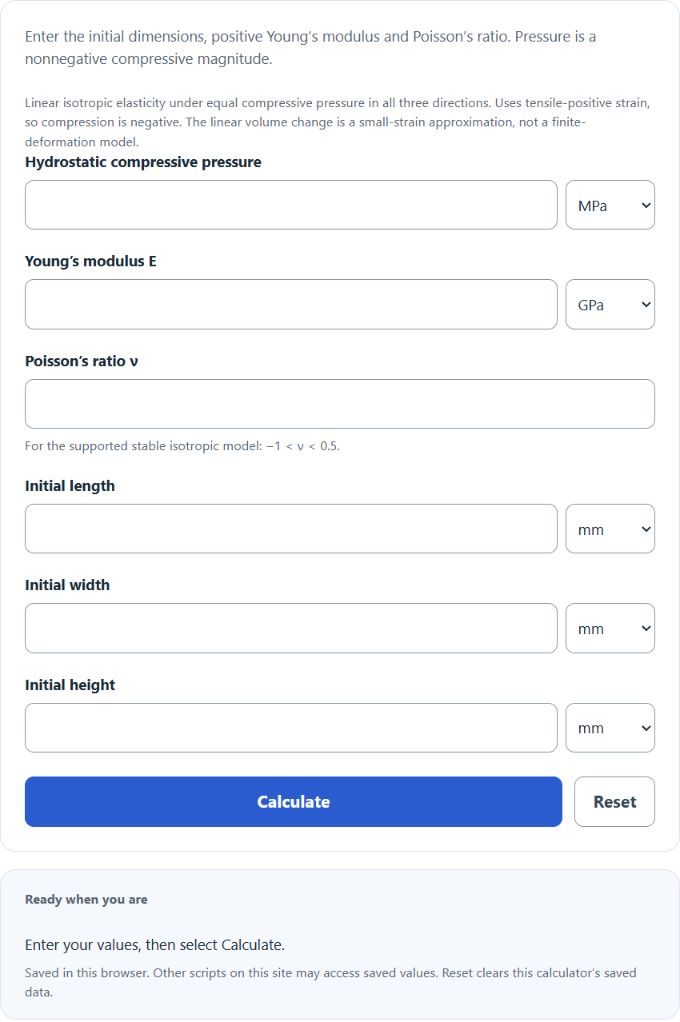
Calculate the equal compressive strain caused by hydrostatic pressure in a linear isotropic material. Use the initial dimensions to find displacement in each direction and approximate volume change.
Hydrostatic strain formulas
With tensile-positive stress and a compressive pressure magnitude p, σx = σy = σz = −p. Isotropic elasticity gives εx = εy = εz = −(1 − 2ν)p/E, where E is Young’s modulus and ν is Poisson’s ratio.
K = E/[3(1 − 2ν)] is bulk modulus. Approximate volumetric strain is εv = 3ε = −p/K. A dimension d changes by Δd = εd; approximate volume change is ΔV = 3εV₀.
The supported compressible, stable isotropic range is −1 < ν < 0.5. Each dimension contracts under equal positive pressure in this range, including an auxetic material. This differs from lateral expansion under uniaxial compression.
Worked example
For p = 100 MPa, E = 200 GPa = 200,000 MPa and ν = 0.3, ε = −0.4 × 100/200,000 = −0.0002, or −0.02%. A 100 × 50 × 20 mm block changes by −0.02, −0.01 and −0.004 mm. Its initial 100,000 mm³ volume has an approximate change of −60 mm³.
Frequently asked questions
Why are all three strains negative?
Pressure compresses all three directions equally. The Poisson terms alter the combined response; all dimensions still contract in the supported isotropic range.
Can I enter ν = 0.5?
No. That limit represents incompressibility; this compressible bulk-modulus formula becomes singular.
Is the volume change exact?
No. It uses the linear small-strain approximation. Large deformation, yielding or nonlinear material response require another model.
References: MIT OpenCourseWare: isotropic elasticity; NIST guide to elastic-modulus measurement.