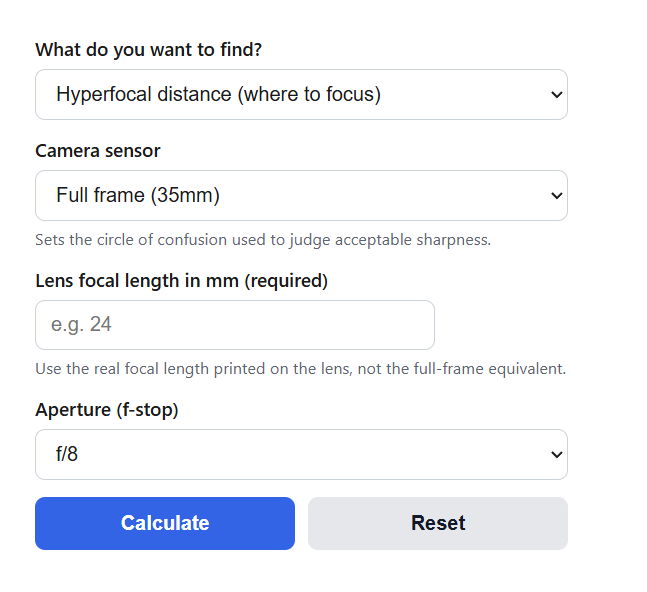
Calculate the hyperfocal distance and near sharpness limit for any sensor, focal length, and f-stop, or find the aperture that keeps your foreground sharp.
Hyperfocal Distance Formula
The calculator uses the standard hyperfocal distance formula:
H = f^2 / (N * c) + f
When you focus the lens at H, the zone of acceptable sharpness starts at half the hyperfocal distance and extends to infinity:
NEAR LIMIT = H / 2
In the aperture solve mode, the calculator inverts the formula to find the f-number that places the near limit at your closest important object:
N = f^2 / (c * (2 * L - f))
Variables:
- H is the hyperfocal distance in mm (the calculator converts it to meters and feet for you)
- f is the lens focal length in mm (use the real focal length printed on the lens, not the full-frame equivalent)
- N is the aperture f-number (f/8 means N = 8)
- c is the circle of confusion in mm, set by your sensor choice (0.030 for full frame, 0.020 for APS-C, 0.015 for Micro Four Thirds)
- L is the distance to the closest object that must be sharp
The first mode computes H and the near sharpness limit from your sensor, focal length, and f-stop, and also lists the hyperfocal distance at nearby full stops so you can see how much room each aperture change buys you. The second mode works backward: enter the closest object that must stay sharp, and the calculator returns the exact required f-number, the next standard stop that covers it, and the foreground margin left over at that stop.
Quick Reference Distances and Focusing Methods
The table below lists the hyperfocal distance at f/11 for common wide-angle focal lengths. Focus at the listed distance and everything from half that distance to infinity is acceptably sharp. Full frame assumes a circle of confusion of 0.030 mm, APS-C assumes 0.020 mm.
| Focal length | Full frame at f/11 | APS-C (1.5x) at f/11 |
|---|---|---|
| 16 mm | 0.79 m (2.6 ft) | 1.18 m (3.9 ft) |
| 20 mm | 1.23 m (4.0 ft) | 1.84 m (6.0 ft) |
| 24 mm | 1.77 m (5.8 ft) | 2.64 m (8.7 ft) |
| 28 mm | 2.40 m (7.9 ft) | 3.59 m (11.8 ft) |
| 35 mm | 3.75 m (12.3 ft) | 5.60 m (18.4 ft) |
| 50 mm | 7.63 m (25.0 ft) | 11.41 m (37.4 ft) |
Hyperfocal focusing is one of several ways to set focus for a deep scene. The comparison below shows how it stacks up against the common field alternatives, including the double the distance rule, a quick approximation that needs no calculator at all.
| Method | Where you focus | What stays sharp | Best when |
|---|---|---|---|
| Hyperfocal focusing | At the hyperfocal distance H | H/2 to infinity | Foreground detail and the horizon both matter and you want maximum total depth of field |
| Double the distance rule | At twice the distance of your nearest important subject | Roughly the nearest subject to infinity at typical landscape apertures | You need a fast field estimate without a calculator or app |
| Focus at infinity | On the horizon | From about H to infinity, close foreground goes soft | There is no close foreground and distant subjects need peak sharpness |
| Focus on the subject | On the subject itself | A band around the subject set by the depth of field | The subject should stand out and background sharpness does not matter |
Example Problems
Example 1: where to focus. You shoot a full frame camera with a 24 mm lens at f/8, so c = 0.030 mm. H = 24^2 / (8 * 0.030) + 24 = 576 / 0.24 + 24 = 2424 mm, or about 2.42 m (7 ft 11 in). Focus at 2.42 m and everything from 1.21 m to infinity is acceptably sharp.
Example 2: which aperture. You shoot a Canon APS-C body (c = 0.019 mm) with an 18 mm lens, and a rock 0.9 m away must stay sharp. N = 18^2 / (0.019 * (2 * 900 – 18)) = 324 / (0.019 * 1782) = 9.57. The next standard stop is f/10. At f/10 the hyperfocal distance is 324 / (10 * 0.019) + 18 = 1723 mm, so focus at about 1.72 m. The sharp zone then starts at 0.86 m, leaving a 4 cm margin in front of the rock.
Hyperfocal Distance FAQ
What happens if I focus slightly in front of the hyperfocal distance?
The far limit of sharpness collapses from infinity to a finite distance, so the horizon, stars, or distant peaks go soft. Overshooting is much safer: focus slightly beyond H and the sharp zone still reaches infinity, while the near limit moves back only a little. When in doubt, err on the far side, never the near side.
Why does sensor size change the hyperfocal distance?
A smaller sensor must be enlarged more to make the same size print, so its circle of confusion is smaller and the same lens and f-stop produce a longer hyperfocal distance. In practice you also use a shorter focal length on a crop body to frame the same scene, and once you compare equivalent framing, the crop sensor ends up with a closer hyperfocal distance and more depth of field at the same f-number.
Should I always use f/22 since it gives the closest hyperfocal distance?
No. Stopping down past about f/16 introduces diffraction, which softens the entire image even though the depth of field keeps growing. Most lenses are sharpest around f/8 to f/11, so use the aperture solve mode to find the widest f-stop that still covers your foreground, and reach for f/16 or smaller only when the composition truly demands it. If even f/22 cannot cover an extremely close foreground, focus stacking is the better tool.