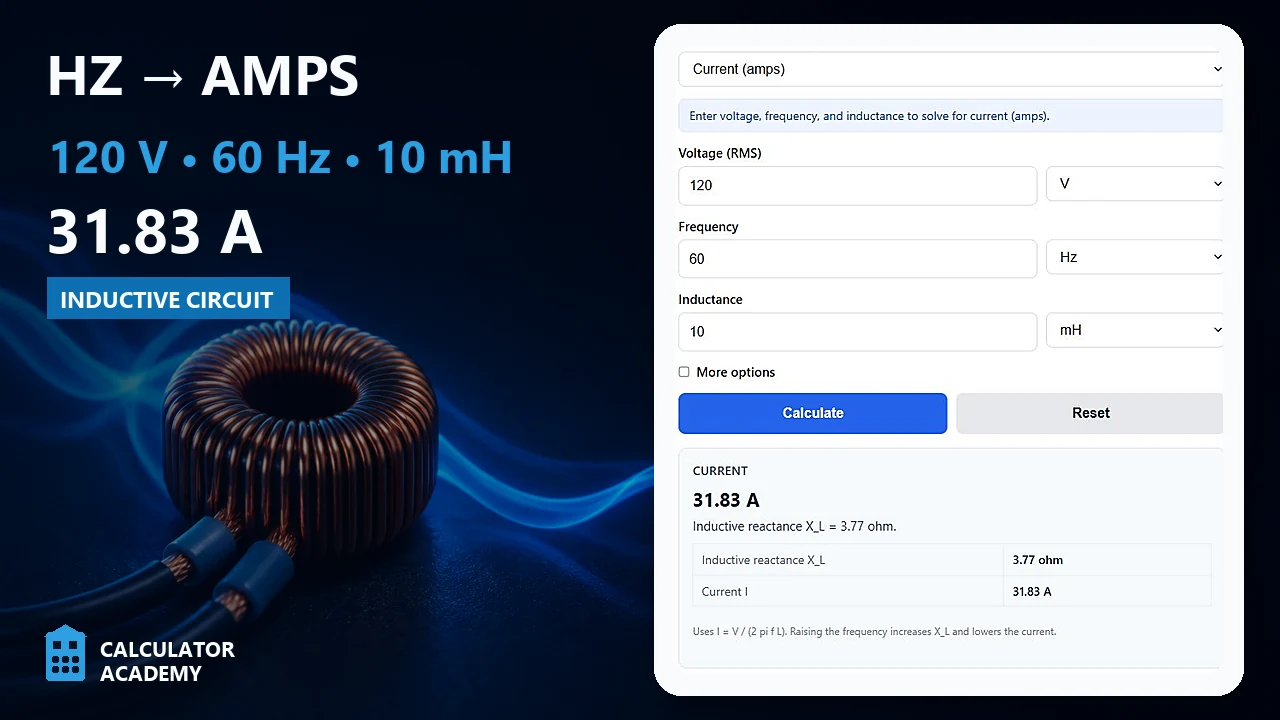
Calculate AC current from frequency, voltage, and inductance or capacitance, or find RLC circuit current using resistance, L, and C.
| Hz to Amps | Amps to Hz |
|---|---|
| 50 Hz = 38.197 A | 0.1 A = 19099 Hz |
| 60 Hz = 31.831 A | 0.2 A = 9549 Hz |
| 100 Hz = 19.099 A | 0.5 A = 3820 Hz |
| 120 Hz = 15.916 A | 1 A = 1910 Hz |
| 400 Hz = 4.775 A | 2 A = 955 Hz |
| 500 Hz = 3.820 A | 5 A = 382 Hz |
| 1000 Hz = 1.910 A | 10 A = 191 Hz |
| 2000 Hz = 0.955 A | 20 A = 95.5 Hz |
| 5000 Hz = 0.382 A | 30 A = 63.7 Hz |
| 10000 Hz = 0.191 A | 40 A = 47.7 Hz |
| Formula (inductor): I = V ÷ (2π f L). Assumes RMS, V = 120 V, L = 10 mH. | |
| Hz to Amps | Amps to Hz |
|---|---|
| 50 Hz = 0.377 A | 0.1 A = 13.3 Hz |
| 60 Hz = 0.452 A | 0.2 A = 26.5 Hz |
| 100 Hz = 0.754 A | 0.5 A = 66.3 Hz |
| 120 Hz = 0.905 A | 1 A = 133 Hz |
| 400 Hz = 3.016 A | 2 A = 265 Hz |
| 500 Hz = 3.770 A | 5 A = 663 Hz |
| 1000 Hz = 7.540 A | 10 A = 1326 Hz |
| 2000 Hz = 15.080 A | 15 A = 1989 Hz |
| 5000 Hz = 37.699 A | 20 A = 2653 Hz |
| 10000 Hz = 75.398 A | 30 A = 3979 Hz |
| Formula (capacitor): I = 2π f C V. Assumes RMS, V = 120 V, C = 10 µF. | |
| Hz to Amps | Amps to Hz |
|---|---|
| 50 Hz = 76.394 A | 1 A = 3820 Hz |
| 60 Hz = 63.662 A | 2 A = 1910 Hz |
| 100 Hz = 38.197 A | 5 A = 763.9 Hz |
| 400 Hz = 9.549 A | 10 A = 382 Hz |
| 1000 Hz = 3.820 A | 20 A = 191 Hz |
| Formula (inductor): I = V ÷ (2π f L). Assumes RMS, V = 240 V, L = 10 mH. | |
Hz To Amps Formulas
Frequency (Hz) relates to current (Amps) through reactance. The formula depends on the type of reactive component in the circuit.
Inductor: I = V / (2 * pi * f * L)
Capacitor: I = 2 * pi * f * C * V
General RLC circuit: I = V / Z, where Z = sqrt(R^2 + (X_L - X_C)^2)
Variables:
- I = current in amperes (A, RMS)
- V = voltage (V, RMS)
- f = frequency in hertz (Hz)
- L = inductance in henries (H)
- C = capacitance in farads (F)
- R = resistance in ohms
- X_L = inductive reactance = 2 * pi * f * L
- X_C = capacitive reactance = 1 / (2 * pi * f * C)
For a pure inductor with no resistance, current drops as frequency rises because inductive reactance (X_L) increases linearly with frequency. The opposite is true for capacitors: capacitive reactance (X_C) falls as frequency rises, so current increases.
How Frequency and Current Interact in AC Circuits
Hz and Amps measure fundamentally different things. Hertz counts the number of complete voltage/current cycles per second. Amperes measure the rate of charge flow. There is no fixed ratio between them. The relationship depends entirely on the impedance of the circuit, which changes with the components present.
In a purely resistive circuit (a heater, an incandescent bulb), changing the frequency from 50 Hz to 60 Hz has zero effect on current. Resistance does not depend on frequency. In a circuit with inductors or capacitors, though, impedance is frequency-dependent, so the same voltage at a different frequency produces a different current.
Inductive Loads
Motors, transformers, solenoids, and chokes are inductive. Their reactance is X_L = 2 * pi * f * L. Double the frequency and the reactance doubles, cutting the current in half (assuming the same applied voltage). This is why equipment rated for 60 Hz grids draws more current if connected to a 50 Hz supply at the same voltage. A motor with 100 mH winding inductance sees X_L of about 31.4 ohms at 50 Hz but 37.7 ohms at 60 Hz.
Capacitive Loads
Power-factor correction capacitor banks, filter capacitors, and coupling capacitors are capacitive. Their reactance is X_C = 1 / (2 * pi * f * C). As frequency rises, X_C drops and current rises. A 10 uF capacitor at 120 V draws about 0.452 A at 60 Hz but 0.377 A at 50 Hz.
50 Hz vs 60 Hz Power Grids
Most of the world uses one of two standard AC frequencies. North America, parts of South America, South Korea, Saudi Arabia, and the Philippines use 60 Hz. Europe, most of Africa, Asia, and Australia use 50 Hz. Japan is split: eastern Japan (Tokyo, Yokohama) runs 50 Hz while western Japan (Osaka, Nagoya) runs 60 Hz, a legacy of importing different generators in the 1890s.
For purely resistive loads, the grid frequency does not matter. For reactive loads, the 20% frequency difference between 50 Hz and 60 Hz causes meaningful changes in current draw. A transformer core designed for 60 Hz will saturate at 50 Hz if the voltage is not reduced proportionally, drawing excess magnetizing current. Variable frequency drives (VFDs) exploit this relationship deliberately, controlling motor speed by adjusting the output frequency and voltage together.
Common Component Values and Their Currents
Knowing typical inductance and capacitance values for real components helps put the formulas in context. All values below assume 120 V RMS at 60 Hz unless noted.
- Small AC motor (washing machine): winding inductance around 50 to 200 mH, drawing roughly 1 to 6 A depending on load and resistance.
- Fluorescent lamp ballast: inductance around 0.5 to 2 H, limiting current to 0.3 to 0.5 A at line frequency.
- Power-factor correction capacitor (residential): 5 to 25 uF, drawing 0.2 to 1.1 A of reactive current at 60 Hz / 120 V.
- AC coupling capacitor (audio amplifier): 1 to 10 uF, passes milliamp-level signal currents at audio frequencies (20 Hz to 20 kHz).
- Transformer primary (small appliance): inductance 1 to 10 H, magnetizing current well under 1 A at 60 Hz.
Worked Example
A 10 mH inductor is connected to a 120 V RMS, 60 Hz supply. Find the RMS current.
Step 1: Calculate inductive reactance. X_L = 2 * pi * 60 * 0.010 = 3.7699 ohms.
Step 2: Calculate current. I = 120 / 3.7699 = 31.831 A.
This matches the 60 Hz row in the inductor table above. In practice, real inductors also have DC winding resistance (often 0.5 to 5 ohms), which would reduce the actual current somewhat.
Skin Effect at High Frequencies
At frequencies above a few kHz, current concentrates near the surface of a conductor rather than flowing uniformly through its cross-section. This is called the skin effect. It increases the effective resistance of the conductor and reduces the current below what the simple reactance formula predicts. The skin depth in copper is about 9.3 mm at 50 Hz, 2.1 mm at 1 kHz, and 0.66 mm at 10 kHz. For power-frequency calculations (50 or 60 Hz), skin effect is usually negligible in conductors smaller than about 2 cm diameter. For high-frequency applications (switched-mode power supplies, RF circuits), it must be accounted for, and engineers use litz wire or hollow conductors to mitigate the losses.
Resonance
When an inductor and capacitor are in series, there is one specific frequency where X_L exactly equals X_C. At this resonant frequency, the two reactances cancel and the impedance drops to just the resistance R. Current reaches its maximum value of V / R, which can be many times higher than the current at other frequencies. The resonant frequency is f_r = 1 / (2 * pi * sqrt(L * C)). Series LC resonance is used in radio tuning circuits, bandpass filters, and can also cause dangerous overcurrents in power systems if a capacitor bank resonates with transformer inductance at a harmonic frequency.