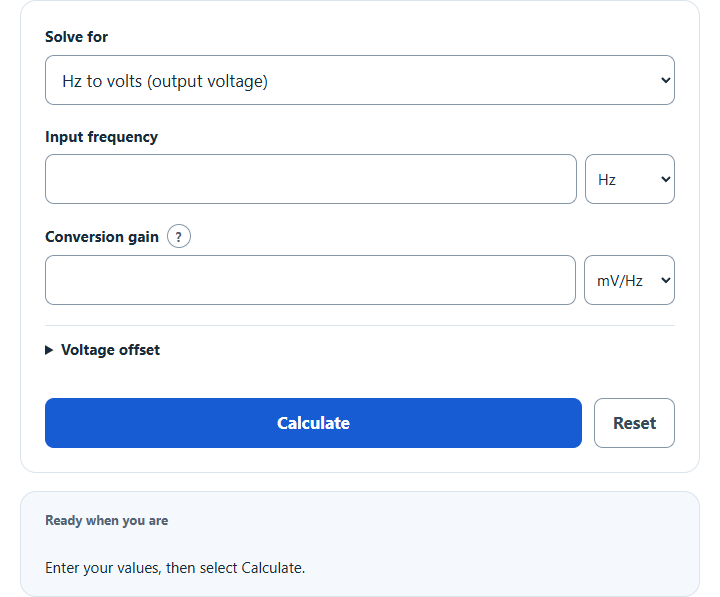
Convert Hz to volts for a frequency-to-voltage converter from its gain and optional offset, or convert volts to Hz and solve for the gain or offset.
Calculator Functions
| Function | What it does | What it requires |
|---|---|---|
| Hz to volts (output voltage) | Finds the output voltage of a frequency-to-voltage converter for an input frequency | Requires the input frequency in Hz, kHz or MHz and the conversion gain in mV/Hz, V/Hz, V/kHz or mV/kHz |
| Volts to Hz (input frequency) | Finds the input frequency that produces a measured output voltage | Requires the output voltage in V or mV and the conversion gain |
| Conversion gain | Finds the gain of a converter from one known operating point | Requires the output voltage and the input frequency at that point |
| Offset voltage | Finds the output voltage the converter gives at zero frequency | Requires the output voltage, the input frequency and the conversion gain |
The first three functions accept an optional offset voltage, which counts as 0 V when left blank. Every result lists the output voltage, input frequency, gain and offset together, with the gain also shown in mV/Hz, V/kHz and mV/kHz.
Hz to Voltage Formulas
| Vout | Output voltage (V) |
| V0 | Offset: the output at zero frequency (V) |
| k | Conversion gain of the converter (V/Hz) |
| f | Input frequency (Hz) |
A frequency has no voltage of its own. The formula describes a frequency-to-voltage converter, a circuit whose output rises in a straight line with the frequency of its input. The gain k belongs to the circuit and comes from its datasheet or from calibration.
Hz to volts (output voltage)
The main formula applies directly. At a gain of 2.09 mV/Hz, which is the same as 2.09 V/kHz, a 1,000 Hz input gives 0.00209 × 1,000 = 2.09 V. With a 0.5 V offset the output is 2.59 V.
This is the gain of one common converter chip, the Texas Instruments LM2907, where VCC is the supply voltage, R1 and C1 are the external resistor and timing capacitor, and K is a gain constant that is typically 1 [1]. A 10 V supply with R1 = 20.9 kΩ and C1 = 0.01 µF gives 10 × 20,900 × 0.00000001 = 0.00209 V/Hz, or 2.09 V/kHz. The output of this chip falls to ground at zero frequency, so its offset is 0 V [1].
50 Hz or 60 Hz to volts
50 Hz and 60 Hz are the frequencies of AC mains power, and neither converts to a voltage. Frequency says how many times a second the supply alternates, and voltage is a separate rating of the same supply, shown on the equipment nameplate or set by the local grid. A voltage follows from 50 Hz or 60 Hz only through a converter with a known gain: at 15 mV/Hz, 60 Hz gives 0.9 V and 50 Hz gives 0.75 V.
Volts to Hz (input frequency)
This is the main formula rearranged. A 5 V output at 2.09 mV/Hz with no offset means an input of 5 ÷ 0.00209 = 2,392.34 Hz. An output below the offset is rejected, because it would need a negative frequency.
Conversion gain
One measured point fixes the gain when the offset is known. The LM2907 datasheet shows a tachometer circuit that gives 6 V at 400 Hz [1], which is 6 ÷ 400 = 0.015 V/Hz, or 15 mV/Hz. The frequency has to be above zero and the output above the offset.
Offset voltage
A converter that reads 2.5 V at 1,000 Hz with a gain of 2.09 mV/Hz has an offset of 2.5 − 2.09 = 0.41 V.
Limits of This Estimate
- The model is a straight line. A real converter departs from it slightly: the LM2907 is specified at 0.3% typical linearity, and its gain constant K can lie between 0.9 and 1.1 [1], so a gain worked out from component values is less exact than one that is measured.
- The calculator does not apply hardware limits. The output cannot go past the supply rails, and each circuit has a maximum input frequency set by its supply voltage and timing capacitor [1].
- The result is the steady output. A real output carries ripple and takes time to settle after the frequency changes, both set by the filter capacitor [1].
Sources
- Texas Instruments, LM2907-N and LM2917-N Frequency to Voltage Converter datasheet (SNAS555D): output voltage equation, gain constant, linearity, zero-frequency output, the 6 V at 400 Hz example, and frequency and ripple limits