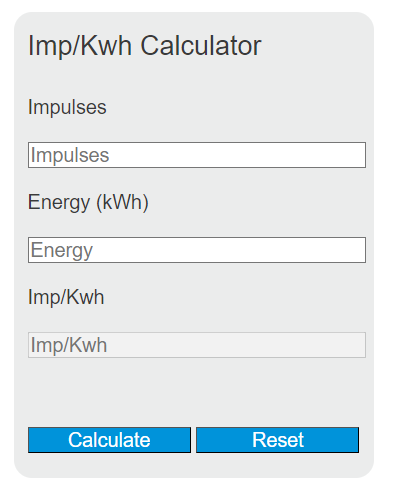
Calculate power in watts, energy in kWh, or the imp/kWh meter constant from your electricity meter’s pulse count, LED flash interval, or flashes per minute.
Related Calculators
- Kw Per Hour Calculator
- RWKW to HP Calculator
- Hz To Ms Calculator
- Measurement Ratio Calculator
- All Unit Converters
Imp/kWh Formula
Imp/kWh means impulses per kilowatt-hour. It tells you how many meter pulses correspond to 1 kWh of electrical energy. This value is often used as a meter constant when checking an electricity meter, converting pulse counts into energy use, or confirming that a pulse output matches expected consumption.
If you already know the meter constant and want to calculate energy from pulse count, rearrange the relationship as follows:
You can also determine how much energy a single pulse represents:
What the Result Means
A higher Imp/kWh value means the meter generates more pulses for the same amount of energy, which gives finer measurement resolution. A lower value means each pulse represents a larger block of energy.
| Imp/kWh | Meaning of One Pulse | Interpretation |
|---|---|---|
| 100 | Each pulse represents 10 Wh | Lower pulse resolution |
| 1000 | Each pulse represents 1 Wh | Common easy-to-read resolution |
| 2000 | Each pulse represents 0.5 Wh | Finer pulse resolution |
Variable Definitions
- Impulses – the total number of pulses counted from the meter during the measurement period.
- Energy (kWh) – the electrical energy used during that same period.
- Imp/kWh – the number of pulses produced for each kilowatt-hour consumed.
How to Use the Calculator
- Enter the total pulse count recorded by the electricity meter or monitoring device.
- Enter the measured energy use in kilowatt-hours for the same time interval.
- Click calculate to find the Imp/kWh value.
- If your calculator setup allows solving for a different variable, enter any two known values to find the third.
The most important rule is consistency: the pulse count and the energy value must refer to the same meter and the same time window.
Example
If a meter records 3200 impulses while 3.2 kWh of energy is used, the meter constant is:
That means the meter produces 1000 pulses for every 1 kWh consumed.
Why Imp/kWh Matters
- Meter verification: helps confirm that pulse output aligns with expected energy use.
- Energy monitoring: useful when pulse data is collected by a logger, PLC, or building management system.
- Billing checks: allows comparison between pulse-based readings and displayed meter totals.
- System commissioning: helps validate new submeters and pulse-connected monitoring hardware.
Common Input Mistakes
- Using kW instead of kWh: power and energy are not the same. This calculator requires energy in kWh.
- Mismatched time periods: the impulses and kWh must come from the same interval.
- Wrong pulse source: make sure the pulse count belongs to the meter being tested.
- Ignoring scaling factors: some monitoring systems apply multipliers that should be checked before calculation.
Practical Notes
Many electronic meters use a pulse or LED flash output so external devices can track usage. When the Imp/kWh constant is known, those pulses can be translated directly into energy consumption. This makes the value especially useful for remote monitoring, submetering, and performance checks.
If you need to estimate usage from pulses alone, first confirm the meter constant printed on the meter label or technical documentation, then use the calculator to convert pulse count into kWh.
Quick Reference
- If the Imp/kWh value increases, each pulse represents a smaller amount of energy.
- If the Imp/kWh value decreases, each pulse represents a larger amount of energy.
- Accurate pulse counting depends on clean signals, correct wiring, and matching measurement periods.