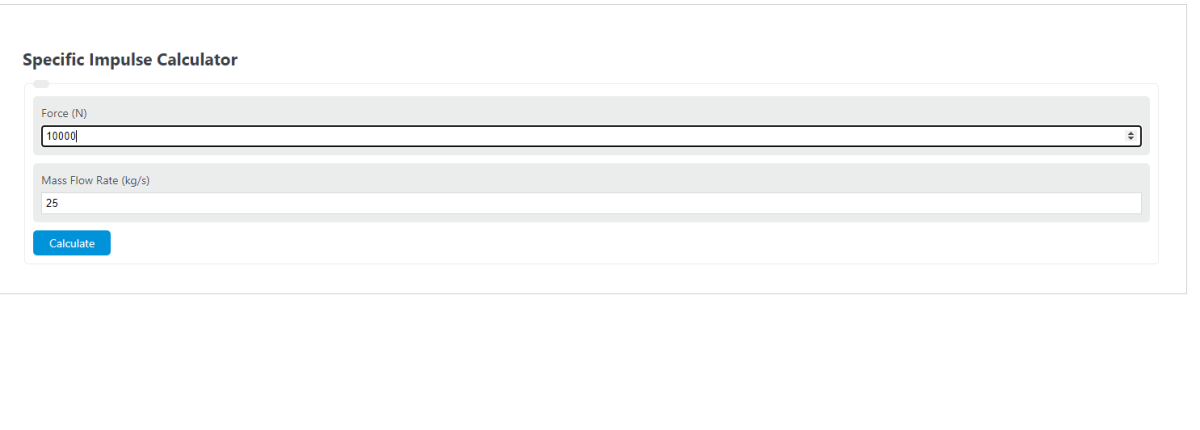
Calculate specific impulse, force, or mass flow rate from any two values with unit conversion between N, lbf, kg/s, lb/s, and seconds.
Specific Impulse Formula
Specific impulse is a standard measure of propulsion efficiency. It shows how effectively an engine converts propellant flow into thrust. In general, a higher specific impulse means the engine produces more impulse from the same amount of propellant, which is especially important in rocket and spacecraft design.
This calculator uses thrust and mass flow rate to determine specific impulse, or it can solve for the missing variable when any two values are known.
| Variable | Meaning | Common Units |
|---|---|---|
| Isp | Specific impulse, a normalized measure of propellant efficiency | seconds (s) |
| F | Thrust produced by the propulsion system | newtons (N) or pounds-force (lbf) |
| ṁ | Propellant mass flow rate | kg/s or lb/s |
| g0 | Standard gravity used to express specific impulse in seconds | 9.80665 m/s² |
Rearranged Forms
If you need to solve for thrust or mass flow rate instead of specific impulse, the same relationship can be rearranged as follows:
How to Use the Specific Impulse Calculator
- Enter the known thrust value for the engine or propulsion system.
- Enter either the mass flow rate or the specific impulse.
- Select matching units so the inputs stay in one consistent system.
- Calculate to solve for the missing value.
For the most meaningful comparisons, make sure the numbers come from the same operating condition. Specific impulse can vary between sea-level and vacuum operation, and it can also change with throttle setting, chamber pressure, and nozzle performance.
What the Result Means
- Higher specific impulse: the engine uses propellant more efficiently.
- Lower specific impulse: more propellant is required to produce the same impulse output.
- Specific impulse is not the same as thrust: two engines can have similar efficiency but very different thrust levels.
- Specific impulse is not burn time: seconds are the unit, but the value represents normalized performance rather than how long an engine fires.
Relationship to Exhaust Velocity
Specific impulse is directly related to effective exhaust velocity. This is useful when comparing propulsion concepts or connecting engine performance to orbital mission calculations.
An engine with a larger effective exhaust velocity generally achieves a larger specific impulse, meaning it extracts more useful momentum change from each unit of propellant consumed.
Example
If an engine produces 1500 N of thrust and consumes propellant at 0.60 kg/s, the specific impulse is:
That value indicates the propulsion system is delivering roughly 255 seconds of specific impulse under those conditions.
Why Engineers Track Specific Impulse
Specific impulse matters because it connects directly to mission capability. For a fixed mass ratio, a higher specific impulse increases the theoretical velocity change available to a rocket or spacecraft.
This is why engine selection is never based on thrust alone. Designers usually weigh specific impulse alongside thrust, propellant storage, structural mass, burn duration, thermal limits, and mission environment.
Common Mistakes When Calculating Specific Impulse
- Mixing SI and imperial units in the same calculation.
- Entering mass flow rate incorrectly or confusing it with total propellant mass.
- Comparing vacuum performance to sea-level performance without noting the difference.
- Assuming a higher specific impulse automatically makes one engine better for every application.
Frequently Asked Questions
- Why is specific impulse measured in seconds?
- Because thrust is divided by propellant weight flow rate, the units reduce to seconds. The result is a compact way to express propulsion efficiency.
- Is specific impulse the same as total impulse?
- No. Specific impulse measures efficiency per unit propellant weight flow, while total impulse describes the overall impulse delivered during a burn.
- Does higher specific impulse always mean better performance?
- Not by itself. High specific impulse improves propellant efficiency, but the best propulsion choice also depends on required thrust, mission duration, vehicle mass, and operating conditions.
- Why do vacuum values tend to be higher?
- Engines usually perform more efficiently without atmospheric back pressure, so vacuum specific impulse is often greater than sea-level specific impulse.