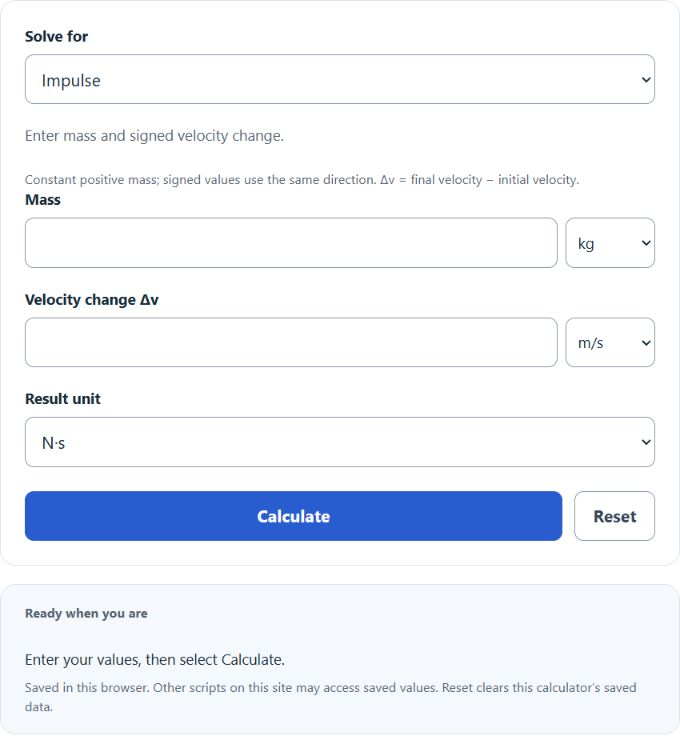
Calculate impulse, mass, or change in velocity from any two inputs and convert between kg, lb, m/s, km/h, mph, and ft/s with calculation steps.
- All Impulse Calculators
- Conservation of Momentum Calculator
- Elastic Collision Calculator
- Average Force Calculator
- Specific Impulse Calculator
- All Physics Calculators
Impulse Formula
Impulse measures how much an object’s momentum changes during an interaction. In everyday terms, it tells you how strongly and for how long a force changes motion. This calculator finds impulse from mass and change in velocity, or rearranges the relationship to solve for the missing value when the other two are known.
For objects with constant mass, impulse is equal to the change in momentum.
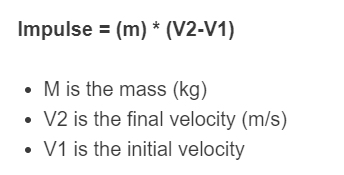
Since momentum is mass multiplied by velocity, the same idea can also be written as:
Variables and units
| Symbol | Meaning | Typical SI Unit |
|---|---|---|
| J | Impulse | N·s or kg·m/s |
| m | Mass | kg |
| vf | Final velocity | m/s |
| vi | Initial velocity | m/s |
| Δv | Change in velocity | m/s |
The SI units N·s and kg·m/s are equivalent. That is why impulse can be interpreted either as force applied over time or as change in momentum.
Force-time form of impulse
If you know the average net force and the positive elapsed contact time instead of the velocities, impulse can also be found from the force-time relationship.
For a force that changes continuously during the event, the most general expression is:
This is especially useful in impact analysis, sports science, crash studies, and collision problems where the force is not constant.
How to calculate impulse
- Measure or enter the object’s mass.
- Determine the initial velocity and final velocity.
- Find the change in velocity by subtracting initial velocity from final velocity.
- Multiply the mass by the change in velocity.
If you already know the change in velocity directly, you can skip the subtraction and use:
Example calculation
A 4 kg object changes velocity from 3 m/s to 11 m/s.
The impulse is 32 kg·m/s, which is also 32 N·s.
If that same change happened over 0.25 seconds, the average force would be:
So the average force would be 128 N.
Why sign matters
Impulse is directional. If the final velocity is less than the initial velocity in your chosen positive direction, the impulse will be negative. A negative result does not mean the calculation is wrong; it means the net effect acted opposite the positive direction you selected.
- Positive impulse: the object gains momentum in the positive direction.
- Negative impulse: the object loses momentum in the positive direction or gains momentum in the negative direction.
Common applications
- Vehicle collisions and crash safety
- Ball strikes in baseball, golf, tennis, and soccer
- Constant-mass propulsion interactions; variable-mass rockets require a different momentum balance
- Manufacturing impacts and machine design
- Biomechanics and jump landing studies
Common mistakes
- Using speed when the problem requires signed velocity.
- Forgetting that change in velocity is final minus initial.
- Mixing units such as kilograms with feet per second.
- Using weight instead of mass.
- Dropping the negative sign when the object slows down or reverses direction.
Rearranged forms
If impulse is known, you can solve for mass or velocity change directly.
These forms are useful when estimating how much motion change a given impact will cause, or how much mass is needed to produce a target impulse.
Impulse vs. momentum
Momentum describes the motion an object currently has. Impulse describes how much that momentum changes during an interaction. In short:
- Momentum is the current quantity of motion.
- Impulse is the amount of change in that motion.
FAQ
Is impulse the same as force?
No. Force is an instantaneous push or pull, while impulse combines force and time into one quantity that measures the total effect on momentum.
Can impulse be zero?
Yes. If momentum does not change, the net impulse is zero.
Why can impulse be written in two different units?
Because force multiplied by time and momentum change are physically equivalent, impulse may be reported as N·s or kg·m/s.
When should I use the force-time formula instead of the mass-velocity formula?
Use the mass-velocity form when you know the object’s motion before and after the event. Use the force-time form when you know the average net force and positive duration of contact.