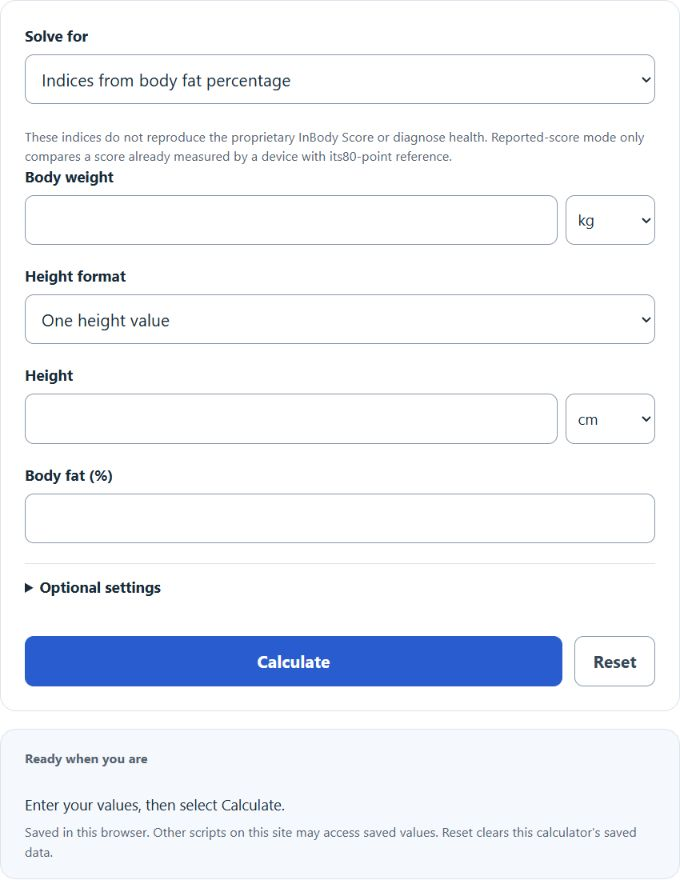
Calculate FFMI, FMI, and SMMI from height, weight, body fat percentage or mass, and optional skeletal muscle mass, or interpret a reported InBody score.
Body Composition Index Formulas (FFMI, FMI, SMMI)
The following formulas are used to calculate FFMI, FMI, and SMMI from body-composition measurements. Use mass in kilograms (kg) and height in meters (m) to get results in kg/m².
FFMI (Fat-Free Mass Index) = FFM / height².
FMI (Fat Mass Index) = FM / height².
SMMI (Skeletal Muscle Mass Index) = SMM / height².
Skeletal muscle percentage = SMM / body mass × 100. This percentage converts the device-reported skeletal muscle value entered; it is not an independent measurement and should not be substituted for lean mass or fat-free mass.
These indices are commonly used in research (and sometimes clinical settings), but interpretation and cutoffs depend on age, sex, ethnicity, measurement method, and the reference population.
Primary research defines the mass/height² indices: VanItallie et al.(1990) and Schutz et al.(2002). Heymsfield et al.(2007) examines skeletal-muscle scaling to height. This tool uses entered total skeletal muscle mass; it does not substitute appendicular lean mass or apply population cutoffs.
What is an InBody Score?
The InBody Score is a branded body-composition summary shown on some InBody reports. InBody’s manufacturer FAQ describes an80-point baseline with lean- and fat-mass adjustments. Its description does not provide a complete reproducible numerical equation. This tool preserves the existing separation: it calculates the listed body-composition indices and compares an already reported score with80; it does not derive an authentic InBody Score from body measurements or diagnose health.
How to Calculate FFMI, FMI, and SMMI?
The following steps outline how to calculate FFMI, FMI, and SMMI:
- Determine your body weight (W) and height (H).
- Determine your fat mass (FM). If you only have body fat percentage (%BF), compute FM = W × (%BF / 100).
- Compute fat-free mass (FFM) = W − FM.
- Compute FFMI = FFM / H².
- Compute FMI = FM / H².
- If you have total skeletal muscle mass (SMM), compute SMMI = SMM / H² (optional). SMM cannot exceed fat-free mass. Keep total skeletal muscle distinct from appendicular lean mass.
- If SMM is entered, compute skeletal muscle percentage = SMM / body mass × 100.
Example Problem:
Use the following variables as an example problem to test your knowledge:
Body Weight (W) = 80 kg
Body Fat Mass (FM) = 20 kg
Height (H) = 1.78 m
Skeletal Muscle Mass (SMM) = 30 kg (optional). Results: FFM = 60 kg, FFMI = 18.94 kg/m², FMI = 6.31 kg/m², SMMI = 9.47 kg/m², and skeletal muscle percentage = 37.5%.