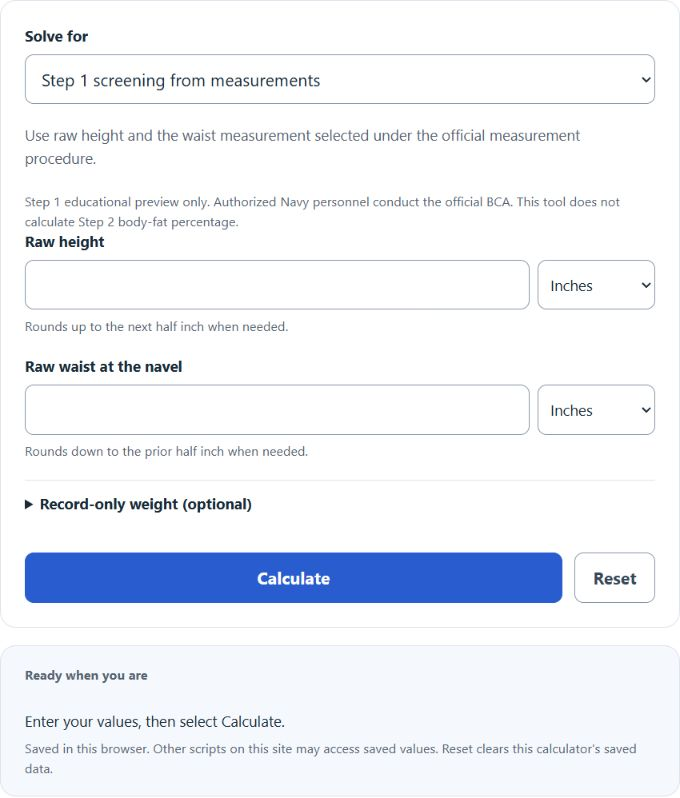
Use the June 2026 Navy Guide-4 Step 1 waist-to-height screening method with the required half-inch measurement rules and four-decimal truncation. This calculator does not estimate Step 2 body fat percentage.
What this calculator reports
- Your supplied measurements, their units and the rounded inch values used in the calculation.
- Height rounded up to the next half inch when needed.
- Waist rounded down to the prior half inch when needed.
- The waist-to-height ratio before truncation.
- The official Step 1 ratio rounded down to four decimal places.
- Either a Step 1 within-standard result or a direction to official Step 2 review.
The optional weight field is record-only. It shows the nearest-pound Guide-4 value but does not calculate body fat.
How the June 2026 Step 1 calculation works
Guide-4 defines Step 1 as waist divided by height. The order matters: first place the measurements on their official half-inch values, then divide the rounded waist by the rounded height, and finally round the ratio down to the fourth decimal place.
- Round raw height up to the nearest 0.5 inch.
- Round the waist measurement down to the nearest 0.5 inch.
- Divide rounded waist by rounded height.
- Discard all digits after the fourth decimal place. Do not use ordinary nearest-value rounding.
- A result no greater than 0.5499 is within the Step 1 screening standard. A result of 0.5500 or greater requires Step 2.
For example, a raw height of 70.01 inches becomes 70.5 inches, while a raw waist of 38.99 inches becomes 38.5 inches. The untruncated ratio is about 0.546099, so the Step 1 value is 0.5460. In contrast, 38.5 divided by 70.0 is 0.5500 and requires Step 2 review.
Using the solve-for selector
Select Step 1 status from measurements to evaluate a raw height and raw waist. Select Maximum Step 1 rounded waist from height to find the largest half-inch waist value that remains no greater than the 0.5499 limit for the rounded height. The second mode also shows the next half-inch value and its Step 2 result.
The maximum-waist mode is an arithmetic aid. Authorized personnel must use the current Guide-4 Table-1 for the official assessment.
Measurement procedure and rounding details
Height
The official procedure measures height without shoes, with socks worn, on a flat surface. The Sailor stands at attention with the head horizontal and chin parallel to the deck. The exact raw score is recorded, then height is rounded up to the nearest half inch.
Waist
The waist is measured on bare skin at the umbilicus from the right side of the body. The tape stays parallel to the deck, contacts the skin, and does not compress soft tissue. The reading is taken at the end of normal respiration with the arms down.
This preview evaluates one supplied waist value; it does not take, select, or average repeated tape readings. Authorized CFL/ACFL personnel must follow the current Guide-4 repeated-measurement and recording procedure to select the waist value for an official assessment. Do not substitute an arbitrary average of home readings.
Weight
Weight is required in an official BCA regardless of the Step 1 result. Guide-4 records the raw value and rounds to the nearest pound: a fraction below one-half pound rounds down, and a fraction of one-half pound or more rounds up. The optional field here performs that record conversion only.
Why this page does not calculate Step 2 body fat
Step 2 is not a single formula supplied by this page. Guide-4 directs authorized personnel to use rounded weight and the rounded height-minus-waist difference with the sex-specific official tables. When measurements exceed table limits, raw measurements are entered into PRIMS and the PRIMS-generated result is recorded. Substituting a legacy circumference equation or another body-fat equation would not reproduce that official process.
If this calculator returns 0.5500 or greater, the correct next step is official Table-2 or Table-3 and PRIMS review. Weight shown in the result is not evidence of a Step 2 percentage.
Interpretation and safety
This tool is for education and planning. It cannot conduct, certify, replace, or appeal an official Navy BCA. Official measurements are conducted by authorized, trained CFL/ACFL personnel and recorded on the required score sheet and Navy systems.
WHtR is a screening measure, not a diagnosis and not a direct body-fat percentage. Small differences near the cutoff can arise from the measurement procedure, which is why the official tape placement, repeated readings, and directed rounding steps matter.
Do not use dehydration, extreme restriction, or other rapid weight-cutting methods to change a measurement. Those practices can be dangerous. For personal medical questions, speak with a qualified health professional; for official BCA questions, consult the current Navy guidance and your command fitness leadership.
Sources
MyNavy HR, Physical Readiness Program Guide-4: Body Composition Assessment, June 2026.
This page implements Step 1 screening arithmetic only. The current Navy Guide-4 controls official measurement selection and recording. The Navy’s 2026 medical-review training confirms the four-decimal Step 1 threshold: at most 0.5499 is within standard, and 0.5500 or higher proceeds to Step 2. This independent preview cannot certify an official assessment.