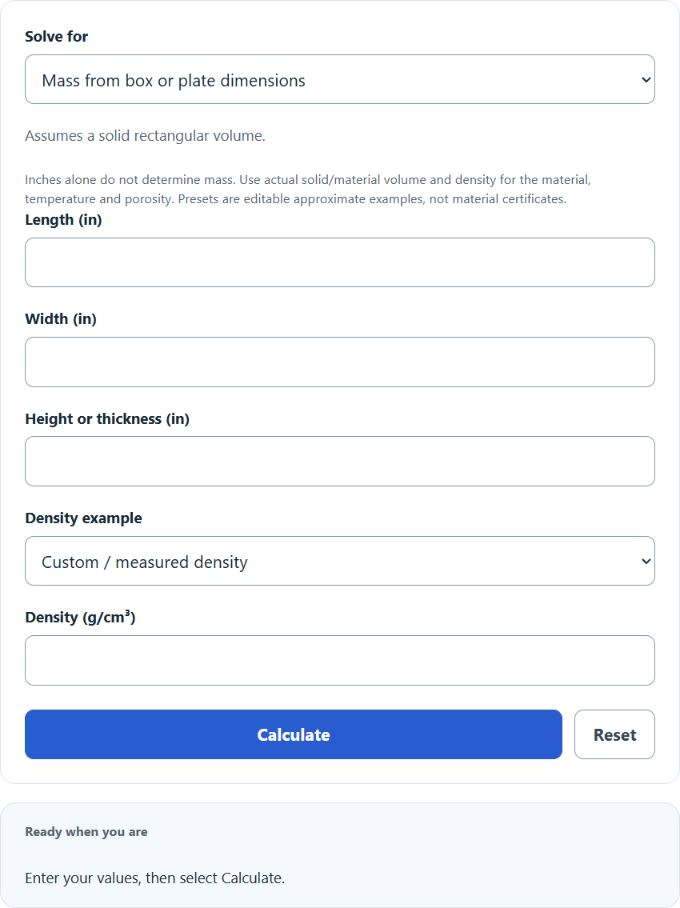
Calculate grams from cubic inches or inch-based box, cylinder, and sphere dimensions using material density, or convert grams back to volume.
- All Unit Converters
- Grams to Inches Calculator
- Inches to Quarts Calculator
- Grams to Volume Calculator
- Dimension to Weight Calculator
- Specific Gravity to Density Calculator
Inches to Grams Formula
Converting a measurement in inches to a weight in grams requires knowing the volume of the object and the density of its material. The core formula is:
Variables:
- W is mass in grams (g), often called weight in everyday usage
- V is the volume in cubic inches (in³)
- D is the density of the material in grams per cubic inch (g/in³)
Inches alone measure only one dimension of length, so they cannot be converted directly to grams (a unit of mass). The conversion becomes possible once you define a three-dimensional volume and pair it with the material’s density. For example, a 2 in x 3 in x 4 in block of aluminum has a volume of 24 in³. Aluminum’s density is approximately 44.25 g/in³, which gives a weight of 24 x 44.25 = 1,062 grams (about 2.34 pounds).
This relationship requires consistent volume and density units. The calculator converts volume to cm³ before applying density in g/cm³. It retains seven editable density examples; these do not establish the density of every alloy or manufactured product.
Material Density Reference Table (g/in³)
The table retains illustrative density inputs in g/cm³ and recomputes their g/in³ equivalents using 16.387064. These rounded assumptions are not certified material data or universal values at a fixed temperature. Use measured or supplier data for the exact material and conditions.
| Material | Density (g/in³) | Density (g/cm³) | Common Uses |
|---|---|---|---|
| Metals & Alloys | |||
| Aluminum (6061-T6) | 44.25 | 2.70 | Aerospace, CNC parts, heat sinks |
| Mild Steel (A36) | 128.64 | 7.85 | Structural beams, brackets, frames |
| Stainless Steel (304) | 131.10 | 8.00 | Kitchen equipment, medical devices |
| Stainless Steel (316) | 131.10 | 8.00 | Marine hardware, chemical processing |
| Tool Steel (D2) | 127.98 | 7.81 | Dies, punches, cutting tools |
| Copper (C110) | 146.83 | 8.96 | Electrical conductors, busbars |
| Brass (C360) | 139.29 | 8.50 | Fittings, musical instruments |
| Bronze (C932) | 144.21 | 8.80 | Bearings, bushings, marine hardware |
| Titanium (Grade 5, Ti-6Al-4V) | 72.59 | 4.43 | Aerospace fasteners, implants |
| Lead | 185.83 | 11.34 | Radiation shielding, ballast |
| Zinc | 116.84 | 7.13 | Die casting, galvanizing |
| Nickel 200 | 145.84 | 8.90 | Corrosion-resistant components |
| Magnesium (AZ31B) | 29.01 | 1.77 | Lightweight aerospace, electronics housings |
| Tungsten | 316.27 | 19.30 | Counterweights, radiation shielding |
| Gold (24K) | 316.60 | 19.32 | Jewelry, electronics contacts |
| Silver (Sterling .925) | 169.11 | 10.32 | Jewelry, silverware, electronics |
| Platinum | 351.50 | 21.45 | Jewelry, catalytic converters, lab equipment |
| Plastics & Polymers | |||
| PLA (3D printing) | 20.32 | 1.24 | 3D printed prototypes, packaging |
| ABS (3D printing) | 17.21 | 1.05 | 3D printed parts, automotive trim |
| PETG | 21.14 | 1.29 | 3D printing, food containers |
| Nylon (PA6) | 18.52 | 1.13 | Gears, bushings, 3D printing |
| PVC (rigid) | 22.61 | 1.38 | Pipe, conduit, window frames |
| HDPE | 15.57 | 0.95 | Bottles, cutting boards, playground equipment |
| Polycarbonate | 19.66 | 1.20 | Safety glasses, phone cases |
| Acrylic (PMMA) | 19.34 | 1.18 | Display cases, light pipes |
| PTFE (Teflon) | 35.56 | 2.17 | Bearings, seals, non-stick surfaces |
| Wood & Natural Materials | |||
| Balsa | 2.62 | 0.16 | Model building, lightweight cores |
| Pine (Southern Yellow) | 9.01 | 0.55 | Construction framing, pallets |
| Oak (Red) | 11.14 | 0.68 | Furniture, flooring, cabinetry |
| Maple (Hard) | 11.47 | 0.70 | Butcher blocks, musical instruments |
| Walnut (Black) | 9.83 | 0.60 | Gunstocks, high-end furniture |
| Ebony | 17.21 | 1.05 | Musical instrument parts, inlays |
| Ceramics, Stone & Composites | |||
| Concrete (standard) | 39.33 | 2.40 | Foundations, countertops |
| Glass (soda-lime) | 40.97 | 2.50 | Windows, bottles, tableware |
| Granite | 43.10 | 2.63 | Countertops, monuments |
| Marble | 44.57 | 2.72 | Countertops, sculpture, flooring |
| Carbon Fiber Composite | 25.89 | 1.58 | Aerospace, racing, sporting goods |
| Fiberglass (E-glass) | 29.33 | 1.79 | Boat hulls, automotive panels |
| Liquids & Other | |||
| Water (assumed 1.00 g/cm³) | 16.39 | 1.00 | Baseline reference density |
| Gasoline | 12.13 | 0.74 | Fuel tank volume calculations |
| Diesel Fuel | 13.93 | 0.85 | Fuel weight estimation |
| Motor Oil (SAE 30) | 14.75 | 0.90 | Engine sump capacity |
| Honey | 23.27 | 1.42 | Food production, packaging |
| Mercury | 221.72 | 13.53 | Scientific instruments (historical) |
| Conversion factor: 1 g/cm³ = 16.387064 g/in³. Values rounded to 2 decimal places. Actual density varies with alloy grade, temperature, and manufacturing process. | |||
What is Inches to Grams?
“Inches to grams” refers to the process of determining the mass (in grams) of an object whose dimensions are measured in inches. Because inches measure length and grams measure mass, the conversion is indirect. You must first compute the object’s volume from its inch-based dimensions, then multiply that volume by the material’s density. This makes the conversion material-dependent: a 1-cubic-inch piece of aluminum weighs about 44 grams, while a 1-cubic-inch piece of steel weighs roughly 129 grams.
One cubic inch equals exactly 16.387064 cm³ or mL. At the explicitly assumed density of 1.00 g/mL, its mass is 16.387064 g; actual water density depends on temperature and pressure. For an illustrative steel density of 7.85 g/cm³, one cubic inch has mass about 128.64 g. Density has units; specific gravity is a dimensionless ratio to a stated reference.
Why Volume-to-Weight Conversion Matters
Knowing how much a part weighs before it is manufactured, shipped, or installed is critical in dozens of industries. Structural engineers calculate steel beam weights to design foundations. CNC machinists estimate raw material costs by converting billet dimensions to weight (metal is priced per pound or per kilogram). Shipping departments need package weights to select freight carriers and estimate costs. Jewelers convert the cubic-inch displacement of a wax casting model to the weight of the finished gold or silver piece, directly determining its material cost.
For 3D printing, multiply actual extruded-material volume by the applicable filament density. A bounding-box volume and nominal infill percentage alone do not include the model shape, shells, top/bottom layers or supports. Use the slicer’s material estimate for practical print planning.
Industry Applications
Manufacturing and CNC Machining
Machine shops typically receive material in standard bar, plate, or rod stock measured in inches. A shop cutting a 3-inch-diameter, 12-inch-long aluminum bar needs to know its weight to estimate shipping costs and raw material expense. Volume of the cylinder = pi x (1.5)² x 12 = 84.82 in³. At 44.25 g/in³, the bar weighs 3,753 grams (about 8.27 lb). Knowing this upfront prevents over-ordering and helps with fixture design, since the workholding must support the stock weight plus cutting forces.
Jewelry and Precious Metals
For an illustrative casting volume of 0.12 in³ and assumed alloy density of 216 g/in³, mass is 25.92 g. If a hypothetical material price is $65/g, its arithmetic material cost is $1,684.80; this is not a current market quote. At an assumed sterling-silver density of 169.10 g/in³, the same volume gives about 20.29 g. Actual alloy, losses and finished shape require their own data.
3D Printing and Prototyping
A solid 4 in × 4 in × 2 in material volume is 32 in³. At an illustrative PLA density of 20.33 g/in³, mass is about 650.6 g. An actual material volume of 6.4 in³ would give about 130.1 g at that density. Nominal 20% infill of a bounding box is not proof of that actual material volume; shells and supports require separate accounting.
Shipping and Freight
Carrier billing may use actual or dimensional weight under service-specific rules. Dimensional weight is not physical material mass: it uses package volume and a carrier-defined divisor. Check the selected carrier and service rather than assuming one universal domestic or international factor.
Food Science and Production
Food ingredients can have different masses for the same volume because density and packing vary. A US customary cup is 14.4375 in³; other cup definitions differ. Use measured mass or a density appropriate to the ingredient, moisture and packing, rather than treating a generic flour or sugar density as exact.
Volume Formulas for Common Shapes (in Cubic Inches)
To use the W = V x D formula, you first need the object’s volume. Below are the standard volume formulas for shapes commonly encountered in engineering and manufacturing, with all dimensions assumed to be in inches so the result is in cubic inches (in³).
| Shape | Formula | Variables |
|---|---|---|
| Rectangular Block | V = L x W x H | L = length, W = width, H = height |
| Cylinder | V = pi x r² x L | r = radius, L = length |
| Sphere | V = (4/3) x pi x r³ | r = radius |
| Hollow Cylinder (Pipe) | V = pi x (R² – r²) x L | R = outer radius, r = inner radius, L = length |
| Cone | V = (1/3) x pi x r² x h | r = base radius, h = height |
| Hemisphere | V = (2/3) x pi x r³ | r = radius |
| Triangular Prism | V = (1/2) x b x h x L | b = base, h = triangle height, L = length |
| Hexagonal Bar | V = (3 x sqrt(3) / 2) x s² x L | s = side length, L = length |
Common Conversion Mistakes
Linear inches alone cannot determine grams. Supply sufficient shape dimensions or a known volume, then apply density. A box uses three dimensions; a solid sphere needs only its diameter. Hollow, porous and composite objects require their actual material volume or a suitable bulk density.
A second common mistake is using the wrong density units. If a reference lists steel density as 7.85 g/cm³ and you multiply by a volume in cubic inches, your answer will be wrong by a factor of 16.387 (the number of cubic centimeters in one cubic inch). Always confirm that your density and volume use matching unit systems, or use the pre-converted g/in³ values from the table above.
Third, users sometimes confuse nominal dimensions with actual dimensions. Lumber sold as “2×4” actually measures 1.5 in x 3.5 in. Pipe described as “1-inch” refers to the nominal bore, not the outer diameter. Always use measured or actual dimensions rather than trade names when calculating volume for weight estimation.
Quick Reference: Cubic Inches to Grams for Common Materials
| Material | 1 in³ | 5 in³ | 10 in³ | 50 in³ |
|---|---|---|---|---|
| Water | 16.4 g | 81.9 g | 163.9 g | 819.4 g |
| Aluminum | 44.2 g | 221.2 g | 442.5 g | 2,212.3 g |
| Steel | 128.6 g | 643.2 g | 1,286.4 g | 6,431.9 g |
| Copper | 146.8 g | 734.1 g | 1,468.3 g | 7,341.4 g |
| Titanium | 72.6 g | 363.0 g | 725.9 g | 3,629.7 g |
| Brass | 139.3 g | 696.5 g | 1,392.9 g | 6,964.5 g |
| PLA Plastic | 20.3 g | 101.6 g | 203.2 g | 1,016.0 g |
| Oak Wood | 11.1 g | 55.7 g | 111.4 g | 557.2 g |
| Concrete | 39.3 g | 196.6 g | 393.3 g | 1,966.4 g |
| Glass | 41.0 g | 204.8 g | 409.7 g | 2,048.4 g |
| Values rounded to 1 decimal place. Uses the illustrative densities in the main table (aluminum 2.70, steel 7.85 and brass 8.50 g/cm³). Actual material density may differ. | ||||
| Cubic Inches (in³) | Grams (g) |
|---|---|
| ⅛ | 2.048 |
| ¼ | 4.097 |
| ½ | 8.194 |
| 1 | 16.387 |
| 2 | 32.774 |
| 3 | 49.161 |
| 4 | 65.548 |
| 5 | 81.935 |
| 6 | 98.322 |
| 8 | 131.097 |
| 10 | 163.871 |
| 12 | 196.645 |
| 16 | 262.193 |
| 20 | 327.741 |
| 24 | 393.290 |
| 32 | 524.386 |
| 40 | 655.483 |
| 48 | 786.579 |
| 64 | 1048.772 |
| 128 | 2097.544 |
| * Rounded to 3 decimals. Assumes water (ρ = 1.00 g/mL). 1 in³ ≈ 16.387 g. | |