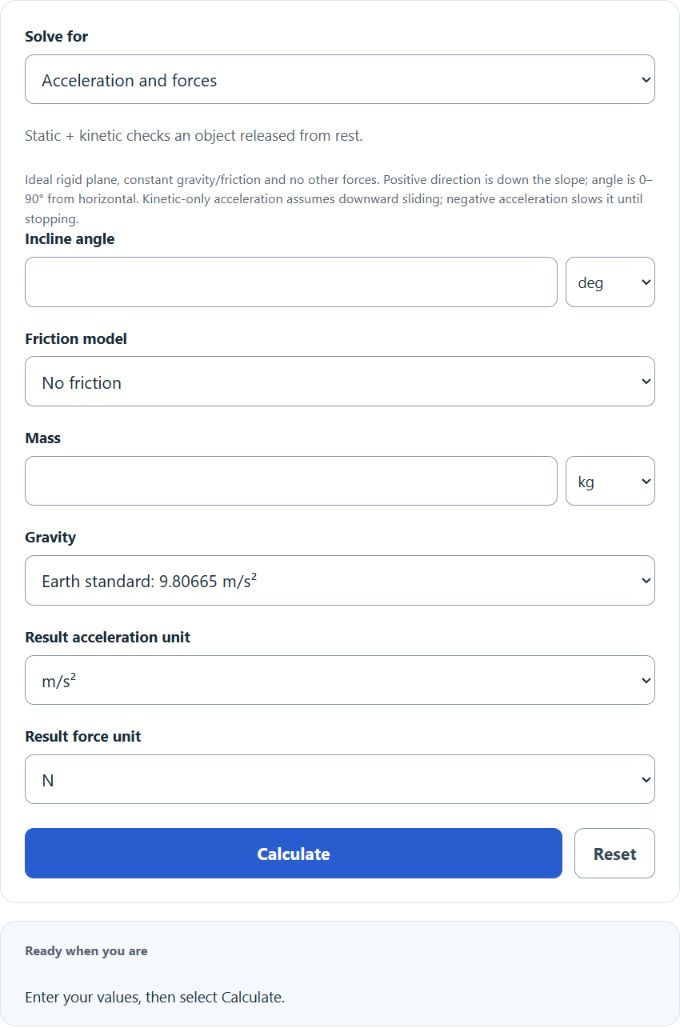
Calculate acceleration, normal force, friction, net force, time, and final speed for objects on an inclined plane with friction and gravity.
- All Physics Calculators
- All Acceleration Calculators
- Coefficient of Friction to Acceleration Calculator
- Inclined Plane Force Calculator
- Uphill Force Calculator
Inclined Plane Acceleration Formula
The following equation gives acceleration while sliding down an ideal plane with kinetic friction. Mass cancels from the acceleration; it still affects the forces.
Formula source: University Physics Volume 1, §6.2 “Friction” (OpenStax, Sep 19, 2016)
- Where A is the Inclined Plane Acceleration (m/s^2)
- m is the mass (kg)
- a is the angle (degrees)
- CF is the dimensionless coefficient of kinetic friction
What are the units for Inclined Plane Acceleration?
The most common units for Inclined Plane Acceleration are m/s^2.
How to Calculate Inclined Plane Acceleration?
Example Problem:
The following example problem outlines the steps and information required to calculate the Inclined Plane Acceleration.
First, determine the mass. In this example, the mass is measured to be 50 (kg).
Next, determine the angle. For this problem, the angle is calculated to be 45 (degrees).
Next, determine the coefficient of friction. In this case, the coefficient of friction is found to be .75 (none).
Finally, calculate the Inclined Plane Acceleration using the formula above:
A = (m*g*sin(a) - m*g*cos(a)*CF) / m
Inserting the values from above and solving the equation gives us:
A = (50*9.80665*sin(45deg) - 50*9.80665*cos(45deg)*.75) / 50 ≈ 1.733587 (m/s^2)
FAQ
What factors affect the Inclined Plane Acceleration?
In the ideal model, acceleration depends on gravity, incline angle and the kinetic friction coefficient. Mass cancels from a = g(sin θ − μk cos θ), although normal, friction and net forces scale with mass. Static friction can hold an object at rest.
How does the angle of incline impact the acceleration?
The angle of the incline plays a crucial role in determining the acceleration. A steeper angle increases the component of gravitational force acting down the slope, thus increasing the acceleration, assuming all other factors remain constant. Conversely, a shallower angle reduces this component, leading to a decrease in acceleration.
Can the Inclined Plane Acceleration be negative?
Inclined Plane Acceleration can be negative if the force of friction opposing the motion down the slope is greater than the component of gravitational force driving the motion. This scenario typically occurs when the coefficient of friction is high and/or the angle of incline is shallow. With downhill taken as positive, negative acceleration slows an object already sliding downhill until it stops. It does not mean an object released from rest starts sliding uphill; static friction must be checked at rest.