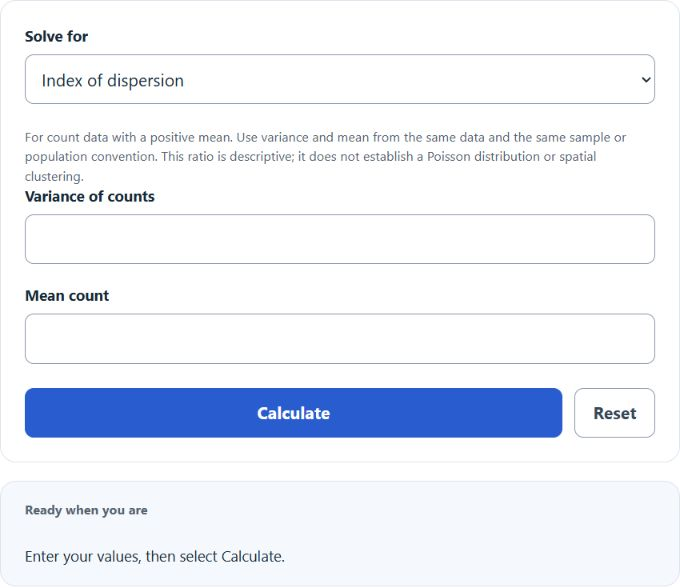
Choose index of dispersion, variance, or mean, then enter the other two values from the same count data set. The mean must be positive.
Related Calculators
- Frequency Density Calculator
- Coefficient of Skewness Calculator
- MSB Calculator
- Weighted Mean Calculator
- All Statistics Calculators
Index of Dispersion Formula
The index of dispersion compares the variance of a data set to its mean. It is commonly used with count data to judge whether values are evenly spread, random, or clustered.
Rearranged formulas:
- D = index of dispersion
- σ² = variance of counts, not a sum of squared deviations
- μ = mean of the data
Select the value to solve and enter the other two known values. Use mean and variance from the same data set and sampling convention.
- If you enter total variance and mean, it calculates the index of dispersion.
- If you enter mean and index of dispersion, it calculates total variance.
- If you enter total variance and index of dispersion, it calculates the mean.
Interpreting the Index of Dispersion
| Index of dispersion | Pattern | Meaning |
|---|---|---|
| D < 1 | Underdispersed | The data is more evenly spread than a random Poisson pattern. |
| D = 1 | Poisson benchmark | The variance equals the mean, as expected in a Poisson distribution; this ratio alone does not prove that distribution. |
| D > 1 | Overdispersed | The data is more clustered or variable than a Poisson pattern. |
Example Problems
Example 1: Calculate the index of dispersion
You have a data set with a mean of 8 and a total variance of 20.
The index of dispersion is 2.5. Since it is greater than 1, the data is overdispersed.
Example 2: Calculate total variance
You have a mean of 12 and an index of dispersion of 0.75.
The total variance is 9.
FAQ
What does an index of dispersion greater than 1 mean?
An index of dispersion greater than 1 means the variance is larger than the mean. This usually shows overdispersion. In practical terms, the values are more spread out or more clustered than expected under a random Poisson pattern.
Can the index of dispersion be zero?
Yes, but only when the variance is zero and the mean is not zero. That means all values are the same, so there is no spread in the data. The calculator does not allow division by zero when solving for the mean or index.
Is the index of dispersion the same as variance?
No. Variance measures spread in the original data. The index of dispersion is a ratio of variance to mean. For count data it is a numerical ratio used to compare dispersion relative to the mean. For measurements with physical units, variance divided by mean retains the measurement unit and depends on the scale used.