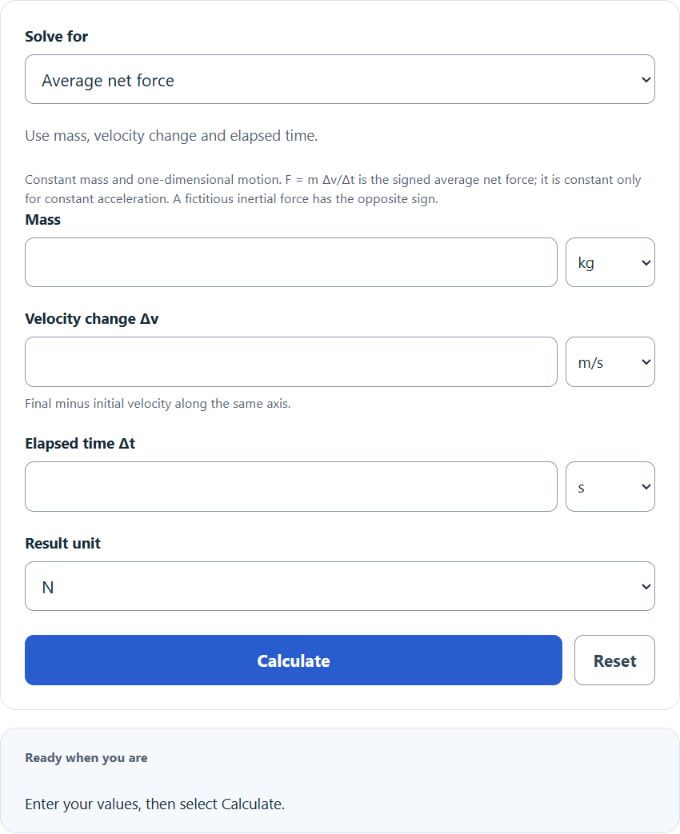
Calculate inertia force, mass, change in velocity, or time using F = m × (Δv/Δt) with kg, g, lb, m/s, km/h, mph, ft/s, s, min, or h inputs.
Inertia Force Formula
For constant mass, this calculator uses Newton’s second law to find the signed average net force from average acceleration, Δv/Δt. It is constant force only when acceleration is constant. The fictitious inertial force in an accelerating frame has the opposite sign.
Choose a solve mode to use the corresponding rearranged formula:
- F = signed average net force, usually in newtons (N)
- m = inertial mass, usually in kilograms (kg)
- Delta v = change in velocity, usually in meters per second (m/s)
- Delta t = change in time, usually in seconds (s)
- Delta v / Delta t = acceleration, in meters per second squared (m/s²)
Choose force, mass, velocity change or elapsed time, then enter the other three values. Mass and elapsed time must be positive; velocity change and force are signed along the same axis. Zero denominators and sign combinations that imply nonpositive mass or time are rejected. Units are converted consistently before evaluating the relation.
Common Unit Conversions for Inertia Force Calculations
| Quantity | Unit | Conversion to base unit | Base unit |
|---|---|---|---|
| Mass | 1 g | 0.001 kg | kg |
| Mass | 1 lb | 0.453592 kg | kg |
| Velocity | 1 km/h | 0.277778 m/s | m/s |
| Velocity | 1 mph | 0.44704 m/s | m/s |
| Velocity | 1 ft/s | 0.3048 m/s | m/s |
| Force | 1 kN | 1000 N | N |
| Force | 1 lbf | 4.44822 N | N |
How Change in Time Affects Inertia Force
| Same mass and velocity change | Change in time | Effect on force |
|---|---|---|
| Object stops or speeds up slowly | Larger Delta t | Lower inertia force |
| Object stops or speeds up quickly | Smaller Delta t | Higher inertia force |
| Instantaneous ideal stop | Approaches 0 | Force becomes extremely large in the ideal model |
Example Inertia Force Calculations
Example 1: Calculate inertia force
You have a 20 kg object with a velocity change of 6 m/s over 3 seconds.
The inertia force is 40 N.
Example 2: Calculate change in time
An object has a mass of 10 kg, an inertia force of 50 N, and a velocity change of 20 m/s.
The change in time is 4 seconds.
FAQ
Is inertia force the same as mass times acceleration?
In this calculator, the result is the signed average net force for constant mass: F = m * (Delta v / Delta t). A fictitious inertial force has the opposite sign.
Why does a shorter stopping time create a larger force?
For the same mass and the same change in velocity, reducing the time increases acceleration. Since force equals mass times acceleration, a larger acceleration produces a larger inertia force.
Can change in time be zero?
No. The formula divides by change in time, so a time value of zero is not valid. In real situations, velocity changes over some amount of time, even if that time is very small.