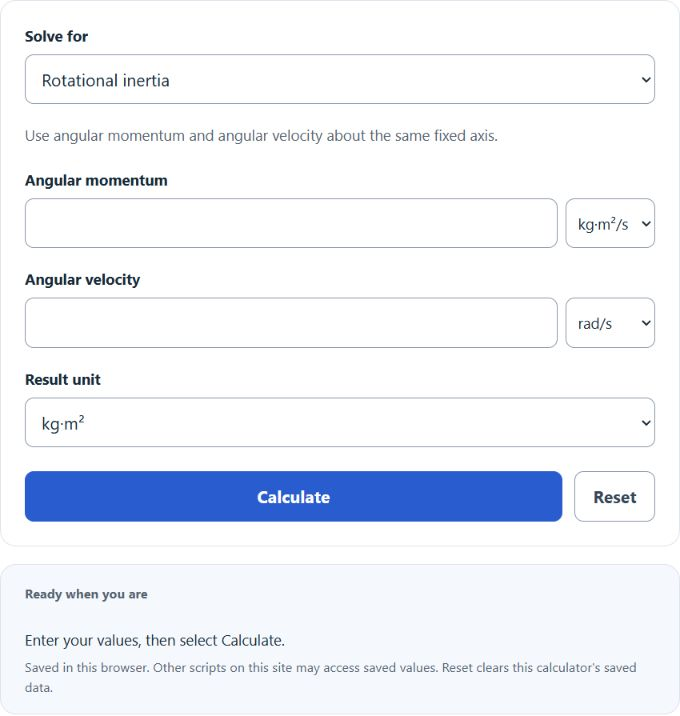
Calculate rotational inertia, angular momentum, or angular velocity by selecting a solve mode and supplying its two required values in kg·m²/s, rad/s, rpm, or lb·ft² units.
Related Calculators
- Radius of Gyration Calculator
- Acceleration To Torque Calculator
- BLDC Speed Calculator
- Water Wheel Power Calculator
- All Physics Calculators
Rotational Inertia Formula
The calculator uses the fixed-axis relationship between axial angular momentum, moment of inertia about that axis, and angular velocity. It is not a general three-dimensional inertia-tensor calculation.
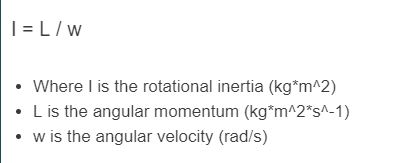
- L = angular momentum
- I = rotational inertia, also called moment of inertia
- ω = angular velocity
If you enter angular momentum and angular velocity, the calculator solves for rotational inertia using I = L / ω.
If you enter rotational inertia and angular velocity, it solves for angular momentum using L = Iω.
If you enter angular momentum and rotational inertia, it solves for angular velocity using ω = L / I.
The calculator converts values to base units before calculating. The base units are kg·m²/s for angular momentum, rad/s for angular velocity, and kg·m² for rotational inertia.
Unit Conversions Used for Rotational Inertia Calculations
| Quantity | Conversion | Base Unit |
|---|---|---|
| Angular momentum | 1 lb·ft²/s ≈ 0.0421401 kg·m²/s (pound mass) | kg·m²/s |
| Angular velocity | 1 rpm = 2π / 60 rad/s | rad/s |
| Rotational inertia | 1 lb·ft² ≈ 0.0421401 kg·m² (pound mass) | kg·m² |
Common Moment of Inertia Formulas
| Object | Axis | Rotational Inertia |
|---|---|---|
| Point mass | Distance r from axis | I = mr² |
| Thin hoop or ring | Center axis | I = mr² |
| Solid disk or cylinder | Center axis | I = 1/2 mr² |
| Solid sphere | Diameter | I = 2/5 mr² |
| Thin rod | Through center, perpendicular to length | I = 1/12 mL² |
Example Calculations
Example 1: Find rotational inertia
You have an angular momentum of 24 kg·m²/s and an angular velocity of 6 rad/s.
The rotational inertia is 4 kg·m².
Example 2: Find angular momentum
You have a rotational inertia of 3.5 kg·m² and an angular velocity of 10 rad/s.
The angular momentum is 35 kg·m²/s.
FAQ
What is rotational inertia?
Rotational inertia is a measure of how hard it is to change an object's rotation. A larger rotational inertia means the object resists changes in angular velocity more strongly. It depends on mass and how far that mass is from the axis of rotation.
Is rotational inertia the same as moment of inertia?
Yes. In most physics problems, rotational inertia and moment of inertia mean the same quantity. Both are represented by I and are commonly measured in kg·m².
Why does angular velocity need to be in rad/s?
The standard formula L = Iω uses angular velocity in radians per second. If you enter rpm, it must be converted to rad/s before the calculation. The conversion is 1 rpm = 2π/60 rad/s.