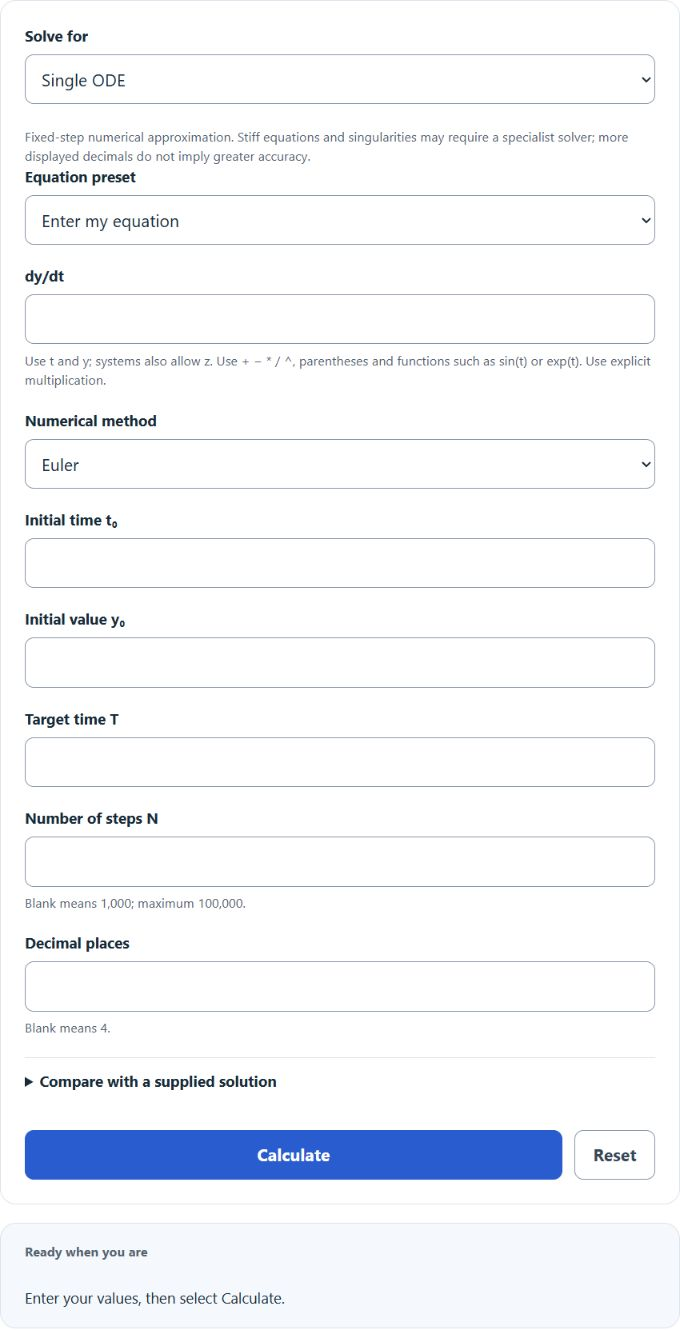
Calculate initial value problem solutions y(T) or y(T) and z(T) from ODEs, initial values, target time, step count, and numerical method.
Related Calculators
- Generalized Power Rule Calculator
- Log Growth Rate Calculator
- Related Rate Calculator
- Decay Factor Calculator
- All Math and Numbers Calculators
Initial Value Problem Formula
The following equation is used to approximate the solution using Euler’s method.
- Where y(T) is the approximated solution at the target time T
- y₀ is the initial value at time t₀
- t₀ is the initial time
- T is the target time
- f(t, y) represents the differential equation
- h is the step size, computed as h = (T – t₀) / N with N being the number of steps
To approximate the solution, apply Euler’s method iteratively from the initial time to the target time.
What is an Initial Value Problem?
Definition:
An initial value problem is a differential equation paired with a specified initial condition that sets the starting value for the function. A unique solution exists locally under suitable continuity and regularity conditions on the differential equation; an initial condition alone does not guarantee existence or uniqueness.
How to Solve an Initial Value Problem?
Example Problem:
The following example outlines the steps needed to approximate the solution of an initial value problem using Euler’s method.
First, specify the differential equation. In this example, the equation is dy/dt = t*y.
Next, set the initial conditions by choosing an initial time t₀ and an initial value y₀, for instance, t₀ = 0 and y₀ = 1.
Then, define the target time T at which you want to approximate the solution, such as T = 2.
Finally, apply Euler’s method iteratively using the formula above to compute an approximation for y(T).
FAQ
What numerical method does this calculator use?
The calculator offers Euler, improved Euler (Heun), and fourth-order Runge–Kutta (RK4) for a single ODE or a two-variable system. It returns a fixed-step numerical approximation.
How does the choice of step size affect the accuracy of the solution?
A smaller step size, achieved by increasing the number of steps, generally leads to a more accurate approximation, although it may require more computation.
Are there limitations to using Euler’s method for solving differential equations?
Yes, Euler’s method may not be sufficiently accurate for stiff or highly nonlinear differential equations, where more advanced numerical methods are recommended.