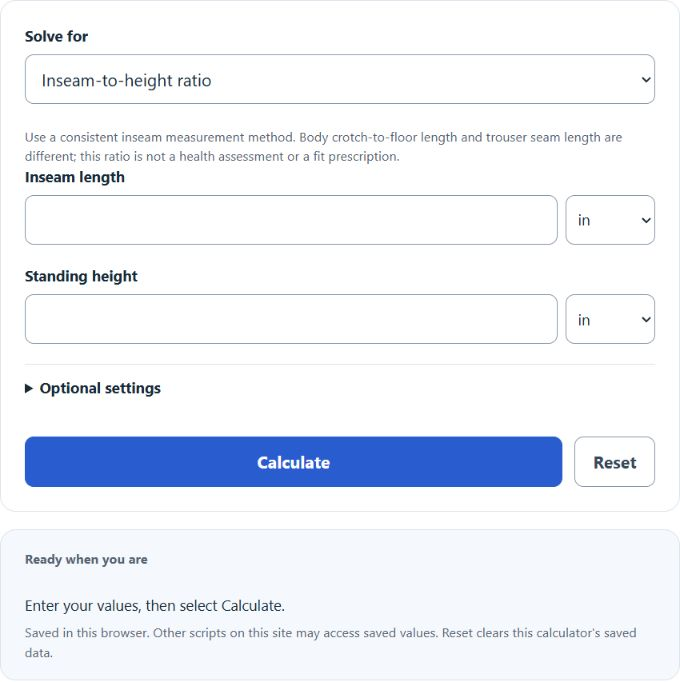
Calculate your inseam-to-height ratio and percentage in metric or imperial units, reverse-solve either measurement, and see how measurement variation affects the result.
Related Calculators
- Height to Neck Length Calculator
- Short Or Long Torso Calculator
- Suit Size Calculator
- Glasses Frame Size Calculator
- All Everyday Life and Education Calculators
Inseam to Height Ratio Formula
The inseam to height ratio compares your inseam length to your total height. Both measurements must use the same unit before dividing.
- R = inseam to height ratio
- I = inseam length
- H = total height
If the measurements use different units, convert them first:
- I_converted = inseam converted to the same unit as height
- H_converted = height converted to the same unit as inseam
The result is unitless. A ratio of 0.45 means your inseam is 45% of your height.
Useful Tables
Use these tables to check common conversions and interpret example ratios arithmetically. These examples are not population norms or health categories.
| Unit | To inches | Example |
|---|---|---|
| Inches | multiply by 1 | 32 in = 32 in |
| Feet | multiply by 12 | 5.5 ft = 66 in |
| Centimeters | multiply by 0.393701 | 80 cm = 31.50 in |
| Meters | multiply by 39.3701 | 1.75 m = 68.90 in |
| Yards | multiply by 36 | 2 yd = 72 in |
| Ratio | Inseam as percent of height | Arithmetic meaning |
|---|---|---|
| 0.42 | 42% | 42 units of inseam per 100 units of height |
| 0.44 | 44% | 44 units of inseam per 100 units of height |
| 0.46 | 46% | 46 units of inseam per 100 units of height |
| 0.48+ | 48%+ | At least 48 units of inseam per 100 units of height |
Example
If your inseam is 32 inches and your height is 70 inches, divide 32 by 70.
Your inseam to height ratio is 0.4571, or about 45.71%.
Choose and record a consistent measurement method: a body inseam measured from crotch to floor is different from a trouser seam measured to its hem. Measure standing height without mixing footwear conventions. The optional variation bound applies independently to both lengths and gives worst-case ratios, not a confidence interval; every allowed combination must keep inseam positive and shorter than height. Exact unit conversions use NIST’s international inch definition.