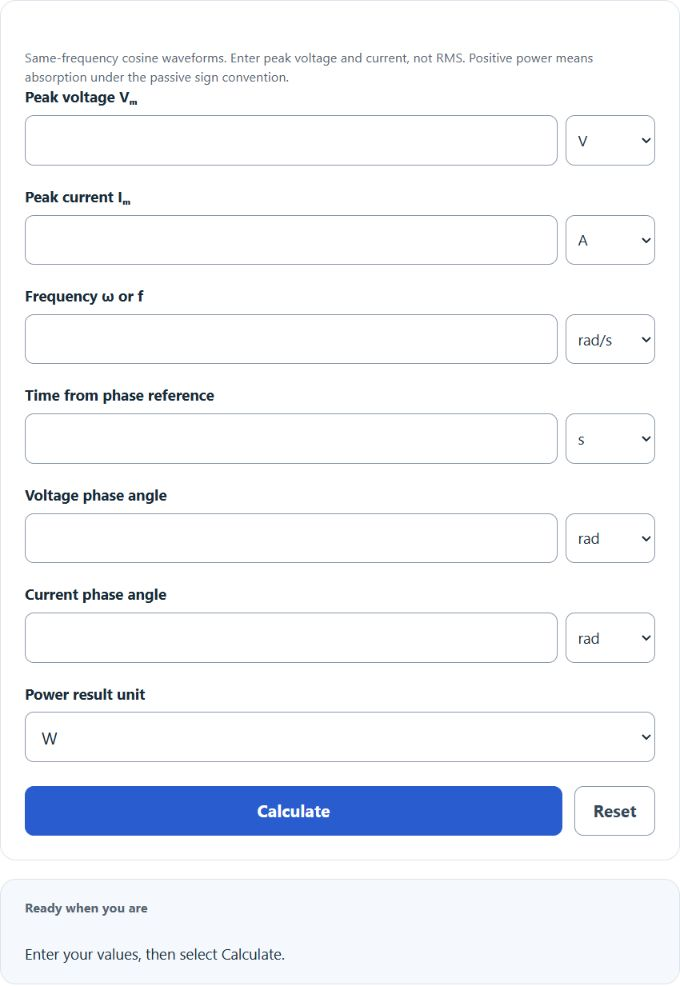
Calculate instantaneous power for sinusoidal waveforms from maximum voltage, current, angular frequency, time, and phase angles in W, kW, or MW.
- All Physics Calculators
- All Electrical Calculators
- Instantaneous Current Calculator
- Instantaneous Voltage Calculator
- Average Power Calculator
Instantaneous Power Formula
The calculator uses the sinusoidal instantaneous power formula. It multiplies the voltage at a specific time by the current at the same time.
- p(t) is instantaneous power at time t, in watts (W).
- Vm is maximum voltage, in volts (V).
- Im is maximum current, in amps (A).
- omega is angular frequency, in radians per second (rad/s).
- f is frequency, in hertz (Hz).
- t is time, in seconds (s).
- av is the voltage phase angle, in radians.
- ai is the current phase angle, in radians.
If you enter frequency in hertz, it is converted to angular frequency using omega = 2*pi*f. If you enter phase angles in degrees, they are converted to radians before the cosine terms are evaluated. Voltage is converted to volts, current is converted to amps, and time is converted to seconds before the formula is applied.
Instantaneous Power Input Conversions and Result Meaning
| Input type | Accepted units | Base unit used in formula |
|---|---|---|
| Maximum voltage | V, kV, mV | Volts (V) |
| Maximum current | A, kA, mA | Amps (A) |
| Angular frequency | rad/s, Hz | rad/s |
| Time | s, min, h | Seconds (s) |
| Phase angle | Radians, degrees | Radians (rad) |
| Power result | Meaning |
|---|---|
| Positive power | Energy is being delivered to the load at that instant. |
| Zero power | Voltage or current is zero at that instant, or their product is zero. |
| Negative power | Energy is flowing back toward the source at that instant. |
Example Calculations
Example 1: Voltage and current in phase
Suppose the maximum voltage is 120 V, maximum current is 5 A, angular frequency is 100 rad/s, time is 0.01 s, and both phase angles are 0 rad.
The instantaneous power is about 175.16 W.
Example 2: Frequency in hertz and phase angles in degrees
Suppose the maximum voltage is 2 kV, maximum current is 50 mA, frequency is 60 Hz, time is 0.001 s, voltage phase is 30°, and current phase is -15°.
The instantaneous power is about 61.7 W.
FAQ
Is instantaneous power the same as average power?
No. Instantaneous power is the power at one specific moment in time. Average power is calculated over a full cycle or over a chosen time interval. In AC circuits, instantaneous power changes continuously as voltage and current change.
Should I enter RMS voltage and current or maximum voltage and current?
This calculator expects maximum voltage and maximum current. If you only have RMS values for a sine wave, convert them before entering them:
Why can instantaneous power be negative?
Instantaneous power can be negative when the signs of voltage and current are opposite at that moment. Under the passive sign convention, this means energy is returning from the load or reactive element back toward the source instead of being absorbed by the load.