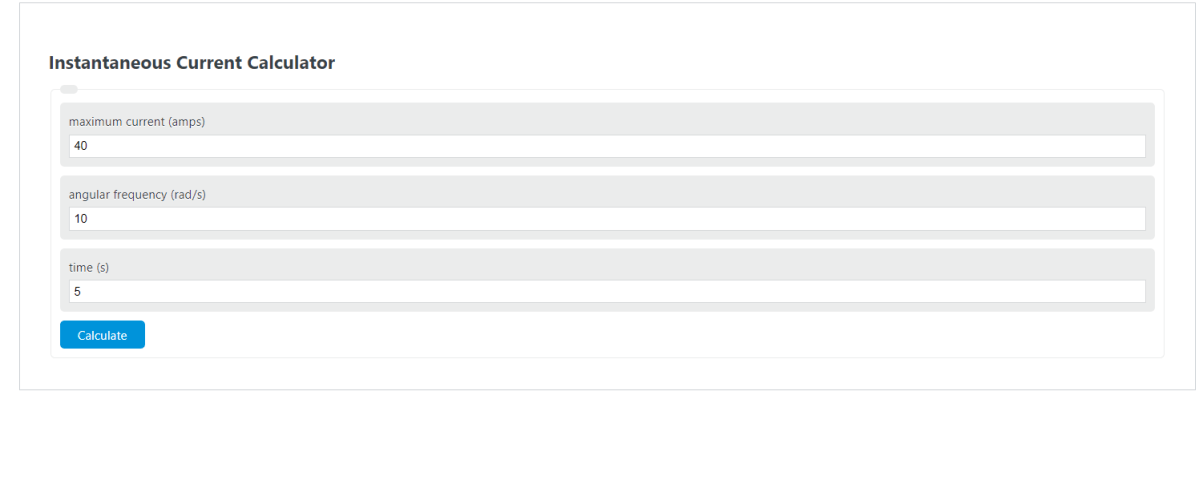
Calculate instantaneous current from maximum current, angular frequency, and time, or find the missing value using I = Imax sin(ωt).
- All Physics Calculators
- All Electrical Calculators
- Instantaneous Voltage Calculator
- Capacitor Charge Current Calculator
- Sequence Current Calculator
- Instantaneous Power Calculator
Instantaneous Current Formula
Instantaneous current is the value of an alternating current at one exact moment in time. For a sinusoidal waveform with no phase shift, the current moves continuously between a positive peak and a negative peak as the cycle progresses.
Where:
- I(t) = instantaneous current at time t, in amperes
- Im = maximum or peak current, in amperes
- ω = angular frequency, in radians per second
- t = time, in seconds
If you know frequency in hertz instead of angular frequency, convert it first.
This gives an equivalent form of the same relationship:
How to Calculate Instantaneous Current
- Identify the peak current of the waveform.
- Use angular frequency directly, or convert frequency from hertz to radians per second.
- Multiply angular frequency by time to get the electrical angle.
- Take the sine of that angle and multiply by the peak current.
The sine function uses radians. If the result is negative, that means the current is flowing opposite the chosen reference direction at that instant.
Examples
Example 1: A waveform has a peak current of 40 A, an angular frequency of 10 rad/s, and a time of 5 s.
The instantaneous current at that moment is approximately -10.49 A.
Example 2: A waveform has a peak current of 15 A, a frequency of 50 Hz, and a time of 0.005 s.
At one-quarter of a cycle, a zero-phase sine wave reaches its positive peak, so the instantaneous current equals the maximum current.
Cycle Behavior
The waveform repeats every cycle period:
- At the start of the cycle, the current is zero for the zero-phase sine form.
- At one-quarter of a cycle, the current reaches its positive peak.
- At half of a cycle, the current returns to zero.
- At three-quarters of a cycle, the current reaches its negative peak.
- After one full cycle, the pattern repeats.
Peak Current vs. RMS Current
This formula requires peak current, not RMS current. Many AC meters display RMS values, so converting first is often necessary.
For example, a 10 A RMS sinusoidal current corresponds to a peak current of about 14.14 A.
Phase Shift Note
If the current waveform is shifted in time relative to the reference, the more general sinusoidal model includes a phase angle:
The basic instantaneous current calculator typically uses the zero-phase version unless a phase term is specifically included in your analysis.
Common Mistakes
| Issue | What to Check |
|---|---|
| Unexpected negative value | A negative answer is normal in AC analysis and only indicates direction relative to the reference. |
| Wrong magnitude | Make sure you entered peak current rather than RMS current. |
| Frequency mismatch | Confirm whether your input is in hertz or radians per second before calculating. |
| Incorrect trigonometric result | Use radians for the electrical angle when applying the sine function. |
| Multiple answers when solving backward | Because sine is periodic, solving for time or frequency from a current value can produce more than one valid solution. |
Why Instantaneous Current Matters
Instantaneous current is useful when analyzing AC circuits, waveform timing, switching events, power behavior, and the exact current present at a specific point in the cycle. It is especially helpful when comparing current and voltage waveforms, checking peak conditions, and understanding how current changes moment by moment rather than using only average or RMS values.