Calculate instantaneous voltage v(t) from peak voltage and angle or time using v(t) = Vmax · sin(ωt) for AC sine waves and circuits.
- All Physics Calculators
- All Electrical Calculators
- Average Voltage Calculator
- Total Voltage Calculator
- Instantaneous Current Calculator
Instantaneous Voltage Formula
Instantaneous voltage gives the voltage of an ideal AC sinusoid at a specified moment in time. The full form includes a phase offset:
| Symbol | Variable | Unit |
|---|---|---|
| v(t) | Instantaneous voltage at time t | V |
| Vmax | Peak (maximum) voltage | V |
| ω | Angular frequency | rad/s |
| t | Time | s |
| φ | Phase angle (initial offset) | rad |
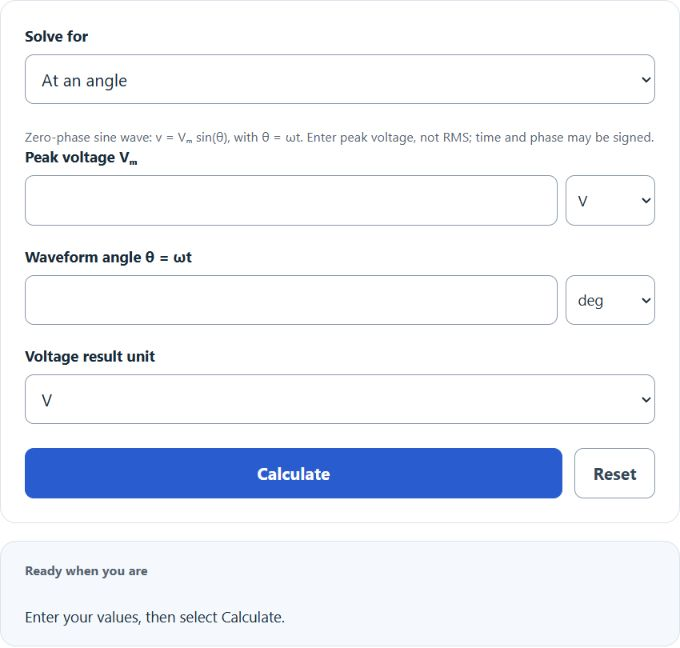
The calculator uses φ = 0 (zero phase offset). Choose “At an angle” to enter the waveform angle ωt, or “At a time” to enter frequency and time; select the voltage result unit. Peak voltage and frequency are nonnegative. Angular frequency, regular frequency, and period relate by:
AC Power Standards: Real-World Instantaneous Voltage
For an ideal sinusoidal supply, peak voltage is RMS voltage multiplied by √2. The table gives illustrative nominal examples; actual voltages, waveforms and frequencies can vary. Industrial and transmission voltage examples use the stated voltage basis (for example, line-to-line); do not interchange it with line-to-neutral voltage.
| Region | Nominal (RMS) | Vmax (Peak) | Frequency | ω (rad/s) | Period (ms) |
|---|---|---|---|---|---|
| US / Canada | 120 V | 169.7 V | 60 Hz | 376.99 | 16.67 |
| EU / UK / AU | 230 V | 325.3 V | 50 Hz | 314.16 | 20.00 |
| Japan | 100 V | 141.4 V | 50 / 60 Hz | 314.16 / 376.99 | 20.0 / 16.7 |
| US Industrial (3-phase) | 480 V | 678.8 V | 60 Hz | 376.99 | 16.67 |
| High-Voltage Transmission | 115,000 V | 162,635 V | 60 Hz | 376.99 | 16.67 |
Vmax = Vrms × √2. For US household current the complete equation is: v(t) = 169.7 × sin(376.99t) volts.
Voltage Type Comparison
| Type | Formula | 120 V RMS Example | Primary Use |
|---|---|---|---|
| Instantaneous | Vmax × sin(ωt) | -169.7 to +169.7 V (varies) | Waveform analysis, transient response, oscilloscope readings |
| Peak | Vrms × √2 | 169.7 V | Insulation ratings, capacitor voltage ratings |
| RMS | Vmax / √2 (0.707 × Vmax) | 120 V | Power calculations, utility billing, appliance ratings |
| Full-wave rectified average | (2/π) × Vmax (0.637 × Vmax) | 108.1 V | Rectifier and DC power supply design |
Key Waveform Positions
For a zero-phase sinusoid, critical voltage values occur at predictable fractions of the period (T = 1/f):
| Condition | Occurs when | Time (t) | At 60 Hz | At 50 Hz |
|---|---|---|---|---|
| Zero crossing (rising) | ωt = 0, 2π, 4π... | 0, T, 2T... | 0, 16.67 ms... | 0, 20.00 ms... |
| Positive peak (+Vmax) | ωt = π/2 | T/4 | 4.17 ms | 5.00 ms |
| Zero crossing (falling) | ωt = π | T/2 | 8.33 ms | 10.00 ms |
| Negative peak (-Vmax) | ωt = 3π/2 | 3T/4 | 12.50 ms | 15.00 ms |