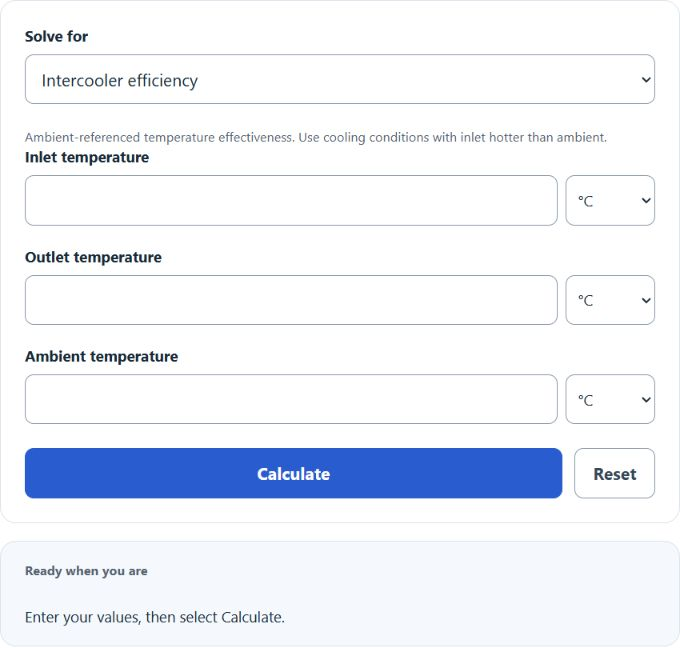
Choose efficiency, inlet temperature, outlet temperature or ambient temperature, then enter the required values.
- All Automotive Calculators
- All Efficiency Calculators
- Chiller Efficiency Calculator
- Evaporative Cooling Calculator
Intercooler Efficiency Formula
Intercooler efficiency measures how much of the available temperature drop an intercooler actually achieves. In simple terms, it compares the real cooling across the intercooler to the maximum possible cooling down to ambient temperature. This makes it a useful metric for comparing intercooler setups, checking heat-soak behavior, and evaluating whether a cooling upgrade improved charge-air temperature control.
In this equation, Tpre is the temperature before the intercooler, Tpost is the temperature after the intercooler, and Tamb is ambient temperature. The result is expressed as a percentage.
| Quantity | Description | Typical Unit |
|---|---|---|
| Intercooler Efficiency | The percentage of the available cooling achieved by the intercooler | % |
| Pre-Intercooler Temperature | Charge-air temperature entering the intercooler core | °C |
| Post-Intercooler Temperature | Charge-air temperature leaving the intercooler core | °C |
| Ambient Temperature | Outside air temperature used as the cooling reference | °C |
Choose the value to solve for. The calculator uses the following relationship for cooling conditions with inlet temperature above ambient; some inverse boundaries are nonunique. The same relationship can be rearranged as follows:
How to Interpret the Result
- 100% efficiency means the outlet temperature matches ambient temperature.
- 0% efficiency means the intercooler produced no effective cooling relative to ambient.
- Greater than 100% means the outlet temperature is below ambient, which usually points to unusual operating conditions, supplemental cooling, or measurement error.
- Negative efficiency means the outlet air is hotter than the inlet air, which often indicates heat soak, bad sensor placement, or incorrect inputs.
A higher number generally indicates better thermal performance, but efficiency alone does not describe the entire intercooler system. Pressure drop through the core also matters because a restrictive intercooler can reduce overall performance even if temperature reduction looks strong.
How to Use the Calculator
- Measure the charge-air temperature immediately before the intercooler.
- Measure the charge-air temperature immediately after the intercooler.
- Record the ambient air temperature used as the cooling reference.
- Choose the solve mode and enter its three required values.
- Calculate the missing value and check whether the result is physically reasonable.
For the most consistent results, use stabilized temperature readings rather than short transient spikes. Each temperature may use its own selected scale; unit changes preserve the physical temperature.
Example Calculation
If the air enters the intercooler at 140°C, leaves at 60°C, and the ambient temperature is 30°C, the efficiency is:
This means the intercooler removed about 72.73% of the maximum temperature drop available between the inlet air and ambient air.
Why Intercooler Efficiency Matters
Compressed intake air becomes hotter as boost increases. An intercooler reduces that temperature before the air enters the engine. Lower charge-air temperature generally helps maintain air density, improve combustion stability, and reduce the tendency for heat-related performance loss. Tracking intercooler efficiency is especially useful when comparing different core sizes or airflow conditions, or after making intake and boost changes.
Practical Notes for Better Accuracy
- Measure temperatures as close as possible to the intercooler inlet and outlet.
- Use the same sensor type and similar response time on both sides of the core.
- Use true ambient air temperature, not under-hood heat-soaked air, unless that is your intended reference.
- Take measurements under comparable load, boost, and vehicle-speed conditions when comparing runs.
- Remember that intercooler performance can change with airflow, coolant temperature, boost level, and heat soak.
Common Input Issues
- If Tpre equals Tamb, efficiency is undefined. This cooling metric requires Tpre above Tamb.
- If the post-intercooler temperature is higher than the pre-intercooler temperature, the result becomes negative.
- If you solve for ambient temperature, efficiency cannot be zero.
- If you solve for pre-intercooler temperature, efficiency cannot be 100%.
Frequently Asked Questions
- Is a higher intercooler efficiency always better?
- Higher thermal efficiency is usually desirable, but it should be considered alongside pressure drop, packaging, and real operating conditions.
- Can intercooler efficiency exceed 100%?
- It can mathematically, but that means the outlet temperature is below ambient. In normal setups, this often suggests nonstandard cooling or a measurement problem.
- Why did I get a negative value?
- A negative result means the outlet temperature is higher than the inlet temperature. This commonly points to heat soak, bad data, or sensors placed in the wrong locations.
- What ambient temperature should I use?
- Use the air temperature that best represents the cooling air available to the intercooler, not a temperature source that has already been significantly heated by the engine bay.