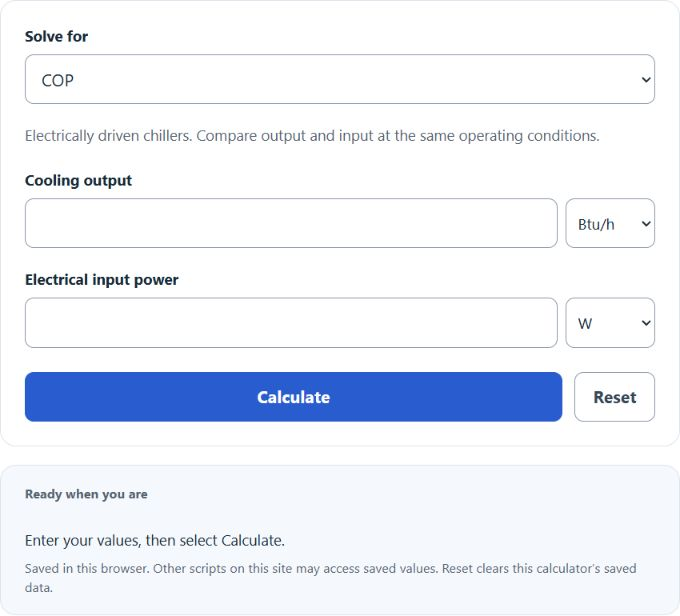
Calculate COP, cooling output, or electrical input power by selecting a solve mode and entering the other two values. Units include Btu/h, kW, mechanical hp, and W.
- All Construction Calculators
- All Efficiency Calculators
- Cooling Tower Capacity Calculator
- Intercooler Efficiency Calculator
Chiller Efficiency Formula
Chiller efficiency is commonly expressed as coefficient of performance, or COP. COP compares useful cooling output to electrical power input after both are expressed in compatible energy-rate units.
- COP = chiller coefficient of performance
- Q = cooling capacity in BTU/hr
- P = power consumed in watts
- 3.412141633 = Btu/h equivalent to 1 watt (a unit conversion)
The calculator uses these formulas in three ways:
- Find COP: enter cooling and power. The calculator converts cooling to BTU/hr, converts power to watts, then divides cooling output by power input.
- Find cooling: enter power and COP. The calculator multiplies power by 3.412141633 and then by COP to estimate cooling output.
- Find power consumed: enter cooling and COP. The calculator divides cooling by COP and by 3.412141633 to estimate electrical power input.
Chiller Unit Conversions and COP Reference
These are power-unit conversions for electrically driven chillers. Cooling kW is thermal output; input kW is electrical consumption. hp means mechanical horsepower as a unit, not an air-conditioner size rating or an assumed shaft-to-electrical conversion.
| Quantity | Unit | Base-unit conversion |
|---|---|---|
| Cooling | BTU/hr | 1 BTU/hr |
| Cooling | kW | 1 kW cooling = 3412.14 BTU/hr |
| Cooling | hp | 1 hp cooling = 2544.43 BTU/hr |
| Power | W | 1 W |
| Power | kW | 1 kW = 1000 W |
| Power | hp | 1 hp = 745.7 W |
A higher COP means the chiller produces more cooling for each unit of electrical input.
| COP range | Approximate kW/ton | General interpretation |
|---|---|---|
| 2.5 to 3.5 | 1.41 to 1.00 | Equivalent input intensity; compare ratings at matching load and temperatures |
| 3.5 to 5.0 | 1.00 to 0.70 | Equivalent input intensity; equipment type and operating conditions matter |
| 5.0 to 7.0 | 0.70 to 0.50 | Equivalent input intensity; this is not a universal performance rating |
| Above 7.0 | Below 0.50 | Equivalent input intensity; compare the same system boundary and rating conditions |
Examples
Example 1: Calculate COP
You have a chiller producing 500,000 BTU/hr of cooling while consuming 40 kW of power.
- Cooling: 500,000 BTU/hr
- Power: 40 kW = 40,000 W
The chiller efficiency is about 3.66 COP.
Example 2: Calculate Power Consumed
You have 1,000 kW of cooling and a COP of 5.2. Find the power consumed in kW.
- Cooling: 1,000 kW = approximately 3,412,141.633 BTU/hr
- COP: 5.2
The estimated power consumed is about 192.3 kW.
FAQ
What is a good COP for a chiller?
Compare COP against the manufacturer rating or an applicable test standard at the same load, temperatures, and system boundary. COP alone has no universal good or bad threshold. This calculator uses electrical input; thermally driven absorption chillers need a different input basis.
Is a higher COP always better?
Yes, for the same cooling job, a higher COP means less electrical power is needed. For example, a COP of 5 means the chiller provides 5 units of cooling for every 1 unit of electrical input. However, COP changes with load and temperature, so one reading does not describe performance under all conditions.
What is the difference between COP and kW per ton?
COP increases as efficiency improves. kW per ton decreases as efficiency improves. They describe the same idea from opposite directions. The common conversion is: