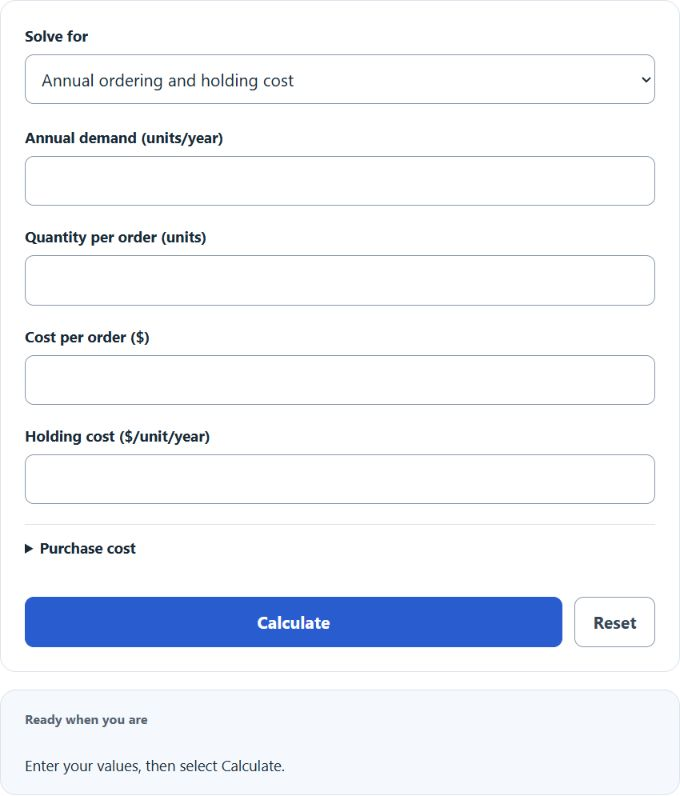
Choose annual ordering and holding cost, economic order quantity (EOQ), annual carrying cost, or cost of goods sold (COGS). The first three are planning models; COGS uses the period inventory-flow identity below.
Related Calculators
- Cost of Sales Calculator
- Wholesale Price Calculator
- Batch Size Calculator
- Conversion Cost Calculator
- All Business Calculators
Inventory Cost Formula
A common way to estimate “inventory cost” over a period is to calculate cost of goods sold (COGS) using beginning inventory, purchases, and ending inventory.
- Where COGS is the cost of goods sold for the period ($)
- BI is the beginning inventory value ($)
- P is purchases for the period (often net purchases) ($)
- EI is the ending inventory value ($)
To calculate the inventory cost for the period (COGS), add beginning inventory to purchases, then subtract ending inventory.
How to Calculate Inventory Cost?
The following example problems outline how to calculate Inventory Cost.
Example Problem #1:
- First, determine the beginning inventory value ($). The beginning inventory value ($) is given as 500.
- Next, determine purchases for the period ($). Purchases ($) are given as 400.
- Finally, determine the ending inventory value ($). The ending inventory value ($) is provided as 300. Then calculate COGS using the equation above:
COGS = BI + P - EI
The values given above are inserted into the equation below:
COGS = 500 + 400 - 300 = 600 ($)
FAQ
What is the significance of calculating inventory cost?
Depending on context, “inventory cost” can refer to (1) the cost of goods sold (COGS) for a period, (2) the carrying/holding cost of keeping inventory on hand, or (3) the accounting valuation of inventory. Tracking these helps with budgeting, pricing, and assessing inventory management performance, and it can impact gross profit and other financial metrics.
How can inaccuracies in inventory valuation affect a business?
Inaccuracies in inventory valuation can lead to significant financial implications for a business. Overvaluation of inventory can result in overstated assets and profits, potentially leading to incorrect financial reporting and tax issues. Conversely, undervaluation of inventory can result in understated profits, which might affect a company's investment attractiveness and creditworthiness. Accurate inventory valuation is essential for reliable financial statements and operational efficiency.
Are there any other methods to calculate inventory cost besides the formula provided?
The relationship COGS = Beginning Inventory + Purchases − Ending Inventory is a basic inventory-flow identity. Methods such as FIFO, LIFO, and weighted average are inventory cost-flow/valuation methods that affect how purchases and inventory are costed (and therefore the COGS and ending inventory amounts), rather than replacing the underlying COGS relationship.