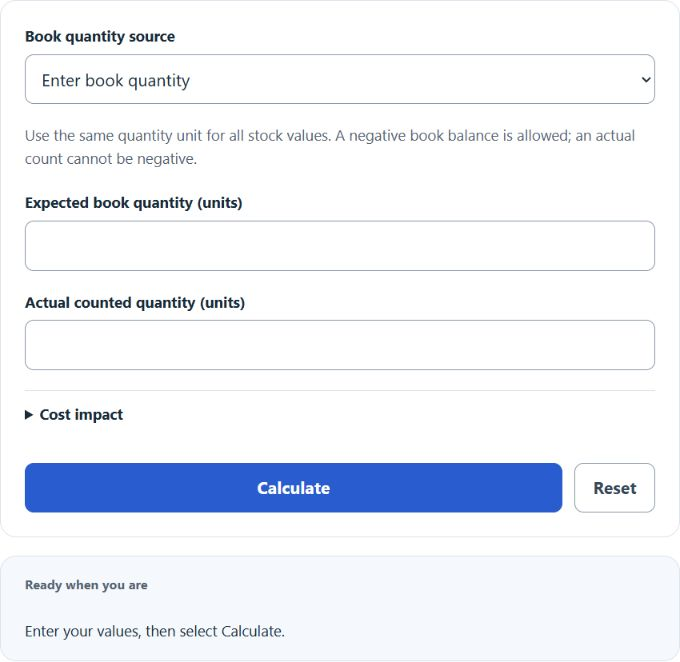
Calculate inventory variance between expected book stock and actual counted quantity, plus overage, shortage, percentage, and cost impact.
Related Calculators
- Variance Calculator
- Budget Variance Calculator
- Cost Per Item Calculator
- Fill Rate Calculator
- Total Cost Calculator
- All Business Calculators
Inventory Variance Formula
The following formula is used to calculate the inventory variance for a given actual and expected inventory.
Variables:
- V is the inventory variance
- A is the actual inventory
- E is the expected inventory
To calculate the inventory variance, subtract the expected inventory from the actual inventory. This will give you the variance, which can be positive or negative depending on whether the actual inventory is higher or lower than the expected inventory.
What is Inventory Variance?
Inventory variance is the difference between the actual inventory and the expected inventory. It is a crucial metric in inventory management as it helps businesses identify discrepancies that may indicate issues such as theft, damage, or errors in inventory tracking. A positive variance indicates that there is more inventory than expected, while a negative variance indicates a shortage. Regularly calculating and analyzing inventory variance can help businesses maintain accurate inventory records and improve overall inventory management processes.
How to Calculate Inventory Variance?
The following steps outline how to calculate the Inventory Variance.
- First, determine the actual inventory (A).
- Next, determine the expected inventory (E).
- Finally, calculate the inventory variance using the formula V = A – E.
- After inserting the values and calculating the result, check your answer with the calculator above.
Example Problem :
Use the following variables as an example problem to test your knowledge.
Actual Inventory (A) = 150
Expected Inventory (E) = 130