Calculate inverse cosine from x, right triangles, triangle sides, vectors, or intervals and get angle results in degrees and radians.
Inverse Cosine Formula
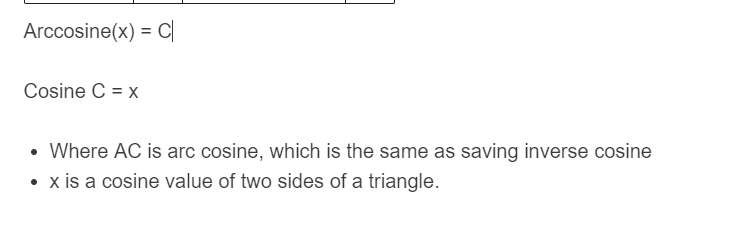
The following formula can calculate an angle from any valid cosine value (x between -1 and 1).
- Where arccos is the arc cosine (inverse cosine) function, and C is the angle whose cosine is x.
- x is a cosine value. In a right triangle, x = cos(C) = (adjacent side)/(hypotenuse). In any triangle, a cosine value can also be found from three side lengths using the Law of Cosines.
Inverse Cosine Definition
Inverse cosine, or arc cosine or acos, is a mathematical function that takes a value between -1 and 1 as input and returns an angle in radians between 0 and π (pi) as output. It is the opposite operation of the cosine function.
Inverse cosine is important because it allows us to find the angle whose cosine equals a given value. This concept is particularly useful in trigonometry and geometry, where we often must determine angles based on known cosine values. Inverse cosine helps solve various real-life problems, such as calculating distances, angles of elevation or depression, and determining the unknown side lengths or angles of triangles.
It also plays a significant role in physics, engineering, and computer graphics. By using inverse cosine, we can accurately determine angles and make precise calculations, contributing to understanding and applying mathematical principles in various domains.
Inverse Cosine Example
How to calculate inverse cosine.
- First, find the ratio of the adjacent side to the hypotenuse.
These are the sides of the angle in a right triangle.
- Next, calculate the angle.
Calculate the angle using the inverse cosine.
FAQ
The inverse cosine is also known as the arc cosine and is used to calculate the value of an angle when the cosine of that angle is known.
Arc cosine is just another way of saying the inverse cosine. The formula is the same as the inverse cosine.