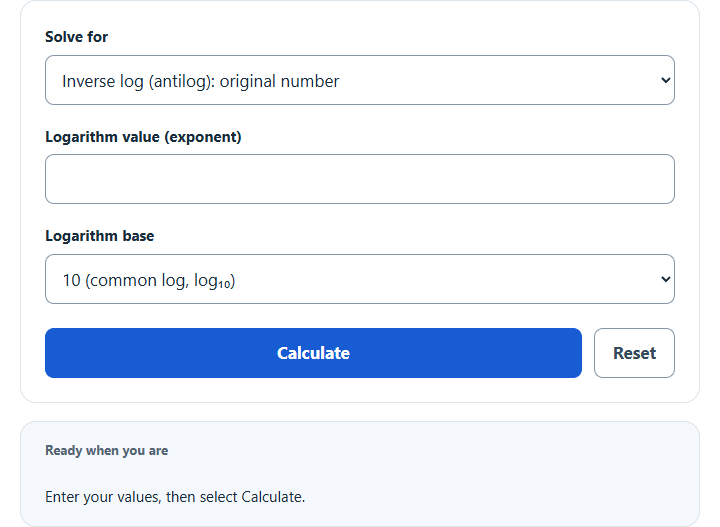
Calculate the inverse log (antilog) of a value in base 10, e or 2, or a custom base, or reverse it to find the log of a number or an unknown base.
Inverse Log Formula
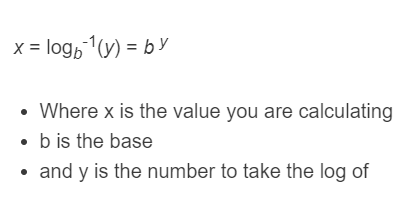
The inverse of a logarithm is an exponent. If you know the log value, raise the base to that power to recover the original number.
- x = original number (the antilog)
- b = base of the logarithm
- y = the log value you start with
For ideal dilute solutions, use the antilog choice with base 10 and exponent equal to the negative pH or pOH to approximate concentration in mol/L. More precisely, pH is defined using hydrogen ion activity:
The logarithm choice runs the calculation in reverse, solving y = logb(x). Base must be greater than 0 and not equal to 1. For the logarithm choice, x must be greater than 0.
Common Bases and Quick Reference
The three bases you will see most often:
| Base | Name | Inverse Form | Typical Use |
|---|---|---|---|
| 10 | Common log | x = 10^y | pH, decibels, Richter scale |
| e ≈ 2.71828 | Natural log | x = e^y | Growth, decay, calculus |
| 2 | Binary log | x = 2^y | Computing, information theory |
At 25°C, pH below 7 is acidic, pH 7 is neutral, and pH above 7 is basic. The approximate concentrations below assume ideal dilute behavior. pH alone does not determine acid or base strength:
| pH Value | [H⁺] (mol/L) | Classification |
|---|---|---|
| 1 | 1 × 10⁻¹ | Acidic |
| 4 | 1 × 10⁻⁴ | Acidic |
| 7 | 1 × 10⁻⁷ | Neutral |
| 10 | 1 × 10⁻¹⁰ | Basic |
| 13 | 1 × 10⁻¹³ | Basic |
Worked Examples
Example 1: Antilog base 10. Given y = 3, find x.
x = 10³ = 1000.
Example 2: Antilog base e. Given y = 2, find x.
x = e² ≈ 7.389.
Example 3: pH to concentration. Given pH = 4.5, find [H⁺].
[H⁺] = 10⁻⁴·⁵ ≈ 3.16 × 10⁻⁵ mol/L.
Example 4: Log of a number. Given x = 1000, base 10.
y = log₁₀(1000) = 3.
FAQ
Is “inverse log” the same as “antilog”? Yes. Both refer to raising the base to the power of the log value.
Why can’t the base equal 1? 1 raised to any power equals 1, so the function has no inverse at that base.
Can the log value be negative? Yes. For bases above 1, a negative y produces a result between 0 and 1, such as 10⁻² = 0.01. For a base between 0 and 1, a negative exponent instead gives a result above 1.
Can x be negative in the logarithm choice? No. Logarithms of zero or negative numbers are undefined for real bases.