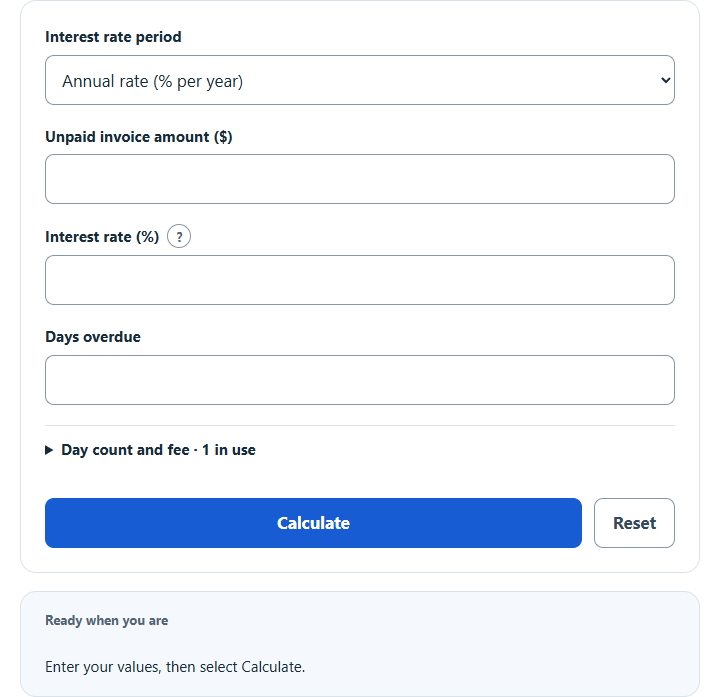
Calculate a late fee on an overdue invoice: enter the amount, the annual, monthly or daily interest rate and days late to get the interest and total due.
Related Calculators
- Net Price Factor Calculator
- Restocking Fee Calculator
- Price Change Difference Calculator
- Price Increase Calculator
- All Business Calculators
Late Payment Interest Formula
Late payment interest is simple interest charged on an overdue invoice for the period it remains unpaid. The amount depends on whether your rate is stated per year, per month, or per day.
Use this annual form when your rate is an annual percentage (for example a statutory rate). If your rate is quoted per month, replace 365 with 30 and keep d as days overdue (a 30-day monthly proration convention); if it is quoted per day, drop the division entirely:
The total amount the customer owes adds any fixed late fee to the interest:
Where:
I is the late payment interest owed in dollars. P is the overdue (unpaid) invoice amount. r is the interest rate as a percentage. d is the number of days the payment is overdue. F is any fixed late fee added on top of the interest. For an annual rate you divide by the number of days in the year (365, or 360 if your contract uses a banker’s year) to get a daily rate, then multiply by the days overdue.
UK Statutory Interest and Fixed Compensation
Select UK statutory interest to estimate interest and fixed compensation on a qualifying commercial payment for goods or services. Enter the unpaid debt in pounds including any VAT, the calendar days overdue and the applicable Bank of England reference rate. This estimate assumes the balance stayed the same throughout the period. Check whether the statutory remedy applies to your contract. Public authority contracts can have different rules.
Use the Bank Rate in force on 31 December if statutory interest starts between 1 January and 30 June, or the Bank Rate in force on 30 June if interest starts between 1 July and 31 December. Enter that reference rate as a percentage. The calculator adds 8 percentage points and uses a 365-day divisor.
The fixed recovery amount is £40 for a debt below £1,000, £70 for £1,000 to £9,999.99, and £100 for £10,000 or more. It is added once per qualifying late payment. The estimated total adds the debt, interest and fixed compensation. Additional recovery costs and changes in the unpaid balance require a separate assessment.
For a qualifying debt of £1,000 that is 30 calendar days overdue, assume a reference rate of 4%. Enter 1,000, 30 and 4 in the UK mode. At the resulting 12% annual rate, interest is about £9.86. Fixed compensation is £70, for an estimated total of £1,079.86.
Late Payment Interest Rate Examples
Rates and fees vary by contract and jurisdiction. The monthly charge and flat fee below are illustrative examples, not legal limits or recommendations. Verify the rate and fee that apply to your agreement.
| Rate basis | Example or statutory basis | Where it is used |
|---|---|---|
| Monthly finance charge | 1.0% to 1.5% per month | Illustrative monthly rates (12% to 18% nominal annual equivalent, without compounding) |
| UK statutory (B2B) | 8 percentage points above the applicable Bank of England reference rate annually | For qualifying UK debts for goods or services. Use the UK statutory interest mode after verifying the applicable remedy. |
| Flat late fee | 1.5% to 5% of the invoice | Illustrative one-time percentage fee; convert it to dollars for the fixed-fee input and verify it is permitted |
Interest on a $1,000 invoice grows with the days overdue. The table below uses a 12% annual rate and a 365-day year.
| Days overdue | Interest on $1,000 at 12%/yr |
|---|---|
| 15 days | $4.93 |
| 30 days | $9.86 |
| 60 days | $19.73 |
| 90 days | $29.59 |
Example Calculations
Example 1: A customer owes $2,500 on an invoice that is 30 days past due. Your contract sets an 8% annual interest rate and you use a 365-day year. The interest is 2500 times 0.08 times 30 divided by 365, which equals $16.44. The total amount due is $2,516.44.
Example 2: A $1,000 invoice is 45 days late and your terms charge 1.5% per month plus a $25 flat late fee. The interest is 1000 times 0.015 times 45 divided by 30, which equals $22.50. Adding the $25 fee gives a total amount due of $1,047.50.
Frequently Asked Questions
Is late payment interest simple or compound? This calculator uses simple interest on the entered unpaid principal and does not compound. Check your agreement and applicable rules if a different method is required.
What rate should I enter? Use the rate stated in your contract or invoice terms. If no rate is set, verify whether statutory interest applies in your jurisdiction and to this debt before using its rate. Pick the matching rate period (per year, per month, or per day) so the math is correct.
How do I check my state’s late fee rules? First identify the type of debt, such as a business invoice, rent or consumer credit, and the type of charge, such as a one-time fee or interest that accrues over time. Check the written terms and the law that governs that debt and charge. A statutory interest rate for overdue amounts does not establish a cap on a flat fee. Enter the rate or fee after verifying that it applies.
How do I count the days overdue? Use the day-count rule in your agreement or applicable law. Enter the resulting days overdue; this calculator does not determine a due date, grace period or legal accrual start.