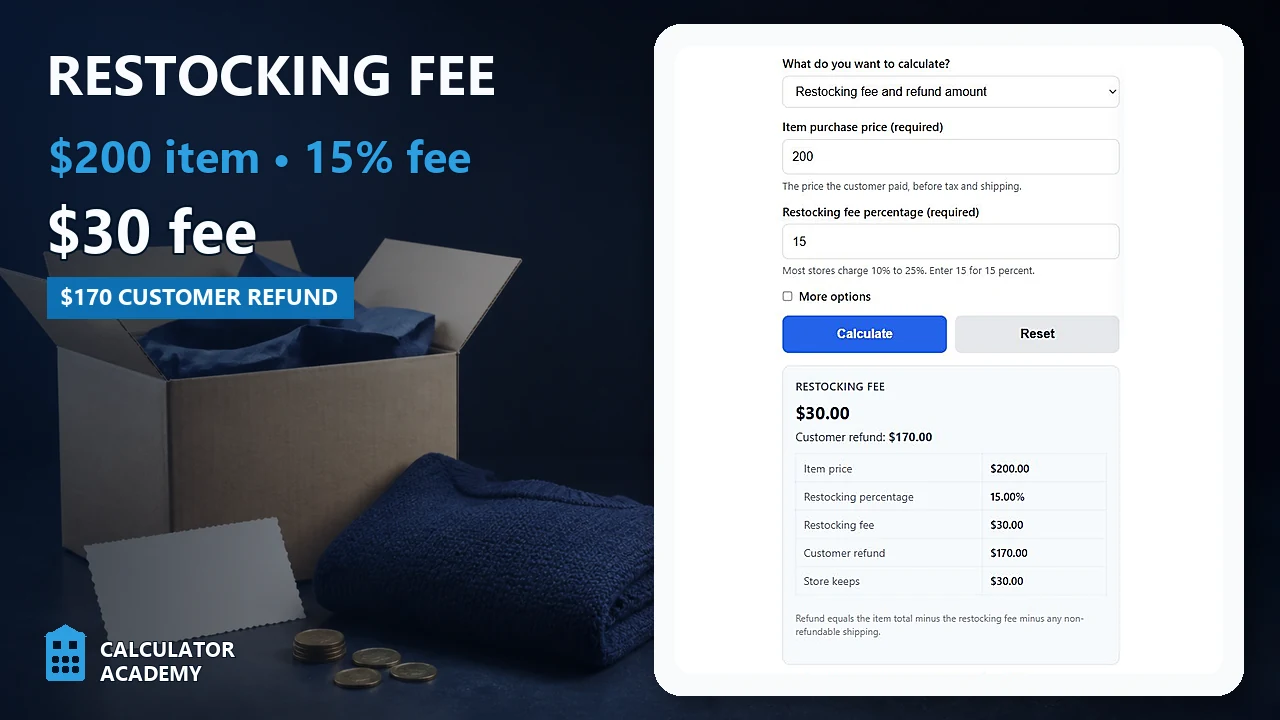
Calculate a restocking fee, purchase price, or restocking percentage by entering any two values for price, fee, and percentage to find the missing amount.
Restocking Fee Formula
Variables:
- RF is the Restocking Fee ($)
- PP is the item purchase price ($)
- RP is the restocking percentage (%)
To calculate the restocking fee, multiply the item price by the restocking percentage, then divide by 100. For example, a $350 camera returned to Best Buy would incur a $52.50 restocking fee at their standard 15% rate.
Restocking Fee Rates: Major Retailers
Restocking fee policies vary significantly across retailers. The table below reflects current policies as of 2024-2025.
| Retailer | Fee Rate | Conditions |
|---|---|---|
| Best Buy | 15% | Opened electronics (cameras, drones, lenses); $45 flat fee on activatable devices (phones, tablets) |
| Amazon (3rd-party sellers) | Up to 20% | Opened electronics; up to 50% for media; Prime members are exempt from third-party restocking fees |
| B&H Photo | 15% | Opened electronics returned in original packaging; non-returnable for certain special orders |
| Adorama | 15% | Opened products within return window; defective items are excluded |
| Wayfair | Up to 15% | Large items and furniture; may include separate return shipping fee |
| AutoZone / O’Reilly | 15-30% | Electrical and special-order parts; many non-returnable once installed |
Industry Standard Rates by Product Category
| Product Category | Typical Range | Notes |
|---|---|---|
| Consumer Electronics | 15-25% | Higher rates for specialized equipment such as cameras and drones |
| Furniture | 20-30% | Often includes a separate pickup or delivery reversal fee of $50-$150 |
| Auto Parts | 20-50% | Highest category; many OEM, electrical, and custom parts are non-refundable |
| Mattresses | 10-20% | Many retailers offer free returns within a trial window; fees apply after |
| Clothing / Apparel | 0-10% | Usually waived for standard items; some luxury brands charge 10% |
| Industrial / B2B Equipment | 25-50% | Custom or special-order items often 50% or fully non-refundable |
| Video Games / Opened Software | Up to 50% | Amazon allows up to 100% deduction for opened digital-eligible media |
When Restocking Fees Cannot Be Charged
Even when a restocking fee is stated in a return policy, retailers cannot legally enforce it in the following circumstances:
- The item arrived defective or damaged
- The retailer shipped the wrong item
- Delivery occurred after the promised date
- The fee was not disclosed before the purchase was completed
- The fee exceeds 50% of the purchase price (illegal or unenforceable in several states)
- The buyer holds Amazon Prime (third-party Amazon sellers cannot charge Prime members a restocking fee)
State-Specific Rules
No federal law in the United States caps or prohibits restocking fees. The legal requirement in all states is that the fee must be disclosed before purchase is completed. Several states go further:
| State | Rule |
|---|---|
| California | Prohibits restocking fees on certain consumer electronics and furniture; clear point-of-sale disclosure required |
| New York | Fee policy must be posted at the point of purchase or printed on the receipt; undisclosed fees cannot be enforced |
| Connecticut | Fees permitted if stated in the return policy and cover actual handling or warehousing costs only |
| Alabama, Colorado, Hawaii, Iowa, Mississippi, Ohio, Oklahoma, South Carolina | Best Buy waives its 15% restocking fee in these states due to local consumer protection statutes |
Restocking Fees and Buyer Behavior
Over 80% of first-time buyers review a retailer’s return policy before completing a purchase. As of 2024, approximately 72% of retailers charge some form of return fee, up from 66% the prior year. For high-ticket items, even a standard 15% rate translates to a significant dollar amount. A $2,000 laptop return at Best Buy yields a $300 restocking fee, which materially affects the true cost of ownership when factoring return risk. Retailers that waive restocking fees (or cap them at low rates) show measurably higher conversion rates for electronics, particularly in competitive pricing environments where buyers have multiple purchase options.