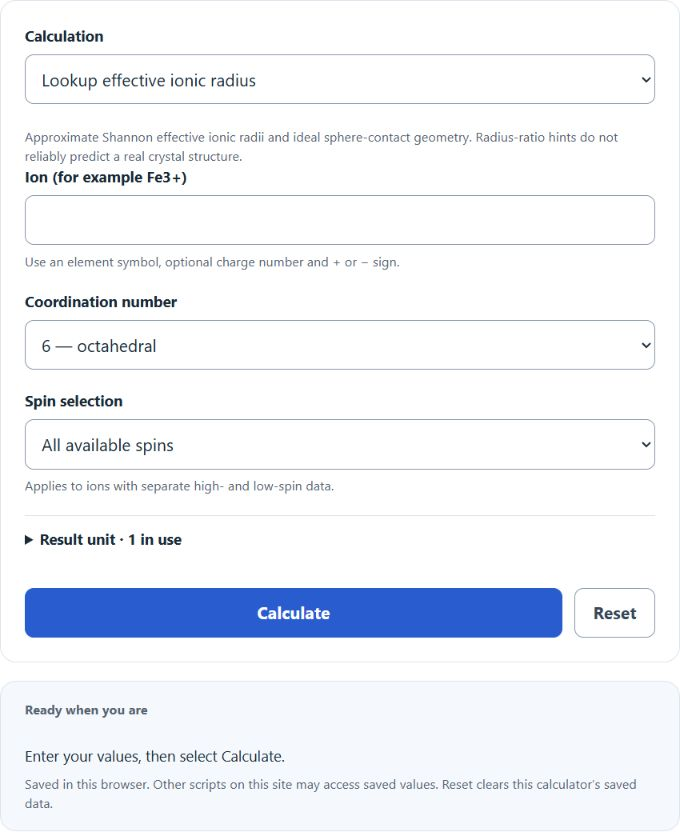
Calculate ionic radius, radius ratio, and crystal lattice values from ion, coordination number, spin, and structure in Å, pm, or nm.
Ionic Radius Formula
The lookup uses Shannon’s empirical effective ionic radii for an exact ion, coordination number and spin entry. For an ideal cubic lattice with unlike ions in contact, the geometric relation is:
Variables:
- r+ and r− are cation and anion radii in compatible length units
- a is the cubic lattice constant in the same units
- f is 1/2 for NaCl, √3/2 for CsCl, and √3/4 for zinc blende or fluorite
For a lattice estimate, select the quantity to calculate and the structure, then enter the two displayed known quantities. Calculate a = (r+ + r−)/f or either radius as fa minus the known radius. The contact model is approximate; it does not determine radius from charge and electron count alone.
What is Ionic Radius?
The ionic radius is a measure of the size of an ion's electron cloud when the ion is part of a crystal lattice. It varies with the ion's charge, the number of electrons, and the arrangement of the surrounding ions in the lattice. The ionic radius is crucial for understanding the properties of ionic compounds, including their stability, solubility, and melting points.
How to Calculate Ionic Radius?
The following steps outline how to calculate the Ionic Radius.
- For a lookup, enter the ion including its charge, then select its coordination number and spin.
- For a lattice estimate, select the cubic structure and whether to calculate a, the cation radius or the anion radius.
- Enter the two known lengths in the displayed fields. Each field accepts Å, pm or nm.
- Select Calculate. A missing lookup combination is reported rather than replaced with another coordination number; “All available spins” shows both entries when applicable.
- Use 1 Å = 100 pm = 0.1 nm to check conversions. Radius-ratio coordination and structure hints are ideal geometry heuristics and may fail for real crystals.
Example Problem :
Use the following variables as an example problem to test your knowledge.
Na+, coordination number 6: Shannon effective ionic radius = 1.02 Å = 102 pm
Ideal NaCl contact example: r+ = 1.02 Å, r− = 1.81 Å, so a = 2(1.02 + 1.81) = 5.66 Å