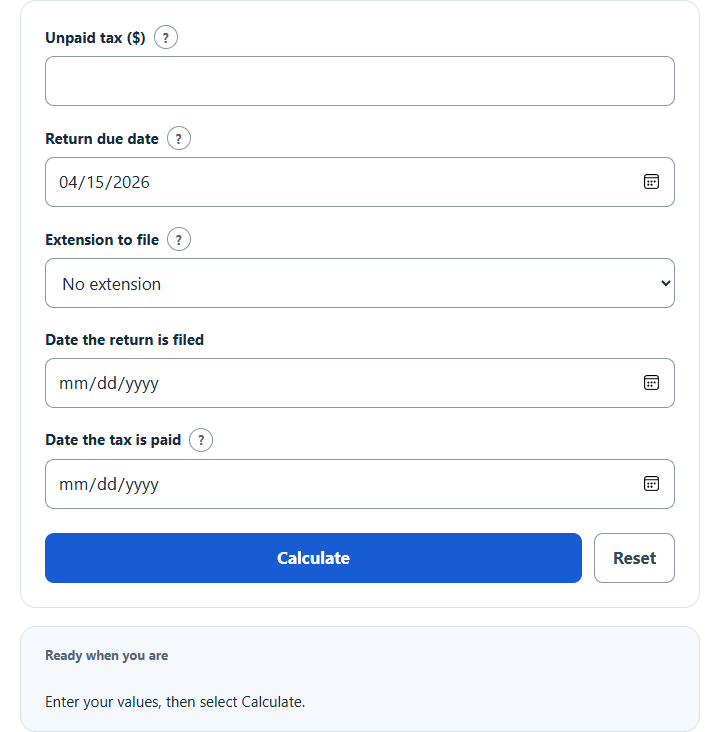
Estimate IRS failure-to-file and failure-to-pay penalties plus interest on unpaid tax from the amount owed, the due date and the dates you file and pay.
- All Interest Rate Calculators
- Penalty and Interest Calculator
- Daily Interest Calculator
- Late Payment Interest Calculator
- Late Fee Calculator
- Medicare Late Enrollment Penalty Calculator
Calculator Functions
The calculator estimates what the IRS adds to an unpaid federal income tax balance: the failure-to-file penalty, the failure-to-pay penalty and interest, with the total and the amount to pay including the tax.
| Function | Use it when | You enter |
|---|---|---|
| IRS penalties and interest | You filed or paid a Form 1040 or Form 1120 balance late, or expect to, and want to know what it will cost | Unpaid tax, the return due date, the date you file and the date you pay |
Unpaid tax is the tax on the return minus withholding, estimated payments and refundable credits paid by the due date. The due date starts at April 15, 2026 and can be changed to any date from 2021 on. Choose the 6-month extension if you filed one: it moves the filing deadline but not the payment deadline. The calculator assumes the whole balance is paid on one date. For a late charge on something other than federal tax, use the Penalty and Interest Calculator.
IRS Penalty and Interest Formulas
| FTF | Failure-to-file penalty ($) |
| FTP | Failure-to-pay penalty ($) |
| I | Interest ($) |
| T | Unpaid tax ($), used in the formulas below |
| m | Months late, counting any part of a month as a full month |
Failure-to-file penalty
The penalty is 5% of the unpaid tax for each month or part of a month the return is late, up to 25%, so it stops growing after 5 months [1]. In a month when the failure-to-pay penalty also applies, the failure-to-file penalty is reduced by that 0.5%, which leaves 4.5%, so FTF = 4.5% × T × m while the tax is also unpaid [2]. Months are counted from the filing deadline, including an extension. A return filed late with nothing left unpaid has no penalty, because the percentage applies to the unpaid tax.
If the return is more than 60 days late, the penalty is at least the amount below or 100% of the unpaid tax, whichever is less [1].
| Return due date (without extension) | Minimum penalty |
|---|---|
| 2026 | $525 |
| 2025 | $510 |
| 2024 | $485 |
| 2023 | $450 |
| 2021 and 2022 | $435 |
Failure-to-pay penalty
The penalty is 0.5% of the unpaid tax for each month or part of a month it stays unpaid after the due date, up to 25%. A full month is charged even if you pay before the month ends [2]. An extension to file does not change the date the tax is due [3].
Interest
Here r is the IRS underpayment rate and d is the number of days from the due date to the payment date. Interest is compounded daily, and the rate is set each quarter [4]. The calculator applies each quarter’s rate to the days that fall in it and divides by 366 in a leap year. It also adds interest on the failure-to-file penalty, which runs from the filing deadline [3]. The underpayment rates below are as of November 17, 2026 [4]. Days after December 2026 use 7%.
| Year | Jan–Mar | Apr–Jun | Jul–Sep | Oct–Dec |
|---|---|---|---|---|
| 2026 | 7% | 6% | 7% | 7% |
| 2025 | 7% | 7% | 7% | 7% |
| 2024 | 8% | 8% | 8% | 8% |
| 2023 | 7% | 7% | 7% | 8% |
| 2022 | 3% | 4% | 5% | 6% |
| 2021 | 3% | 3% | 3% | 3% |
Worked example
You owe $5,000 on a return due April 15, 2026 and file and pay on July 15, 2026, which is 3 months late. The failure-to-file penalty is 4.5% × 3 × $5,000 = $675 and the failure-to-pay penalty is 0.5% × 3 × $5,000 = $75. Interest for the 91 days is $77.44 on the tax and $10.45 on the failure-to-file penalty. The total is $837.89, so you pay $5,837.89.
Limits of This Estimate
- This is an estimate, not a bill, and it is not tax advice. The IRS can remove or reduce a penalty for reasonable cause, which also reduces the related interest [2].
- It assumes one payment in full. Partial payments lower the balance that later penalties and interest are charged on.
- The failure-to-pay rate is fixed at 0.5%. It drops to 0.25% a month during an approved payment plan when the return was filed on time, and rises to 1% a month if the tax is still unpaid 10 days after a notice of intent to levy [2].
- Interest on the failure-to-pay penalty is left out, because it starts only when the IRS sends a notice or assesses the penalty [3]. Partnership and S corporation returns use a different late-filing penalty [1], and state penalties are not included.
Sources
- Internal Revenue Service, Failure to file penalty: 5% a month up to 25%, the minimum penalty table and other return types
- Internal Revenue Service, Failure to pay penalty: 0.5% a month up to 25%, the 4.5% combined month, payment plan and levy rates, penalty relief
- Internal Revenue Service, Interest: when interest starts on tax and on each penalty
- Internal Revenue Service, Quarterly interest rates: underpayment rates by quarter and daily compounding