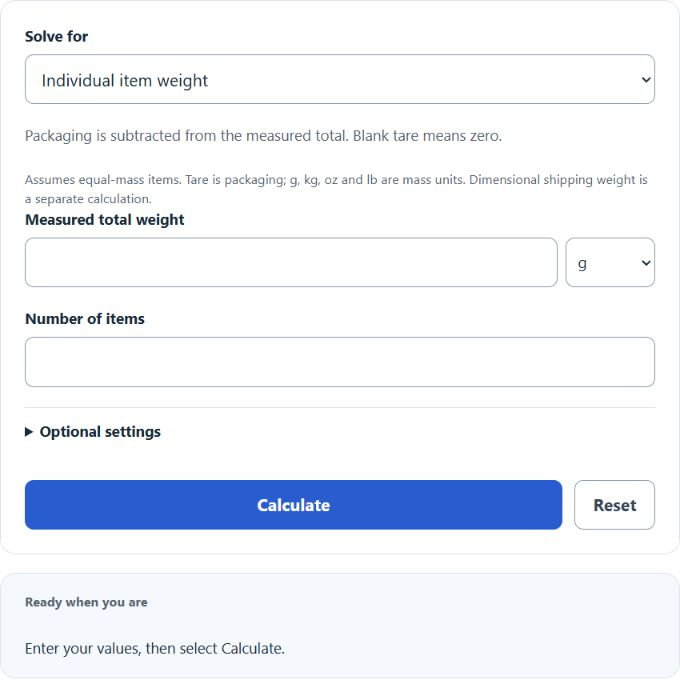
Calculate the weight of one item from a total weight and count, the total weight of many identical items, or how many items are in a weighed batch.
Calculator Functions
| Function | What it does | What it requires |
|---|---|---|
| Individual item weight | Finds the average weight of one item in a batch | Requires the measured total weight and the number of items |
| Total batch weight | Finds the total weight of a number of identical items | Requires the known weight of one item and the number of items |
| Number of items | Finds how many items are in a batch from its weight | Requires the measured total weight and the known weight of one item |
Weights are entered in g, kg, oz or lb. Every function has an optional tare, the weight of the box or container, and a blank means zero. Number of items can show the count unrounded, to the nearest whole item, rounded down or rounded up. Each result also lists the weight of one item in all four units.
Item Weight Formulas
| w | Average weight of one item |
| G | Measured total weight, packaging included |
| T | Tare, the weight of the packaging |
| n | Number of items |
Taking the tare off the measured total leaves the net contents, the weight of the items alone [1].
Individual item weight
The net contents are divided by the number of items. A batch of 230 items weighing 300 lb averages 300 ÷ 230 = 1.304 lb each. A box of 10 apples that weighs 2.42 kg with 0.50 kg of packing holds 1.92 kg of apples, or 0.192 kg per apple.
Total batch weight
The weight of one item is multiplied by the count, and any tare is added. A case of 30 items at 120 g each weighs 3,600 g, and with a 250 g carton it weighs 3,850 g.
Number of items
The net contents are divided by the weight of one item. If 10 cards weigh 75 g, one card weighs 7.5 g, and a stack of 4.035 kg holds 4,035 ÷ 7.5 = 538 cards. Rounding changes only the count that is displayed.
Limits of This Estimate
- The result is an average. It treats every item as the same weight, so it does not give the weight of any one item in a mixed batch.
- A count taken by weight is only as good as the scale and as consistent as the items. When items vary, the unrounded count shows how far the batch is from a whole number.
- Mixed units are converted with 1 lb = 453.59237 g and 1 oz = 28.349523125 g [2]. These are avoirdupois ounces, not fluid ounces.
Sources
- NIST Handbook 133, Checking the Net Contents of Packaged Goods, 2026 edition, Appendix F (Glossary): tare weight, gross weight and net contents
- NIST, Guide for the Use of the International System of Units (SP 811), Appendix B.8: factors for pounds and ounces