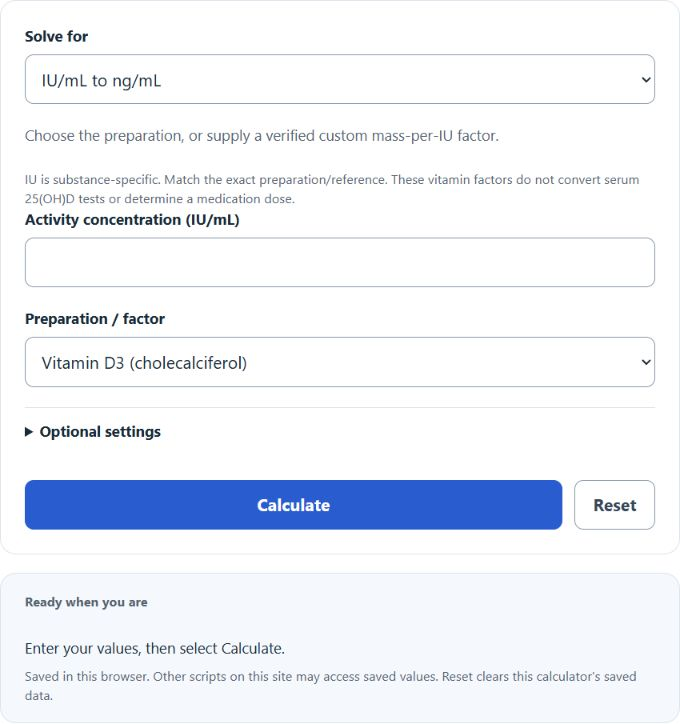
Convert between IU/mL and ng/mL using a matching vitamin-preparation factor or a verified custom product/reference factor. This is unit arithmetic, not a drug-dose or serum vitamin D interpretation tool.
- Units to mg Converter
- mcg to units Converter
- ug/l to ng/ml Converter
- ug/ml to molarity Converter
- All Unit Converters
IU/mL to ng/mL Formula
The following formula is used to convert a concentration from IU/mL to ng/mL.
The inverse relationship is:
Variables:
- ng/mL is the concentration in nanograms per milliliter
- IU/mL is the concentration in international units per milliliter
- ng per IU is the mass equivalent of one IU for the selected substance
To calculate ng/mL, multiply the IU/mL concentration by the substance-specific number of nanograms represented by 1 IU.
What is IU/mL to ng/mL?
IU/mL expresses the biological activity of a substance per milliliter, while ng/mL expresses the actual mass of that substance per milliliter. Since an International Unit is defined differently for different vitamins, hormones, and drugs, there is no single universal IU-to-ng conversion. Use the mass-per-IU definition for the exact chemical form and reference preparation; a generic substance name alone may be insufficient.
For example, 1 IU of vitamin D is commonly treated as 25 ng, while 1 IU of vitamin A (retinol) is commonly treated as 300 ng. That means the same IU/mL value can correspond to very different ng/mL values depending on the substance selected.
Common IU to ng Reference Values
- Vitamin D (cholecalciferol): 1 IU ≈ 25 ng
- Vitamin A (retinol): 1 IU ≈ 300 ng
- Vitamin A (beta-carotene): 1 IU ≈ 600 ng
- Vitamin E (d-α-tocopherol): 1 IU ≈ 670,000 ng
- Vitamin E (free dl-α-tocopherol): 1 IU ≈ 910,000 ng; synthetic dl-α-tocopheryl acetate: approximately 1,000,000 ng
- Penicillin, insulin and other medicines: use a verified product/reference-specific custom factor
- An assumed 1 ng/IU is an illustrative custom factor only, not a definition for a generic substance
How to Convert IU/mL to ng/mL?
The following steps outline how to convert IU/mL to ng/mL.
- First, determine the concentration in IU/mL.
- Next, identify the substance and its conversion factor in ng per IU.
- Multiply the IU/mL value by the ng per IU factor using the formula ng/mL = IU/mL × (ng per IU).
- After inserting the values and calculating the result, check your answer with the calculator above.
IU/mL to ng/mL Conversion Table
The table below shows conditional ingredient-mass examples at 1 IU/mL. It does not define universal factors for medicines, mixtures, assay results or vitamin metabolites.
| Substance | Approx. ng per IU | 1 IU/mL in ng/mL |
|---|---|---|
| Vitamin D (cholecalciferol) | 25 | 25 ng/mL |
| Vitamin A (retinol) | 300 | 300 ng/mL |
| Vitamin A (beta-carotene) | 600 | 600 ng/mL |
| Vitamin E (d-α-tocopherol) | 670,000 | 670,000 ng/mL |
| Vitamin E (dl-α-tocopheryl acetate) | 1,000,000 | 1,000,000 ng/mL |
| Other drug / product | Product-specific | Use verified custom factor |
| Illustrative custom factor (1 ng/IU) | 1 | 1 ng/mL |
Use a matching preparation and biological reference standard. Vitamin E values here represent ingredient mass for the stated chemical form, not modern alpha-tocopherol label claim. Beta-carotene mass is not mcg RAE. The vitamin D factors concern D2/D3 ingredients; serum 25(OH)D uses a different analyte and cannot be inferred from supplement IU/mL.
Example Problem:
Use the following examples to test your understanding.
Example 1: Vitamin D concentration = 2 IU/mL
Vitamin D factor = 25 ng per IU
Result: 2 × 25 = 50 ng/mL
Example 2: Vitamin A (retinol) concentration = 0.5 IU/mL
Vitamin A factor = 300 ng per IU
Result: 0.5 × 300 = 150 ng/mL