Convert micrograms to IU for vitamin D, vitamin A, vitamin E, or insulin by selecting the substance and entering the mcg amount quickly.
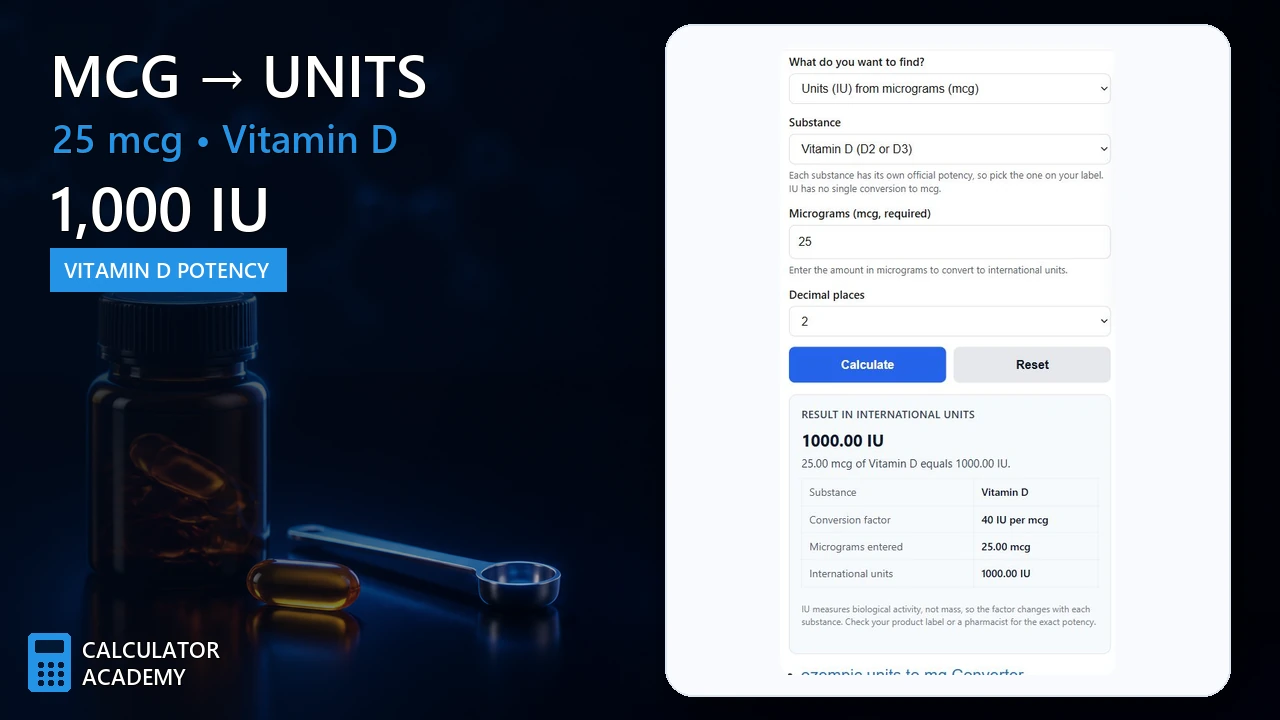
- ozempic units to mg Converter
- cc to mg Converter
- Grams To cc Calculator
- cm to mL Calculator (cc to Milliliters) + Chart
- All Unit Converters
mcg to Units Formula
The following formula is used to convert micrograms to international units for a substance with a defined IU potency.
Variables:
- IU is the number of international units
- mcg is the amount in micrograms
- F is the number of micrograms per 1 IU for the selected substance
To convert mcg to IU, divide the amount in micrograms by the compound-specific mcg-per-IU factor. For example, vitamin D uses 0.025 mcg per IU, so 10 mcg of vitamin D equals 400 IU.
What is mcg to Units Conversion?
Micrograms (mcg) measure mass, while international units (IU) measure biological activity or potency. Because of that difference, there is no single universal conversion between mcg and IU. Each vitamin or medicine that uses IU has its own official potency definition, which determines how many micrograms equal 1 IU.
For example, vitamin D2 and vitamin D3 both use 0.025 mcg per IU, vitamin A retinol uses 0.3 mcg per IU, β-carotene uses 0.6 mcg per IU, and human insulin uses approximately 34.7 mcg per IU. That is why the selected substance must always be known before converting.
How to Calculate mcg to Units?
The following steps outline how to convert micrograms to international units.
- First, determine the amount in micrograms (mcg).
- Next, identify the substance being converted and find its mcg-per-IU factor.
- Then, divide the mcg value by the mcg-per-IU factor using the formula IU = mcg / F.
- Finally, verify the result with the calculator above.
mcg to Units Conversion Table
The table below shows how a 10 mcg dose converts to IU for several commonly used substances.
| Substance | mcg per 1 IU | 10 mcg in IU |
|---|---|---|
| Vitamin D3 (cholecalciferol) | 0.025 mcg | 400 IU |
| Vitamin D2 (ergocalciferol) | 0.025 mcg | 400 IU |
| Vitamin A (retinol) | 0.3 mcg | 33.33 IU |
| Vitamin A (retinyl palmitate) | 0.55 mcg | 18.18 IU |
| Vitamin A (β-carotene) | 0.6 mcg | 16.67 IU |
| Vitamin E (d-alpha-tocopherol) | 670 mcg | 0.0149 IU |
| Insulin (human) | 34.7 mcg | 0.2882 IU |
Example Problem
Use the following variables as an example problem to test your knowledge.
Amount = 10 mcg
Substance = Vitamin D3
Factor (F) = 0.025 mcg per IU
Using the formula: IU = mcg / F = 10 / 0.025 = 400 IU