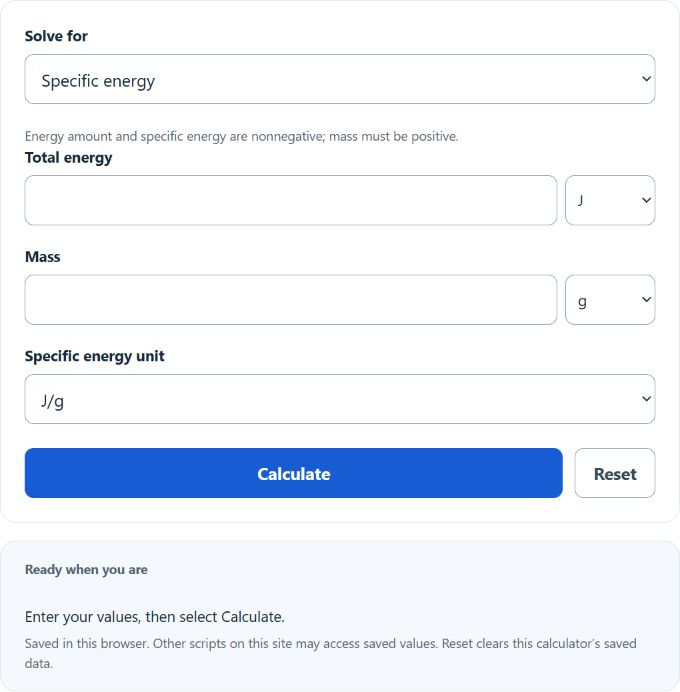
Calculate joules per gram, total energy, or mass from any two values with unit conversions and calculation steps for J, kJ, MJ, GJ, g, kg, mg, and lb.
- All Unit Converters
- Joules Per Hour To Watts Calculator
- Battery Energy Density Calculator
- Energy Density Calculator
Joules Per Gram Formula
Joules per gram is energy divided by mass. The calculator uses joules as the base energy unit and grams as the base mass unit before converting the answer to your selected unit.
- J/g = joules per gram, or energy per unit mass
- E = total energy in joules
- m = total mass in grams
If you enter total energy and total mass, the calculator finds joules per gram. If you enter mass and joules per gram, it finds total energy. If you enter energy and joules per gram, it finds total mass.
The calculator also handles unit conversions. Energy values can be entered as J, kJ, MJ, or GJ. Mass can be entered as g, kg, mg, or lb. Energy density can be entered as J/g, kJ/g, MJ/g, GJ/g, J/kg, kJ/kg, MJ/kg, or GJ/kg.
Common Unit Conversions for Joules Per Gram
| Unit | Equivalent in J/g | Notes |
|---|---|---|
| 1 J/g | 1 J/g | Base unit used by the calculator |
| 1 kJ/g | 1,000 J/g | Common for high-energy materials and food energy density |
| 1 J/kg | 0.001 J/g | Divide J/kg by 1,000 to get J/g |
| 1 kJ/kg | 1 J/g | Numerically equal to J/g |
| 1 MJ/kg | 1,000 J/g | Same as 1 kJ/g |
Energy and Mass Conversion Factors
| Quantity | Unit | Base-unit conversion |
|---|---|---|
| Energy | 1 kJ | 1,000 J |
| Energy | 1 MJ | 1,000,000 J |
| Mass | 1 kg | 1,000 g |
| Mass | 1 mg | 0.001 g |
| Mass | 1 lb | 453.59237 g |
Example Problems
Example 1: Calculate joules per gram
You have 2,500 J of total energy and a mass of 50 g.
The energy density is 50 J/g.
Example 2: Calculate total energy
You have a mass of 2 kg and an energy density of 3 kJ/g.
First convert the mass to grams:
Then convert kJ/g to J/g:
Now calculate total energy:
The total energy is 6,000,000 J, or 6 MJ.
FAQ
What does joules per gram mean?
Joules per gram tells you how much energy is present for each gram of mass. A higher J/g value means more energy per gram. For example, 100 J/g means each gram contains or releases 100 joules of energy.
Is J/g the same as kJ/kg?
Yes. The numbers are the same because 1 kJ is 1,000 J and 1 kg is 1,000 g. So 1 J/g = 1 kJ/kg.
Which values do I enter?
Select the quantity to solve for, then enter the other two known quantities. The result appears below the calculator. Mass must be positive; energy amount and specific energy can be zero. A mass cannot be uniquely recovered from zero energy and zero specific energy.