Calculate how much force it takes to jump from your body weight, jump height and crouch depth, or find jump height from a known take-off force.
Jumping Force Formula or Method
The distance method estimates displacement-averaged vertical ground force using work and energy. The time method estimates time-averaged vertical ground force using impulse and momentum. Both assume the centre of mass starts upward propulsion at rest and that jump height is the rise after takeoff.
How the Calculation Works
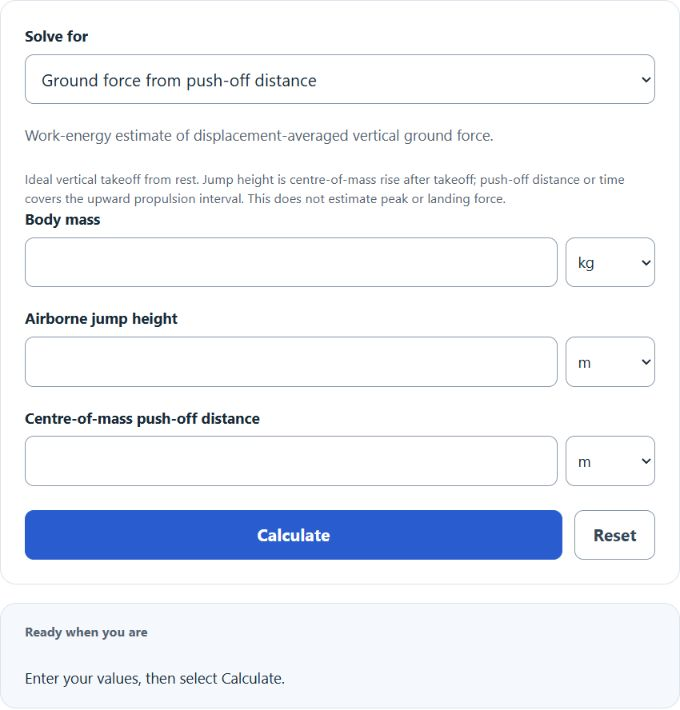
Choose the desired result and distance or time model. Only the required source inputs are shown; switching tasks preserves entered values.
How to Use This Calculator
- Select the result you want in the Solve for menu.
- Enter only the visible source values and their explicit units.
- Select Calculate and review the primary answer, supporting values, and substituted steps.
- Use Reset before starting a different performance or scenario.
Worked Example
At 70 kg, a 0.50 m jump height and 0.25 m push-off distance produce about 2,059.40 N of average ground force, or 3.00 times body weight.
Input and Result Guide
| Item | How to use it |
|---|---|
| Body mass | Choose kilograms (kg) or pounds (lb). |
| Length | Choose metres (m), centimetres (cm), inches (in), or feet (ft). |
| Force | Choose newtons (N), pounds-force (lbf), or kilogram-force (kgf). |
| Distance method | Uses centre-of-mass push-off distance. |
| Time method | Uses upward propulsion time and net impulse. |
Interpreting the Result
Compare like measurements: displacement-averaged and time-averaged force can differ when force changes through push-off. Average ground force, net force, and peak force are different quantities.
Assumptions and Limitations
Both methods estimate average total ground reaction force, not peak force. Results depend strongly on accurate centre-of-mass displacement or propulsion time and do not model technique, limb asymmetry, landing force, or force-plate waveforms.
Common Questions
Why did an input disappear when I changed Solve for?
The hidden field is the requested output. Enter the remaining visible values and the calculator will solve for that target.
Will my last successful calculation be restored?
Yes. The calculator saves a structured snapshot after a successful calculation and recomputes it on reload. Reset clears this calculator’s saved data.
Sources
OpenStax: Work–Energy Theorem and Impulse and Collisions; standard gravity g = 9.80665 m/s².