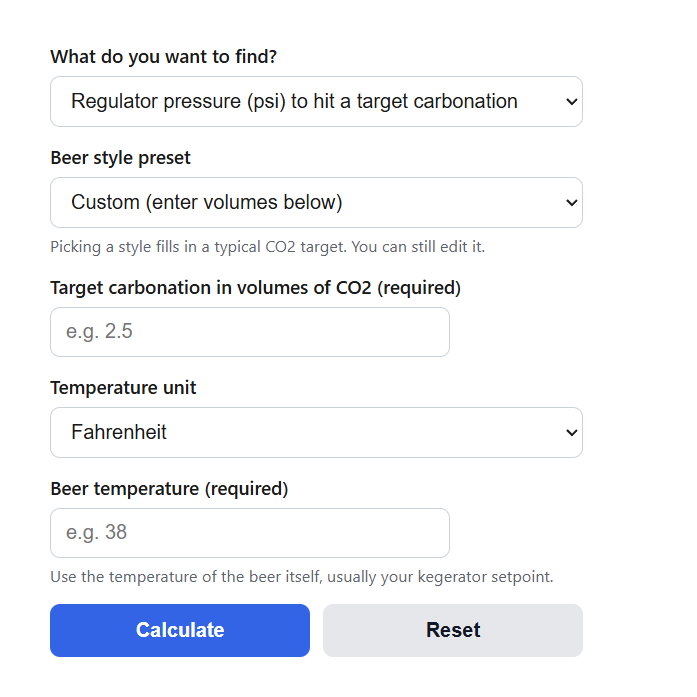
Calculate the CO2 regulator pressure (PSI) to force carbonate your keg from beer temperature and target carbonation volumes, or find the carbonation level at your current pressure.
Keg Carbonation CO2 Pressure Formula
The calculator sets your regulator pressure using the standard force carbonation equation, a curve fit of the published carbonation charts:
P = -16.6999 - 0.0101059*T + 0.00116512*T^2 + 0.173354*T*V + 4.24267*V - 0.0684226*V^2
Variables:
- P is the regulator gauge pressure in psi (psig)
- T is the beer temperature in degrees Fahrenheit
- V is the target carbonation level in volumes of CO2, where 1 volume means 1 liter of CO2 dissolved in 1 liter of beer
All three modes work from this relationship. Pressure mode plugs your beer temperature and target volumes into the equation and returns the psi to set on your regulator, with a style preset list to fill in a typical target. Carbonation level mode runs the same equation in reverse: you enter the temperature and your current regulator setting, and the calculator solves for V as a quadratic to show the volumes of CO2 the beer will settle at. Line length mode balances the draft system once the beer is carbonated, using:
L = (P - 1 - 0.5*H) / R
- L is the balanced beer line length in feet
- P is the serving pressure in psi
- 1 is the roughly 1 psi that should remain at the faucet for a controlled pour
- H is the faucet height above the center of the keg in feet, which costs about 0.5 psi per foot of rise
- R is the line resistance in psi per foot, about 2.7 for 3/16 inch vinyl and 0.85 for 1/4 inch vinyl
Carbonation Targets by Style and Balanced Line Lengths
Use the first table to pick a target carbonation level. The psi column shows the regulator setting the formula gives at a typical kegerator temperature of 38 F, using the midpoint of each style range.
| Style | Typical volumes of CO2 | Regulator psi at 38 F |
|---|---|---|
| British ales | 1.5 to 2.0 | 3.9 |
| Stouts and porters | 1.7 to 2.3 | 6.0 |
| Belgian ales | 1.9 to 2.4 | 8.1 |
| American ales and lagers | 2.2 to 2.7 | 11.2 |
| European lagers | 2.4 to 2.6 | 11.2 |
| Ciders | 2.5 to 3.0 | 14.4 |
| German wheat beers | 3.3 to 4.5 | 23.7 |
| Fruit lambics | 3.0 to 4.5 | 24.8 |
| Hard seltzer and soda water | 3.5 to 4.5 | 26.8 |
Carbonation pressure is only half of a good draft setup. The second table shows the beer line length that balances common serving pressures, assuming the faucet sits level with the keg. Subtract about 1 foot of 3/16 inch line for every 2 feet the faucet sits above the keg center. If the balanced length comes out under 4 feet, run 4 to 5 feet anyway, since very short lines are touchy to pour on.
| Serving pressure | 3/16 in vinyl line | 1/4 in vinyl line |
|---|---|---|
| 8 psi | 2.6 ft | 8.2 ft |
| 10 psi | 3.3 ft | 10.6 ft |
| 12 psi | 4.1 ft | 12.9 ft |
| 14 psi | 4.8 ft | 15.3 ft |
One adjustment most carbonation charts skip: elevation. A regulator gauge reads pressure relative to the local atmosphere, so at altitude the same gauge reading dissolves less CO2 into the beer. Add roughly 1 psi to the calculated setting for every 2,000 feet of elevation. In Denver at about 5,280 feet, that means adding around 2.5 psi to whatever the formula returns.
Example Problems
Example 1: Find the regulator pressure for an American pale ale.
Your kegerator holds the beer at 38 F and you want 2.5 volumes of CO2, the middle of the American ale range. Plug T = 38 and V = 2.5 into the formula:
P = -16.6999 – 0.384 + 1.682 + 16.469 + 10.607 – 0.428 = 11.25 psi
Set the regulator to about 11 psi, leave it connected, and the beer will reach 2.5 volumes in 5 to 10 days.
Example 2: Find the carbonation level at your current setting.
Your keg sits at 42 F with the regulator at 12 psi and you want to know how fizzy the beer will end up. Using carbonation level mode, the calculator solves the equation for V and returns 2.38 volumes of CO2, a normal level for American ales and lagers. You can check the answer by plugging T = 42 and V = 2.38 back into the formula, which returns very close to 12 psi.
Frequently Asked Questions
How long does force carbonation take at the calculated pressure?
At the set and forget pressure the calculator gives, most 5 gallon kegs reach the target in 5 to 10 days, faster if the beer is cold when you hook it up. You can speed it up by applying about double the calculated pressure for 24 to 36 hours and then dropping to the target setting, but check it often. If you overshoot, you have to vent the keg repeatedly and wait for CO2 to come back out of solution, which takes longer than carbonating correctly the first time.
Why does my beer pour foamy even though the pressure is right?
The most common cause is an unbalanced line, not the carbonation pressure. If the line is too short for your serving pressure, the beer arrives at the faucet with too much pressure left and breaks out of solution as foam. Use line length mode to check your setup. Other causes are temperature swings that let CO2 come out of solution in the line, a first pour through a warm faucet, and serving at a much higher pressure than the beer was carbonated at.
Can I carbonate and serve at two different pressures?
You can, but the carbonation level will drift toward whatever pressure the keg spends most of its time at. If you carbonate at 12 psi and serve at 8 psi, the beer slowly loses carbonation toward the 8 psi equilibrium. The cleaner fix is to pick one pressure that matches your target volumes and balance the line length to it, which is exactly what the pressure and line length modes are designed to do together.