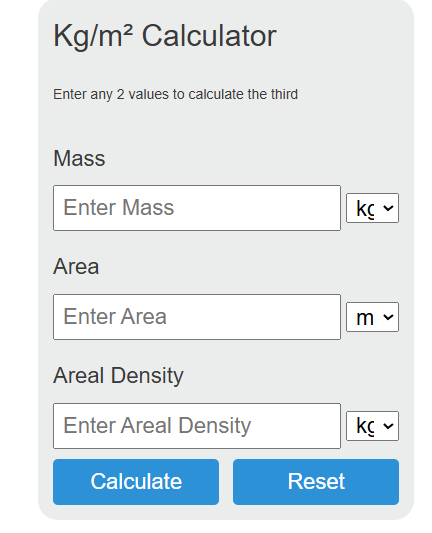
Calculate areal density in kg/m² from mass and area or from thickness and material density, convert to GSM, lb/ft² and oz/yd², and get total load or BMI.
Related Calculators
- BSA Calculator – Body Surface Area
- Belly Size Calculator
- Weight Set Point Calculator
- Weight Loss Percentage Calculator
- All Health and Medical Calculators
kg/m² Formula
Kilograms per square meter (kg/m²) is a unit of areal density, the mass spread over a unit of surface area. To find it, divide the mass by the area.
D = m / A
Where:
D is the areal density in kg/m².
m is the mass in kilograms (kg).
A is the area in square meters (m²).
When kg/m² is read as kgf/m² (kilogram-force per square meter, a pressure), you convert it to pascals by multiplying by standard gravity.
P = σ × 9.80665
Where:
P is the pressure in pascals (Pa, equal to N/m²).
σ is the value in kgf/m².
9.80665 is standard gravity in m/s², the factor that turns a kilogram-force into newtons.
kg/m² Conversion Reference
The first table lists what one kg/m² equals in other areal density units. The second table lists what one kgf/m² equals as a pressure.
| 1 kg/m² equals | Value |
|---|---|
| g/m² (GSM) | 1000 |
| mg/cm² | 100 |
| lb/ft² | 0.204816 |
| oz/ft² | 3.277058 |
| lb/yd² | 1.843347 |
| oz/yd² | 29.49353 |
| 1 kgf/m² equals | Value |
|---|---|
| Pascal (N/m²) | 9.80665 |
| Kilopascal (kPa) | 0.00980665 |
| lb/ft² (psf) | 0.204816 |
| psi | 0.0014223 |
Example Problems
Example 1: A flat sheet has a mass of 6 kg and covers an area of 3 m². Divide the mass by the area: 6 / 3 = 2 kg/m². Select the Areal Density mode, enter 6 kg and 3 m², and the result reads 2 kg/m².
Example 2: A fabric is rated at 250 g/m² and you want the weight in oz/yd². Select the Areal Density Unit Converter, enter 250 with the unit g/m², and read the oz/yd² row, which gives about 7.37 oz/yd².
FAQ
What does kg/m² measure?
It measures areal density, which is how much mass sits on each square meter of surface. It is common for sheet materials, fabrics, coatings, and snow or rainfall loads.
Is kg/m² the same as a pressure?
Not by itself. A mass per area becomes a pressure only when you account for gravity. One kilogram-force per square meter (kgf/m²) equals 9.80665 pascals, so the pressure converter multiplies your value by 9.80665.
How do I convert kg/m² to GSM?
Multiply by 1000, because one kilogram is 1000 grams and the area stays the same. So 0.25 kg/m² is 250 g/m² (GSM).