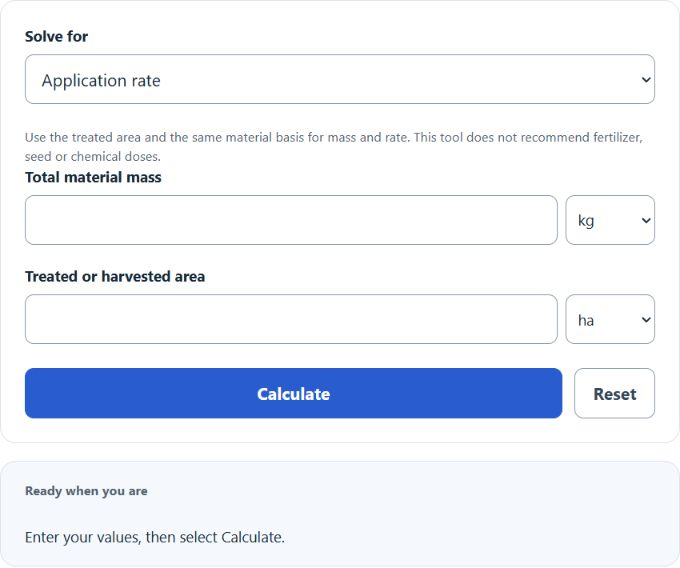
Calculate kilograms per hectare, total material required, or covered area, with conversions for hectares, acres, square meters, kg/ha, lb/ac, g/m², and t/ha.
kg Per Hectare Formula
Kilograms per hectare expresses how much material is applied, harvested, or measured across one hectare of land. It is a standard way to compare fertilizer rates, seeding rates, soil amendments, and crop yields across fields of different sizes.
Variables
- KPH = kilograms per hectare
- M = total mass in kilograms
- A = area in hectares
If you already know any two values, you can solve for the third. That makes this calculator useful for both finding an application rate and planning how much product is needed for a field.
Rearranged Forms
| Purpose | Formula | Use Case |
|---|---|---|
| Find rate | KPH = (M) / (A) |
Determine kg/ha from known mass and field area |
| Find total mass needed | M = KPH × A |
Estimate how many kilograms to buy or apply |
| Find covered area | A = (M) / (KPH) |
Estimate how many hectares a given amount can treat |
How to Calculate kg Per Hectare
- Measure or enter the total mass of material.
- Measure or enter the total land area.
- Make sure the mass and area refer to the same field or treated section.
- Divide the mass by the area to get the rate in kilograms per hectare.
- Use the result to compare fields, calibrate spreading plans, or estimate material requirements.
Examples
Finding the application rate
If 500 kilograms of material are spread over 2 hectares, the rate is:
The field received 250 kg/ha.
Finding how much material is needed
If the target rate is 180 kg/ha and the field size is 6.5 hectares, the required mass is:
You need 1,170 kilograms of material.
Converting from acres before calculating
If a field is 4 acres and the target is 150 kg/ha, convert the area to hectares first:
You would need about 242.8 kilograms.
Common Unit Conversions
The calculator can be especially helpful when your field notes, spreader settings, or supplier data use different units.
| Conversion | Formula | Why It Matters |
|---|---|---|
| Acres to hectares | ha = ac × 0.40468564224 |
Useful when field size is measured in acres |
| Hectares to acres | ac ≈ ha × 2.47105381467 |
Useful when comparing metric and U.S. field records |
| kg/ha to lb/ac | lb / ac ≈ kg / ha × 0.892179 |
Common for U.S. fertilizer and agronomy recommendations |
| lb/ac to kg/ha | kg / ha ≈ lb / ac × 1.120851 |
Converts U.S. application rates to metric rates |
| kg/ha to g/m2 | g / m² = (kg / ha) / (10) |
Useful for gardens, test plots, and greenhouse beds |
| t/ha to kg/ha | kg / ha = t / ha × 1000 |
Useful for compost, manure, and crop yield reporting |
Where kg Per Hectare Is Used
- Fertilizer application: nitrogen, phosphate, potash, lime, sulfur, and micronutrient rates
- Seeding rates: kilograms of seed distributed over a planting area
- Soil amendments: compost, gypsum, biochar, and manure application planning
- Harvest reporting: converting total harvested mass into a normalized field yield
- Research plots: comparing results between plots of different sizes
- Inventory planning: estimating how much product is needed before field work begins
Tips for Accurate Results
- Use the treated area, not the total property area, if only part of the field receives the material.
- Keep units consistent; if area is recorded in acres or square meters, convert before interpreting the final rate.
- Subtract unopened stock or leftover material if you want the actual applied mass.
- Do not use zero as the area value; division by zero is undefined.
- For irregular fields, break the land into sections and sum the total area before calculating.
- If the result seems too high or too low, check whether tons, pounds, or grams were entered instead of kilograms.
Frequently Asked Questions
- What does kg/ha tell me?
- It tells you the mass of material assigned to each hectare of land, which makes different field sizes directly comparable.
- Can I use this for fertilizer and seed?
- Yes. Any situation involving mass spread over land area can be expressed in kilograms per hectare.
- What if I know the target rate but not the total kilograms needed?
- Use the mass form of the equation to multiply the target kg/ha by the field area in hectares.
- Can this also be used for crop yield?
- Yes. If you know the harvested mass and harvested area, the same calculation gives yield in kg/ha.
- Why is kg/ha preferred in agriculture?
- It standardizes field measurements so rates, recommendations, and results can be compared consistently across different parcels of land.