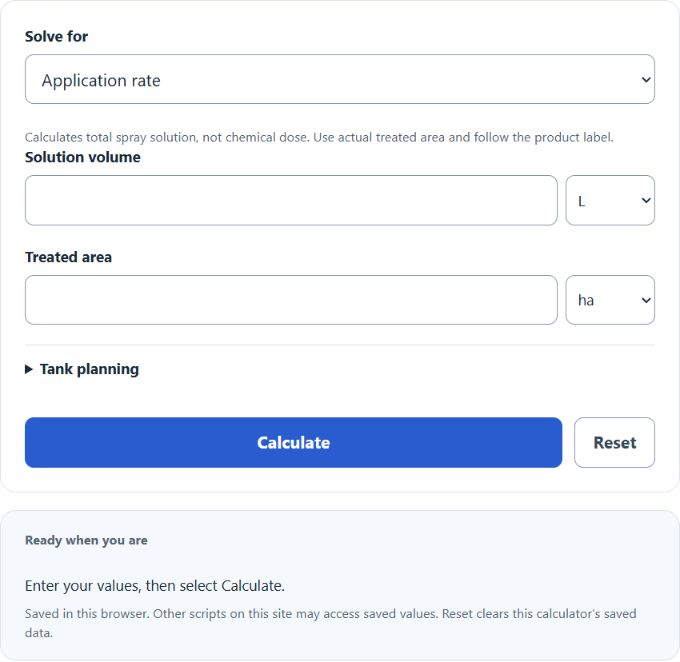
Calculate spray application rate, total volume, area covered, and tanks needed for spray mix from litres per hectare or gallons per acre.
Litres Per Hectare Formula
Litres per hectare (L/ha) is an application-rate measurement that shows how much liquid is spread over one hectare of land. It is commonly used for spraying, irrigation checks, fertigation, and liquid fertilizer planning because it connects total liquid volume to the exact area being treated.
In this formula:
- LPH
- Litres per hectare, or the liquid application rate.
- V
- Total liquid volume applied or available, measured in litres.
- A
- Treated area, measured in hectares.
If you need to solve for total volume or total area instead of the rate, rearrange the equation as follows.
Calculator Inputs and Outputs
| Field | Meaning | Common Units |
|---|---|---|
| Volume | Total liquid being applied or mixed | Litres, US gallons, UK gallons |
| Area | Total land area being treated | Hectares, acres |
| Litres Per Hectare | Application rate over the field | L/ha, gallons/acre |
How to Calculate Litres Per Hectare
- Measure the total liquid volume that will be applied.
- Measure the actual treated area, not just the full property size.
- Convert all inputs into compatible units if needed.
- Divide the total volume by the treated area.
- Use the result to confirm equipment setup, refill planning, or target coverage.
Common Unit Conversions
Use consistent units before calculating. This is especially important when one value is entered in gallons or acres and another is entered in metric units.
Examples
If 500 litres are applied over 2 hectares, the application rate is:
If the target rate is 180 L/ha and the field size is 4.5 hectares, the total liquid needed is:
If 1,200 litres are available and the planned rate is 300 L/ha, the treatable area is:
Why This Measurement Matters
- Coverage control: Helps apply a liquid evenly across the target area.
- Tank planning: Makes it easier to estimate how many fills are needed for a job.
- Cost tracking: Supports budgeting for water, fertilizer, and chemical usage.
- Calibration checks: Confirms whether a sprayer or irrigation setup is delivering the intended output.
- Field comparison: Lets you compare application rates across different field sizes using one standard unit.
Practical Accuracy Tips
- Use the treated area, not the total farm area, if sections are skipped or excluded.
- Recheck units before calculating; acres and hectares are often mixed by mistake.
- Base volume on the actual liquid delivered, not only nominal tank capacity.
- Recalculate after changing speed, nozzles, pressure, row spacing, or boom setup.
- Round only at the end of the calculation to reduce cumulative error.
- Remember that L/ha describes total carrier volume per area; it does not automatically describe product concentration or active ingredient rate.
Common Mistakes
- Entering gallons for volume while assuming the result will automatically be in L/ha without conversion.
- Using gross field size when only part of the field is actually treated.
- Confusing total litres with litres per hectare.
- Ignoring unit changes when switching between hectares and acres.
- Assuming the same tank mix volume gives the same rate on fields with different sizes.
Frequently Asked Questions
- What does litres per hectare tell me?
- It tells you how much liquid is applied to each hectare of land.
- Can I use this for sprayers and irrigation systems?
- Yes. Any process that distributes a known liquid volume over a known land area can be expressed in L/ha.
- What if my area is in acres?
- Convert acres to hectares first, or use the calculator’s unit options and let it convert for you.
- What is the difference between total litres and L/ha?
- Total litres is the full amount of liquid used. L/ha is the rate that amount represents when spread across a specific area.
- Why does my L/ha change even when tank volume stays the same?
- If the treated area changes, the rate changes. The same liquid volume spread over more land produces a lower L/ha, while spreading it over less land produces a higher L/ha.