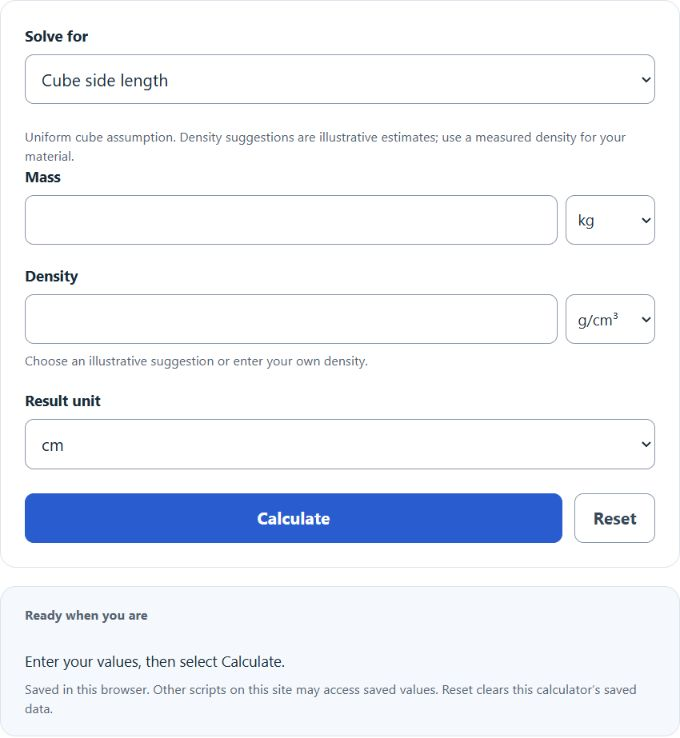
Calculate cube side length from weight and density for cube-shaped objects, or choose a solve mode for mass, density, or side length and enter the other two values.
Related Calculators
- GSM To Thickness Calculator
- Liters to Grams Calculator
- Gauge To Inches Calculator
- gauge to fraction Converter
- All Unit Converters
kg To cm Formula
The following formula is used to calculate the length of a cube side (L) in centimeters from the mass (m) in kilograms and the density (d) in kilograms per cubic centimeter:
Variables:
- m is the mass in kilograms (kg)
- d is the density in kilograms per cubic centimeter (kg/cm³)
- L is the length of a cube side in centimeters (cm)
To calculate the length, divide the mass by the density to get the volume, then take the cube root of that volume.
Why Convert kg to cm?
Kilograms measure mass and centimeters measure length. These are fundamentally different physical quantities, so a direct conversion between them does not exist. However, when you know the density of a material, you can determine how much physical space a given mass occupies. This is the bridge between mass and dimension.
The relationship works through volume. Density equals mass divided by volume (d = m / V). For a cube, volume equals the side length cubed (V = L³). Combining these: L = (m / d)^(1/3). This calculation is used regularly in shipping and logistics (sizing packages from known product weights), manufacturing (determining stock material dimensions), material science (comparing how dense materials translate into compact or bulky physical forms), and rough material-volume estimates. This uniform-cube model does not determine packaging clearance or structural load capacity.
Common Material Densities
The density value you use determines the output of the conversion. The values below are illustrative assumptions organized by category. Density varies with composition, grade, temperature and moisture. Calculator suggestions retain representative values from this page; measured density is preferable.
| Material | Density (g/cm³) | Cube Side for 1 kg (cm) |
|---|---|---|
| Metals | ||
| Aluminum | 2.70 | 7.18 |
| Iron (cast) | 7.20 | 5.18 |
| Steel (carbon) | 7.85 | 5.03 |
| Stainless Steel (304) | 8.00 | 5.00 |
| Brass | 8.50 | 4.90 |
| Copper | 8.96 | 4.81 |
| Silver | 10.49 | 4.57 |
| Lead | 11.34 | 4.45 |
| Gold | 19.32 | 3.73 |
| Tungsten | 19.25 | 3.73 |
| Titanium | 4.51 | 6.05 |
| Zinc | 7.13 | 5.20 |
| Liquids | ||
| Water (4 °C) | 1.00 | 10.00 |
| Seawater | 1.025 | 9.92 |
| Milk (whole) | 1.03 | 9.90 |
| Olive Oil | 0.92 | 10.28 |
| Gasoline | 0.75 | 11.01 |
| Mercury | 13.53 | 4.20 |
| Wood (air-dried) | ||
| Balsa | 0.16 | 18.42 |
| Pine | 0.51 | 12.52 |
| Oak | 0.72 | 11.16 |
| Maple (hard) | 0.71 | 11.21 |
| Ebony | 1.12 | 9.63 |
| Plastics & Other | ||
| HDPE | 0.95 | 10.17 |
| PVC | 1.40 | 8.94 |
| Acrylic (PMMA) | 1.18 | 9.46 |
| Concrete | 2.40 | 7.47 |
| Glass (soda-lime) | 2.50 | 7.37 |
| Granite | 2.70 | 7.18 |
| Ice (0 °C) | 0.917 | 10.29 |
| Cube side calculated as L = (1000 / density)^(1/3) in cm. Densities are typical values at room temperature unless noted. | ||
kg to cm Conversion Tables by Material
The tables below show pre-computed cube side lengths for common mass values across four different materials. This makes it easy to compare how the same mass translates to very different physical sizes depending on material density.
| Mass (kg) | Cube Side (cm) |
|---|---|
| 0.1 | 4.64 |
| 0.5 | 7.94 |
| 1 | 10.00 |
| 2 | 12.60 |
| 5 | 17.10 |
| 10 | 21.54 |
| 25 | 29.24 |
| 50 | 36.84 |
| 100 | 46.42 |
| Mass (kg) | Cube Side (cm) |
|---|---|
| 0.1 | 2.34 |
| 0.5 | 3.99 |
| 1 | 5.03 |
| 2 | 6.34 |
| 5 | 8.60 |
| 10 | 10.84 |
| 25 | 14.71 |
| 50 | 18.54 |
| 100 | 23.35 |
| Mass (kg) | Cube Side (cm) |
|---|---|
| 0.1 | 3.33 |
| 0.5 | 5.70 |
| 1 | 7.18 |
| 2 | 9.05 |
| 5 | 12.28 |
| 10 | 15.47 |
| 25 | 21.00 |
| 50 | 26.46 |
| 100 | 33.33 |
| Mass (kg) | Cube Side (cm) |
|---|---|
| 0.1 | 5.18 |
| 0.5 | 8.86 |
| 1 | 11.16 |
| 2 | 14.06 |
| 5 | 19.08 |
| 10 | 24.04 |
| 25 | 32.62 |
| 50 | 41.10 |
| 100 | 51.79 |
How Shape Changes the Calculation
The calculator above assumes a cube, but real objects are not always cubic. The relationship between mass and a characteristic length dimension changes depending on the assumed shape. Below are the formulas for the three most common geometric shapes used in these calculations.
Cube: side length L = (m / d)^(1/3). This is the formula used in the calculator above.
Sphere: diameter D = 2 * (3m / (4 * pi * d))^(1/3). A sphere of 1 kg of water has a diameter of about 12.41 cm, compared to a 10 cm cube side for the same mass and density.
Cylinder (equal height and diameter): diameter D = (4m / (pi * d))^(1/3). A cylinder of 1 kg of water with equal height and diameter measures about 10.84 cm across.
For these three specified shapes at equal volume, the sphere diameter is greater than the equal-height cylinder diameter, which is greater than the cube side. These dimensions are different measurements; this does not establish a general packing or longest-dimension rule.
How to Calculate kg to cm
Follow these steps to calculate the length of a cube side in centimeters:
- Determine the mass of the object in kilograms (m).
- Find the density of the material in g/cm³ or kg/cm³. Use the material density table above or look up the specific alloy, grade, or composition.
- Divide the mass by the density to get the volume in cubic centimeters. If your density is in g/cm³, first convert mass to grams (multiply kg by 1000).
- Take the cube root of the volume to get the side length in centimeters: L = V^(1/3).
- Choose Cube side length in the calculator and enter mass and density. To find mass or density instead, select that solve mode and enter the other two values.
Example Problem 1:
A steel block has a mass of 5 kg. Steel has a density of 7.85 g/cm³ (0.00785 kg/cm³). What is the cube side length?
Volume = 5 / 0.00785 = 636.94 cm³
L = 636.94^(1/3) = 8.60 cm
Example Problem 2:
An aluminum cube measures 15 cm on each side. Aluminum has a density of 2.70 g/cm³. What is its mass?
Volume = 15³ = 3375 cm³
Mass = 3375 * 2.70 = 9112.5 g = 9.11 kg
Frequently Asked Questions
Can you convert kg to cm directly?
No. Kilograms measure mass and centimeters measure length. You need a third piece of information, the material’s density, plus an assumed shape to relate mass to a physical dimension.
What density should I use if I do not know the exact material?
No density is assumed automatically. Choose a listed illustrative suggestion or enter a measured density in the selected unit. Broad labels such as wood or plastic do not determine a unique density; use the grade, composition and relevant conditions for your object.
Why does the same mass of gold and aluminum produce such different cube sizes?
Gold has a density of 19.32 g/cm³ while aluminum is 2.70 g/cm³. That means gold packs about 7.2 times more mass into the same volume. A 1 kg gold cube measures only 3.73 cm per side, while a 1 kg aluminum cube is 7.18 cm per side, nearly double.
How do I convert to a sphere instead of a cube?
Use the sphere formula: D = 2 * (3m / (4 * pi * d))^(1/3). For a 1 kg water sphere, the diameter is approximately 12.41 cm.