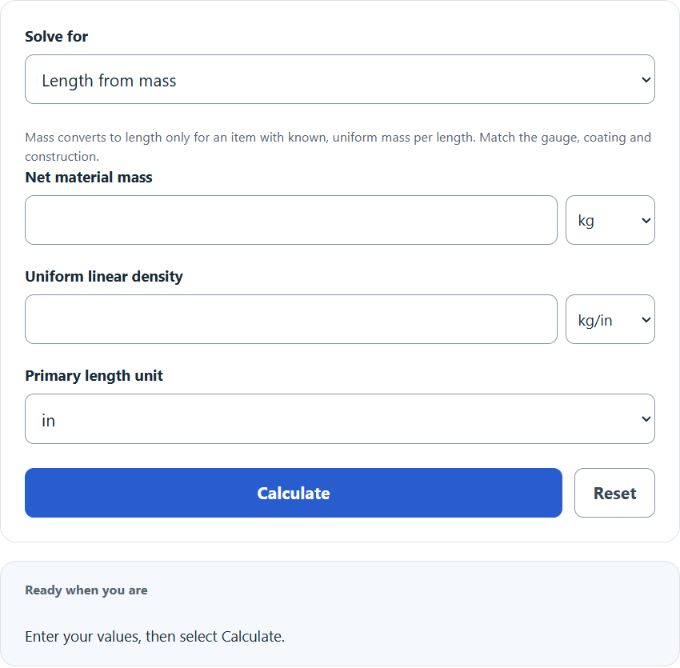
Solve for a uniform item’s length, mass, or linear density from the other two quantities. Kilograms and inches measure different properties, so a direct conversion is only possible when mass per unit length is supplied.
Kilograms measure mass and inches measure length, so there is no universal direct conversion. A conversion becomes meaningful only when the object has a known linear density such as kilograms per inch.
How to Use This Calculator
- Choose whether to solve for length, mass, or linear density.
- Enter the two known quantities.
- Use values for the same material and construction.
- Calculate and review the metric and customary results.
After a successful calculation, the inputs and result remain saved in this browser. Select Reset to clear the stored values and return to empty quantity fields.
How the Kg to Inch Calculator Works
Linear density can come from a manufacturer specification or from a representative sample. Divide the sample mass by its measured length, using the same units that will be entered in the calculator.
The primary relationship is m = d × L; therefore L = m ÷ d and d = m ÷ L. Calculations retain full available precision internally; displayed values are rounded for readability.
Formula Variables and Input Guide
Choose whether to find length, mass, or linear density, then enter the other two known quantities for the same uniform item.
| Variable or term | Meaning | Unit or note |
|---|---|---|
| m | Mass | kg |
| L | Length | in |
| d | Linear density | kg/in |
| m ÷ L | Measured sample density | kg/in |
Choosing the Right Inputs
Choose the unknown you actually need: total length, total mass, or linear density. Mass should exclude pallets, reels, connectors, and other tare unless those items are intentionally part of the estimate. Length should describe the same uniform product represented by the density value, including the same gauge, cross-section, coating, and construction.
Select the density unit that matches the datasheet: kg/in, kg/m, g/m or lb/ft. To convert manually from kg/m to kg/in, multiply by the exact factor 0.0254. When no specification is available, weigh a representative sample and divide its net kilograms by its measured inches. A longer sample usually reduces the effect of scale resolution and small end irregularities.
Practical Uses
- Estimating roll, cable, wire, or extrusion length from shipment mass.
- Converting production mass targets into cut length.
- Checking manufacturer mass-per-length specifications.
- Estimating remaining material from a measured total mass.
Ten kilograms at different linear densities
| Linear density | Length |
|---|---|
| 0.01 kg/in | 1,000 in |
| 0.10 kg/in | 100 in |
| 0.25 kg/in | 40 in |
| 1.00 kg/in | 10 in |
Understanding Your Results
The calculator returns length, mass, or linear density in the units shown for the selected mode.
The result changes inversely with density when solving for length. If the linear density doubles, the same mass represents half as much length.
Worked Example
A 10 kg roll with a linear density of 0.25 kg/in is 10 ÷ 0.25 = 40 inches long.
If a uniform cable is 80 inches long and has a linear density of 0.25 kg/in, its mass is 80 × 0.25 = 20 kg.
Checking the Result by Hand
Use the equation that matches the selected unknown: length = mass ÷ linear density, mass = length × linear density, or density = mass ÷ length. The units should cancel to inches, kilograms, or kilograms per inch respectively. Reinsert the result into one of the other forms to recover the original known value.
As a sensitivity check, double density while holding mass fixed; calculated length should be cut in half. If the result is off by about 39.37 times, a kg/m value was probably entered as kg/in.
Common Mistakes to Avoid
- Using volumetric density instead of mass per length.
- Entering kg/m as though it were kg/in.
- Including connectors or fittings not represented in the density.
- Applying one density to a tapered or nonuniform item.
Assumptions and Limitations
The result assumes constant linear density along the full item. Do not use this as a direct unit conversion without a valid material-specific density.
Frequently Asked Questions
Can kg convert directly to inches?
No. The conversion requires a linear-density relationship for a specific object.
How do I find linear density?
Use the product datasheet or divide a representative sample mass by its length.
Can I use kg per metre?
Yes. Select kg/m beside the linear-density input; unit changes convert an entered value rather than relabeling it.
What if the item is not uniform?
Split it into uniform sections or weigh and measure the actual item.
Sources