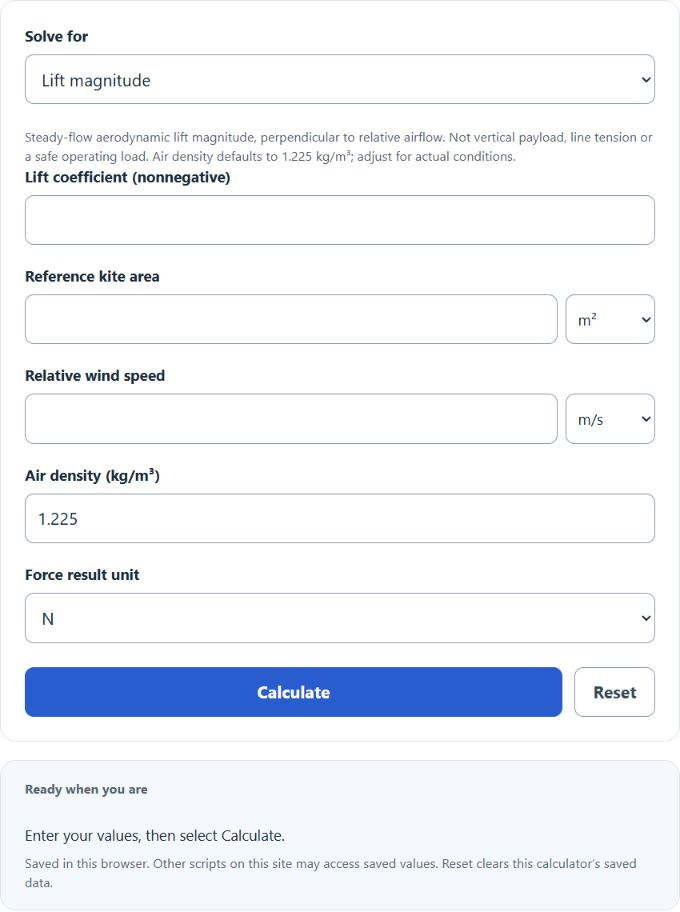
Choose lift, coefficient, reference area, or wind speed to solve for; enter the other three values and the air density.
- All Physics Calculators
- Lift Force Calculator
- Hydrofoil Lift Calculator
- Lift to Drag Ratio Calculator
Understanding the Kite Lift Calculator
The Kite Lift Calculator estimates the aerodynamic lift produced by a kite using its coefficient of lift, sail area, and wind velocity. It is most useful for quick comparisons between kite sizes, estimating lift in different wind conditions, and checking whether a design change is likely to produce more or less aerodynamic lift. Because the calculator lets you choose one of four quantities to solve for, it can also be used in reverse for sizing a kite or estimating the wind speed needed to reach a target lift.
Kite Lift Equation
In this equation:
- KL = kite lift
- CL = coefficient of lift, a dimensionless measure of how efficiently the kite produces lift
- A = kite surface area
- d = air density
- V = wind velocity
Air density defaults to a standard sea-level reference and can be adjusted for actual conditions:
That means the largest drivers of lift in the calculator are usually wind speed, kite area, and lift coefficient. Since wind velocity is squared, even a modest increase in wind can create a much larger increase in lift.
Rearranged Forms
If you know three variables, you can solve for the missing one with the following forms:
How to Use the Calculator
- Choose the quantity to solve for and enter the other three known values, then confirm the air density.
- Choose the correct units for area, wind speed, and force.
- Calculate the missing value.
- Interpret the result as an ideal lift estimate under steady airflow.
The unit selectors are especially helpful when switching between common measurement systems:
- Surface area: m2, ft2, yd2
- Wind velocity: m/s, km/h, mph, ft/s
- Lift output: N or lbf
How Each Input Affects Lift
| Input Change | Effect on Lift |
|---|---|
| Double the surface area | Lift doubles |
| Double the coefficient of lift | Lift doubles |
| Double the wind velocity | Lift becomes 4 times larger |
| Increase wind velocity by 20% | Lift increases by about 44% |
This relationship is why wind speed deserves extra attention. A kite that feels manageable at one wind speed can produce dramatically higher forces when the wind rises.
What the Inputs Mean in Practice
- Coefficient of Lift
- This value represents how effectively the kite converts airflow into lift. It depends on the kite’s shape, angle to the wind, and aerodynamic behavior. Higher values mean more lift for the same area and wind speed.
- Surface Area
- This is the effective sail or planform area of the kite. Larger kites generally produce more lift, but they also create more drag and can become harder to control in strong wind.
- Wind Velocity
- This is the relative airflow acting on the kite. Since lift scales with the square of velocity, wind speed is often the most sensitive input in the entire calculation.
- Kite Lift
- This is the aerodynamic lift magnitude, perpendicular to relative airflow, estimated by the formula. It is not always the same as usable payload capacity, because some force is lost to drag, line angle, kite weight, and real-world instability.
Example
If the coefficient of lift is 0.30, the kite area is 5 m2, and the wind velocity is 10 m/s, the lift is:
This shows how even a moderate-size kite in moderate wind can generate noticeable force.
Important Practical Notes
- Lift is an estimate: real kites operate in changing wind, not perfectly steady flow.
- Line angle matters: not all aerodynamic force becomes pure vertical lift.
- Drag is not included directly: a kite may generate lift and drag at the same time, which changes line tension and handling.
- Air density can vary: altitude, temperature, and weather conditions can make actual lift higher or lower than the estimate.
- Payload is lower than total lift: part of the force supports the kite itself and part is lost through system inefficiencies.
Common Mistakes
- Using kite width or wingspan instead of actual surface area.
- Entering gust speed instead of a more representative sustained wind speed.
- Assuming the calculated lift is the same as safe operating load.
- Ignoring that small wind increases can cause large force increases.
- Comparing results without keeping units consistent.
When This Calculator Is Most Useful
- Comparing two kite sizes in the same wind
- Estimating the wind speed needed to reach a target lift
- Checking how much lift changes after increasing area
- Making first-pass design decisions before more detailed testing
Used properly, the calculator gives a fast and practical first estimate of kite lifting performance. It is best treated as a design and comparison tool rather than a complete substitute for field testing.