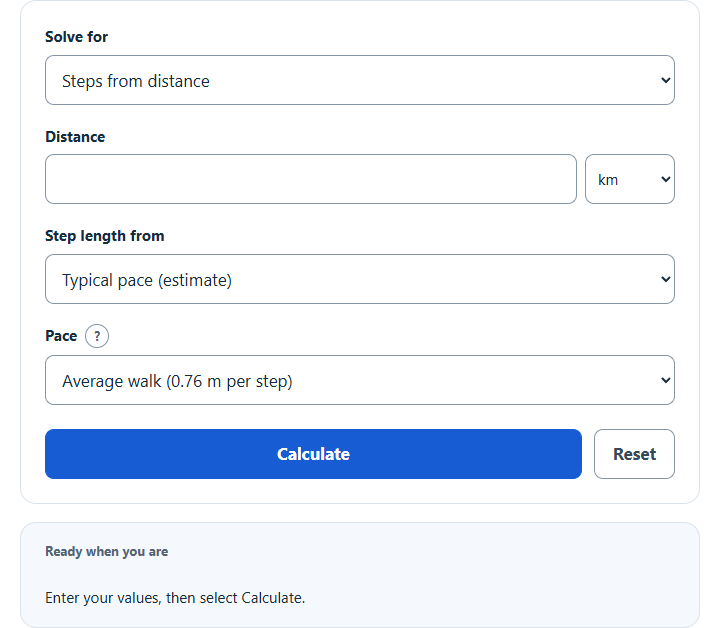
Convert km to steps using a typical walking or running step length, your measured step or your height, or turn a step count back into kilometers.
Calculator Functions
| Function | What it does | What it requires |
|---|---|---|
| Steps from distance | Converts a distance in km, miles or meters to a number of steps | Requires the distance and a step length source: a typical pace, a measured step length or a height |
| Distance from steps | Converts a step count to kilometers and miles | Requires the step count and a step length source: a typical pace, a measured step length or a height |
| Average step length | Finds the average length of one step over a walk or run of known distance | Requires the distance covered and the steps counted over it |
The step length comes from one of three places. Typical pace offers 0.71 m for a slow walk, 0.76 m for an average walk, 0.80 m for a brisk walk, 0.88 m for a jog and 1.20 m for a run. A measured step length can be entered in cm, inches or meters. Height estimates the step as 41.4% of height, and that percentage can be changed. Every result also shows steps per km and the distance in miles.
Km to Steps Formulas
| N | Number of steps, rounded to the nearest whole step |
| km | Distance in kilometers. Miles are multiplied by 1.609344 first |
| L | Average step length (m): the distance from one foot landing to the other foot landing |
Step length is half of stride length, because a stride runs from one foot landing to the same foot landing again [1]. A stride length has to be halved before it is entered.
Steps from distance
The main formula applies directly. At the average-walk length of 0.76 m, 1 km is 1,000 ÷ 0.76 = 1,316 steps and 5 km is 6,579 steps. With a measured step of 70 cm, 5 km is 5,000 ÷ 0.70 = 7,143 steps. With a height of 170 cm, the step is 170 × 0.414 = 70.38 cm and 5 km is 7,104 steps.
| Distance | Average walk (0.76 m) | Brisk walk (0.80 m) | Run (1.20 m) |
|---|---|---|---|
| 1 km | 1,316 | 1,250 | 833 |
| 1.5 km | 1,974 | 1,875 | 1,250 |
| 2 km | 2,632 | 2,500 | 1,667 |
| 2.5 km | 3,289 | 3,125 | 2,083 |
| 3 km | 3,947 | 3,750 | 2,500 |
| 3.5 km | 4,605 | 4,375 | 2,917 |
| 4 km | 5,263 | 5,000 | 3,333 |
| 5 km | 6,579 | 6,250 | 4,167 |
| 6 km | 7,895 | 7,500 | 5,000 |
| 7 km | 9,211 | 8,750 | 5,833 |
| 8 km | 10,526 | 10,000 | 6,667 |
| 9 km | 11,842 | 11,250 | 7,500 |
| 10 km | 13,158 | 12,500 | 8,333 |
| 16 km | 21,053 | 20,000 | 13,333 |
Distance from steps
At 0.76 m per step, 4,000 steps cover 4,000 × 0.76 = 3,040 m, or 3.04 km, and 10,000 steps cover 7.6 km.
| Steps | Average walk (0.76 m) | Brisk walk (0.80 m) |
|---|---|---|
| 1,000 | 0.76 km | 0.80 km |
| 2,000 | 1.52 km | 1.60 km |
| 4,000 | 3.04 km | 3.20 km |
| 5,000 | 3.80 km | 4.00 km |
| 6,000 | 4.56 km | 4.80 km |
| 8,000 | 6.08 km | 6.40 km |
| 10,000 | 7.60 km | 8.00 km |
| 16,000 | 12.16 km | 12.80 km |
| 20,000 | 15.20 km | 16.00 km |
Average step length
Counting 6,500 steps over a measured 5 km gives 5,000 ÷ 6,500 = 0.7692 m, or 76.92 cm per step. This is the most reliable step length to use in the other two functions, because it comes from the walker’s own gait at that pace.
Limits of This Estimate
- Steps per km has no single value, because step length changes with the person and the pace. In one treadmill study, adults took 80 steps per minute at 2.6 km/h, 100 at 4.0 km/h and 120 at 5.6 km/h [1]. Dividing speed by step rate gives steps of about 0.54 m, 0.67 m and 0.78 m.
- The typical pace lengths and the 41.4% of height rule are rules of thumb for adults, not measurements. These estimates are based on the best available data and estimations.
- Leg length matters as well as pace. In another study, each extra centimeter of leg length lowered the step rate at a given effort by about 1.15 steps per minute [1], so taller people take fewer steps per km.
- Hills, stairs, rough ground and carrying a load shorten steps. A phone or watch can also miss or add steps, so a counted total may not match the formula.
Sources
- Tudor-Locke et al., How fast is fast enough? Walking cadence (steps/min) as a practical estimate of intensity in adults, British Journal of Sports Medicine, 2018: stride-to-step conversion, step rates at measured walking speeds and the effect of leg length
Sources
National Institute of Standards and Technology. Guide for the Use of the International System of Units (SI).