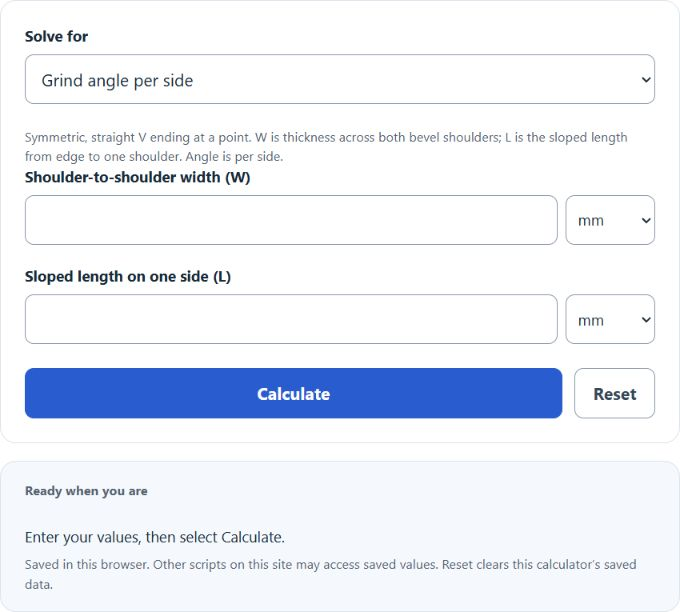
Calculate knife grind angle, bevel width, or bevel side length from any two inputs with unit conversion in mm, cm, m, in, or ft, and degrees.
Related Calculators
- Angle Cut Calculator
- Angle Tolerance Calculator
- Blade Pitch Angle Calculator
- Helix Angle Calculator
- All Everyday Life and Education Calculators
Knife Grind Angle Formula
This calculator models a symmetric, straight V bevel ending at a point in cross-section. W is the thickness across the two bevel shoulders; L is the sloped distance from the edge to one shoulder. The per-side angle is measured from the blade centerline, and the total included angle is twice that value. It does not model convex, hollow, asymmetric, secondary bevels, or a finite-width edge land.
| Variable | Meaning | Practical Note |
|---|---|---|
| KGA | Knife grind angle per side in degrees | Use this value to compare bevel geometry between blades or sharpening passes. |
| W | Thickness across both bevel shoulders | A larger bevel width increases the calculated angle when side length stays fixed. |
| L | Sloped length from edge to one shoulder | A longer bevel side reduces the calculated angle when bevel width stays fixed. |
Because the formula uses the ratio W/L, the units cancel. Millimeters, centimeters, inches, and feet all work as long as both measurements describe the same blade section.
Rearranged Forms
If you know the angle and need to solve for one of the dimensions, use the equivalent forms below.
| Find | Formula |
|---|---|
| Bevel width | W = 2L sin(KGA) |
| Bevel side length | L = (W) / (2sin(KGA)) |
How to Calculate Knife Grind Angle
- Measure the thickness across both bevel shoulders at the blade section you want to evaluate.
- Measure the sloped side length of that same bevel section.
- Divide the shoulder-to-shoulder width by twice the sloped side length.
- Take the inverse sine of that ratio.
- The inverse-sine result is the per-side angle; double it only to obtain the total included angle.
Example Calculation
If the shoulder-to-shoulder width is 2 mm and the sloped side length is 3 mm:
This gives a per-side angle of about 19.47 degrees and a total included angle of about 38.94 degrees.
How to Interpret the Result
- Smaller angle: usually indicates a thinner, more acute cutting geometry.
- Larger angle: usually indicates a thicker, more robust edge geometry.
- Consistency matters: even a small change in measured bevel dimensions can noticeably change the angle.
- Compare carefully: some knife specifications refer to a per-side angle, while others refer to a total included angle.
Measurement Tips
- Measure both values from the same cross-section of the blade.
- Use calipers or another repeatable measuring tool whenever possible.
- Keep units consistent before calculating if you are measuring manually.
- For symmetrical comparisons, measure both sides the same way.
- Curved, convex, hollow, or asymmetric bevels are outside this straight, symmetric model.
Input Limits and Common Errors
- Both values must be positive.
- The ratio must be valid: W/(2L) must be greater than 0 and less than 1; equality gives a degenerate cross-section.
- If W is at least 2L, the measurement pair is not valid for a nondegenerate symmetric V bevel.
- Mixed measurements create bad results: measuring width at one spot and side length at another can distort the angle.
Why This Calculator Is Useful
This calculator helps when comparing grind profiles, documenting sharpening geometry, checking manufacturing consistency, or estimating how a change in bevel dimensions affects the final angle. It is especially useful when you can measure the bevel directly but want a fast angle estimate without manual trigonometry.
Frequently Asked Questions
- Does the unit choice affect the answer?
- No. Since the calculation uses a ratio, the units cancel as long as both inputs are expressed in the same unit system.
- What happens if the bevel width increases while side length stays the same?
- The calculated knife grind angle increases.
- What happens if the side length increases while bevel width stays the same?
- The calculated knife grind angle decreases.
- Why is my result invalid?
- The most common reason is an impossible ratio, usually caused by entering a shoulder-to-shoulder width at least twice the sloped side length or by mixing measurements from different parts of the blade.