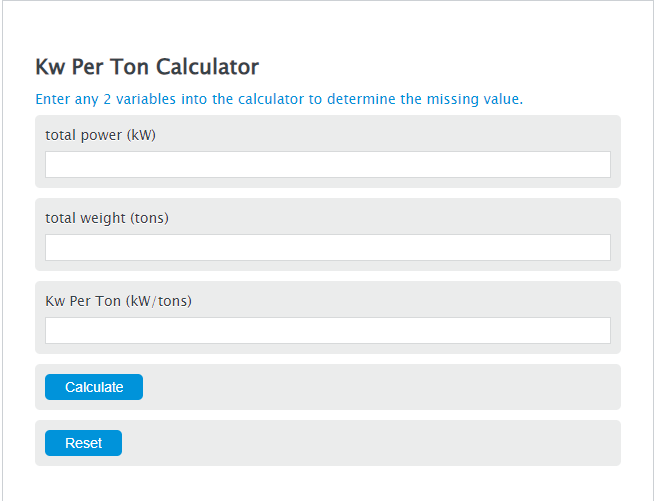
Calculate HVAC chiller kW per ton, electrical input power, cooling capacity, COP, and EER using refrigeration tons, cooling kW, Btu/h, watts, kW, and hp.
- All Unit Converters
- Cost Per KWH Calculator
- Energy Performance Index Calculator
- KW to Weight Ratio Calculator
What Is kW per Ton?
kW per ton (kW/ton) is the standard efficiency metric for commercial and industrial cooling systems. It measures how many kilowatts of electrical power a chiller or refrigeration system consumes to produce one ton of cooling (one refrigeration ton = 12,000 BTU/h = 3.517 kW of thermal energy removed). A lower kW/ton value means the system removes more heat per unit of electricity consumed, making it more efficient.
kW per Ton Formula
Where P is the electrical power input in kilowatts and Q is the cooling capacity in refrigeration tons. For example, a chiller drawing 164.9 kW while producing 253.1 tons of cooling operates at 164.9 / 253.1 = 0.65 kW/ton.
Typical kW/Ton by Chiller Type
Different compressor technologies produce significantly different efficiency ranges. The values below represent full-load performance under standard AHRI rating conditions.
| Chiller Type | Typical kW/ton Range | Equivalent COP Range | Typical Capacity (tons) |
|---|---|---|---|
| Centrifugal (water-cooled) | 0.45 – 0.65 | 5.4 – 7.8 | 200 – 10,000+ |
| Screw / Helical-Rotary (water-cooled) | 0.60 – 0.80 | 4.4 – 5.9 | 70 – 450 |
| Scroll (water-cooled) | 0.60 – 0.72 | 4.9 – 5.9 | 20 – 200 |
| Reciprocating (water-cooled) | 0.70 – 1.00 | 3.5 – 5.0 | 10 – 200 |
| Air-cooled (all compressor types) | 0.80 – 1.30 | 2.7 – 4.4 | 5 – 500 |
A centrifugal chiller rated at 0.50 kW/ton at full load may degrade to 0.90 kW/ton or higher at 25% load. This is why IPLV (Integrated Part-Load Value) exists: it weights performance at 25%, 50%, 75%, and 100% load to reflect real-world operation, where chillers rarely run at full capacity for extended periods.
Converting Between kW/ton, COP, and EER
The three primary efficiency metrics are interconvertible using the constant 3.517 (the kW equivalent of one refrigeration ton) and 12 (the thousands of BTU/h per ton, divided by 1,000 W/kW).
| From | To | Formula |
|---|---|---|
| kW/ton | COP | COP = 3.517 / kW/ton |
| COP | kW/ton | kW/ton = 3.517 / COP |
| kW/ton | EER | EER = 12 / kW/ton |
| EER | kW/ton | kW/ton = 12 / EER |
| COP | EER | EER = COP x 3.412 |
| EER | COP | COP = EER / 3.412 |
COP (Coefficient of Performance) is the dimensionless ratio of cooling output to electrical input, both in kW. EER (Energy Efficiency Ratio) expresses cooling in BTU/h per watt of input. IPLV/NPLV weight the efficiency across partial loads using the formula: IPLV = 0.01A + 0.42B + 0.45C + 0.12D, where A = 100% load, B = 75%, C = 50%, D = 25%.
Quick Reference: kW/ton to COP to EER
| kW/ton | COP | EER (BTU/Wh) |
|---|---|---|
| 0.40 | 8.79 | 30.00 |
| 0.50 | 7.03 | 24.00 |
| 0.60 | 5.86 | 20.00 |
| 0.70 | 5.02 | 17.14 |
| 0.80 | 4.40 | 15.00 |
| 0.90 | 3.91 | 13.33 |
| 1.00 | 3.52 | 12.00 |
| 1.10 | 3.20 | 10.91 |
| 1.20 | 2.93 | 10.00 |
| 1.30 | 2.71 | 9.23 |
Why 3.517 kW Equals One Ton of Refrigeration
The refrigeration ton originated from the 19th-century ice harvesting industry. One ton of refrigeration is the rate of heat absorption needed to melt one short ton (2,000 lb) of ice at 32 F in 24 hours. The latent heat of fusion for water is 144 BTU/lb, so: 2,000 lb x 144 BTU/lb = 288,000 BTU per 24 hours = 12,000 BTU/h. Converting to metric: 12,000 BTU/h / 3,412.14 BTU/kWh = 3.517 kW. This is the fixed thermal constant that links all chiller efficiency metrics together.
Factors That Degrade kW/Ton in Practice
Published kW/ton ratings are measured under controlled laboratory conditions. In real buildings, several variables push actual kW/ton higher (worse). Condenser water temperature is the biggest factor for water-cooled chillers: every 1 F increase in entering condenser water raises energy consumption by roughly 1.5-2%. Fouled condenser tubes can add 0.05 to 0.15 kW/ton. Low refrigerant charge shifts the compressor off its design envelope. Oversized chillers forced to run at low part-load ratios operate well above their rated kW/ton. Aging compressor bearings and worn impeller seals also erode performance over time.
A practical rule of thumb: if a system consistently operates above 1.5 kW/ton, it is a strong candidate for maintenance intervention, retrofit, or replacement.
Estimating Annual Energy Cost from kW/Ton
kW/ton can be translated directly into operating cost. Multiply kW/ton by the cooling load in tons by the number of operating hours by the electricity rate in $/kWh. For a 500-ton chiller at 0.60 kW/ton running 2,000 equivalent full-load hours per year at $0.12/kWh: 0.60 x 500 x 2,000 x 0.12 = $72,000/year. Upgrading that same chiller from 0.80 kW/ton to 0.55 kW/ton saves $30,000/year, illustrating why even small kW/ton improvements translate to significant cost reductions in large facilities.
Frequently Asked Questions
What is a good kW per ton for a chiller?
For water-cooled centrifugal chillers, 0.50 to 0.60 kW/ton at full load is considered efficient. Water-cooled screw chillers performing at 0.65 to 0.75 kW/ton are within a good range. Air-cooled chillers below 1.0 kW/ton are considered efficient for their category. Any system consistently above 1.5 kW/ton warrants an efficiency review.
What is the difference between kW/ton and COP?
Both measure the same thing from different directions. kW/ton measures input per unit of output (lower is better). COP measures output per unit of input (higher is better). They are inversely related through the constant 3.517: COP = 3.517 / kW/ton. A chiller at 0.60 kW/ton has a COP of 5.86.
Why does kW/ton change at partial loads?
Compressors are designed for a specific operating point. At partial loads, components like inlet guide vanes or slide valves throttle capacity, introducing aerodynamic or mechanical losses. Centrifugal chillers in particular lose efficiency at low loads due to surge control requirements and fixed parasitic losses (oil pumps, controls) that become a larger fraction of reduced output. The IPLV metric accounts for this by weighting efficiency at 25%, 50%, 75%, and 100% load.
Does condenser type affect kW/ton?
Significantly. Water-cooled condensers reject heat to a lower-temperature sink (typically 85 F cooling tower water) compared to air-cooled condensers (95 F+ ambient air). Lower condensing temperatures reduce compressor lift, which directly reduces compressor work. This is why water-cooled chillers achieve 0.45-0.65 kW/ton while air-cooled units of similar capacity operate at 0.80-1.30 kW/ton.